


Pace line efficiency?


 09-24-11 | 08:16 AM
#27
Maximus
Joined: Jun 2008
Posts: 1,846
Likes: 0
From: Wisconsin
When riders that are not familiar with the "system" get involved, it frequently turns into a cluster**ck.
09-24-11 | 08:36 AM
#28

Mr. Dopolina


Joined: May 2007
Posts: 10,276
Likes: 185
From: Taiwan
Bikes: KUUPAS, Simpson VR
What is this rotating paceline you all speak of?
A paceline doesn't rotate. An echelon does. Look at the illustration CDR posted. It's pretty clear.
If there is a crosswind then the number of riders in an echelon is limited by the width of the road.
Look at some of the Spring Classics. The race will break up into echelons in the strong cross winds and riders will fight to jump across the one closer to the front echelon and then try to fight their way in.
A paceline doesn't rotate. An echelon does. Look at the illustration CDR posted. It's pretty clear.
If there is a crosswind then the number of riders in an echelon is limited by the width of the road.
Look at some of the Spring Classics. The race will break up into echelons in the strong cross winds and riders will fight to jump across the one closer to the front echelon and then try to fight their way in.
09-24-11 | 08:44 AM
#29

Artificial Member


Joined: Jan 2010
Posts: 7,162
Likes: 7,563
From: The Cloud
Bikes: Retrospec Judd, Dahon Boardwalk, Specialized Langster

What is this rotating paceline you all speak of?
A paceline doesn't rotate. An echelon does. Look at the illustration CDR posted. It's pretty clear.
If there is a crosswind then the number of riders in an echelon is limited by the width of the road.
Look at some of the Spring Classics. The race will break up into echelons in the strong cross winds and riders will fight to jump across the one closer to the front echelon and then try to fight their way in.
A paceline doesn't rotate. An echelon does. Look at the illustration CDR posted. It's pretty clear.
If there is a crosswind then the number of riders in an echelon is limited by the width of the road.
Look at some of the Spring Classics. The race will break up into echelons in the strong cross winds and riders will fight to jump across the one closer to the front echelon and then try to fight their way in.
09-24-11 | 08:47 AM
#30
Maximus
Joined: Jun 2008
Posts: 1,846
Likes: 0
From: Wisconsin
What is this rotating paceline you all speak of?
A paceline doesn't rotate. An echelon does. Look at the illustration CDR posted. It's pretty clear.
If there is a crosswind then the number of riders in an echelon is limited by the width of the road.
Look at some of the Spring Classics. The race will break up into echelons in the strong cross winds and riders will fight to jump across the one closer to the front echelon and then try to fight their way in.
A paceline doesn't rotate. An echelon does. Look at the illustration CDR posted. It's pretty clear.
If there is a crosswind then the number of riders in an echelon is limited by the width of the road.
Look at some of the Spring Classics. The race will break up into echelons in the strong cross winds and riders will fight to jump across the one closer to the front echelon and then try to fight their way in.

and to this, as an echelon

ech·e·lon (sh-ln)
n.
1.
a. A formation of troops in which each unit is positioned successively to the left or right of the rear unit to form an oblique or steplike line.
09-24-11 | 08:59 AM
#31
Senior Member
Joined: Jun 2008
Posts: 9,201
Likes: 289
From: Vancouver, BC
09-24-11 | 10:14 AM
#32
Senior Member
Joined: Sep 2007
Posts: 6,944
Likes: 853
From: Wilmette, IL
The key is the riders are "pulling through" from behind. In a pace line with longer turns at the front the lead rider "pulls off" the front. Pulling through keeps the pace higher and encourages greater effort for a shorter period of time. This type of rotating paceline requires more concentration and teamwork. If done well with the right guys, the miles melt away.
09-24-11 | 11:06 AM
#33

Senior Member
Joined: Oct 2010
Posts: 1,361
Likes: 19
Single paceline you lose the front person about every 20 seconds, so you lose half the distance. Disadvantage is that you're not sheltered when dropping back so typically the hardest effort is getting back into the paceline. Advantage is you have the most resting time. Better for surging type riders.
09-24-11 | 11:19 AM
#34
Senior Member

Joined: Apr 2006
Posts: 4,609
Likes: 507
From: Albuquerque, NM
09-24-11 | 02:48 PM
#35
Senior Member
Joined: Feb 2011
Posts: 797
Likes: 0
From: New England
Bikes: 2010 Jamis Xenith Comp
Done properly, there's no effort - you slip into the line without chasing the last rider; once drafting, your pace increases to match the speed of the line without an increase in effort. It's difficult to master technically, but there's no increased physical effort in the manoeuvre.
haha, yeah. OP is right. fiery - you do need to accelerate, so there's some increased effort. maybe if you do it perfectly, that effort is very little, but it's still there. i've ridden in a rotating paceline with a small group for part of a race, and my legs definitely burned every time i had to make that acceleration. however, i think the energy you save from the aerodynamic advantage of the paceline far outweighs the energy you spend getting on that last wheel every minute or two.
09-24-11 | 05:00 PM
#36
Mr. Dopolina
Joined: May 2007
Posts: 10,276
Likes: 185
From: Taiwan
Bikes: KUUPAS, Simpson VR
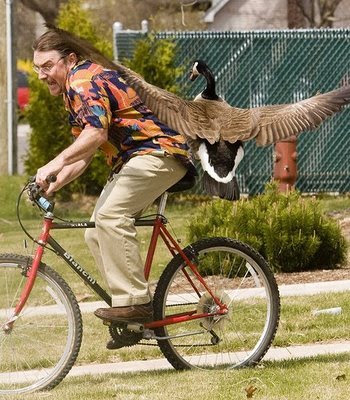
I've seen geese but never ones riding a bike.
I'd pay money to see that.
I'd pay money to see that.
Last edited by Bob Dopolina; 09-24-11 at 05:13 PM.
09-24-11 | 05:12 PM
#37
Mr. Dopolina
Joined: May 2007
Posts: 10,276
Likes: 185
From: Taiwan
Bikes: KUUPAS, Simpson VR
Third example from the left, second from the right is a rotating paceline. I remember you called a rotating paceline an echelon in the Tour for the 41 thread one morning. The difference between the two would be the direction of the wind. I do agree they are similar and one can turn into the other as the direction of the wind changes.
I think, in my mind, what is different between a 'rotating paceline' and an echelon is that in an echelon you move to the front and then immediately to one side (based on wind direction) whereas in any kind of paceline each rider spends some time at the front and then pulls off to one side (based on wind direction).
I my experience an echelon is much harder to keep going because you need a certain skill level with ALL the riders wheras you can teach a monkey to ride in a paceline (minus the bloody surges
 ).
09-24-11 | 05:12 PM
).
09-24-11 | 05:12 PM
#38


Zoom zoom zoom zoom bonk
Joined: Sep 2006
Posts: 4,941
Likes: 1,007
From: New Zealand
Bikes: Giant Defy, Trek 1.7c, BMC GF02, Trek Marlin 6, Scott Sub 35, Kona Rove, Trek Verve+2
 09-24-11 | 05:13 PM
#39
This depends on the strength of the individual riders. Stronger riders will normally pull longer, weaker ones less. The idea is to not pull so long that you tire and get dropped off the back.
09-24-11 | 05:56 PM
#40
Je pose, donc je suis.
Joined: Mar 2008
Posts: 2,898
Likes: 6
From: Back. Here.
09-24-11 | 06:07 PM
#41

Administrator
Joined: Feb 2005
Posts: 13,655
Likes: 2,707
From: Delaware shore
Bikes: Cervelo C5, Guru Photon, Waterford, Specialized CX
09-25-11 | 04:37 PM
#42
Senior Member
Joined: Feb 2007
Posts: 15,410
Likes: 189
From: Tariffville, CT
Bikes: Tsunami road bikes, Dolan DF4 track
Done properly, there's no effort - you slip into the line without chasing the last rider; once drafting, your pace increases to match the speed of the line without an increase in effort. It's difficult to master technically, but there's no increased physical effort in the manoeuvre.
I'm not sure which book says it but one book on bike racing points out that all rotating pacelines are echelons - it's just the angle that makes people change what they call it. An echelon straight on is usually called a rotating paceline, but unless you're in traffic (i.e. group ride) or you're going head on into the wind, many rotating pacelines angle one way or another, if only from slight tire overlap.
09-25-11 | 04:58 PM
#43

Senior Member
Joined: Jul 2002
Posts: 40,863
Likes: 3,116
From: Sacramento, California, USA
Bikes: Specialized Tarmac, Canyon Exceed, Specialized Transition, Ellsworth Roots, Ridley Excalibur
I would say that properly done, there's a hell of a lot of effort. It's just that it's at a level that's manageable, recoverable, and repeatable for each rider in the rotation.
09-25-11 | 10:50 PM
#44
Senior Member
Joined: Sep 2010
Posts: 2,172
Likes: 6
From: SoCal T.O.
Bikes: CAAD9-6, 13' Dawes Haymaker 1500
I always used to think that pacelines were BS and there would be no advantage, But now I know. It makes a huge difference for me, especially because I am small compared to other riders so I get full advantage of their draft. It always fun................until it's your turn to take a pull.
Hammering in a paceline down PCH with a tail wind is the best feeling ever. It's just amazing.
Hammering in a paceline down PCH with a tail wind is the best feeling ever. It's just amazing.

Thread
Thread Starter
Forum
Replies
Last Post
kewlkevkev
Road Cycling
9
03-18-17 08:53 PM
worldtraveller
Long Distance Competition/Ultracycling, Randonneuring and Endurance Cycling
2
07-10-11 10:51 PM
TrainerMicDude
Road Cycling
5
07-26-10 09:58 AM
karjak
Road Cycling
72
01-10-10 03:57 PM
