


Car Ownership Costs Hit All Time High!
 04-19-13 | 06:00 PM
#51

Bicycle Repair Man !!!
Joined: Sep 2007
Posts: 27,266
Likes: 152
From: YEG
Bikes: See my sig...
My last Nissan (an '89) went over 1,000,000 km / 663,000 miles and was a relatively trouble free car that never failed me, the current Nissan is a '93 and is much improved in quite a few aspects (engine layout and power is better) and it is just about at 250,000 km / 150,000 miles and runs great. It just gets regularly scheduled oil changes and cost of service over the past 20 years (I knew the previous owner) has been minimal and limited to wear items like brakes, tires, and most recently, the exhaust (muffler).
The Japanese really made domestic auto makers up their game when they offered cars that were reliable, economical, and required far less maintenance and their safety records were also much better.
 04-19-13 | 08:32 PM
#52

In the right lane
Joined: Dec 2005
Posts: 9,556
Likes: 8
From: Des Moines
Bikes: 1974 Huffy 3 speed
I I understand the allure of cars as toys and as tools.
...
I bike sixty-five miles per week. Owning a car for such low mileage would really be a luxury. It is the only way I can think about it. I can't justify it as a necessity because I know I can live without a car. This perspective is something that most car owners don't have. Since they haven't ever tried living without a car they have no idea that they could get by without one.
...
I bike sixty-five miles per week. Owning a car for such low mileage would really be a luxury. It is the only way I can think about it. I can't justify it as a necessity because I know I can live without a car. This perspective is something that most car owners don't have. Since they haven't ever tried living without a car they have no idea that they could get by without one.
 )
)However... and although I know you know this... think about other readers who haven't considered it.
However... you also need to factor in the benefits of not having the car. It would be a luxury to do the 65 miles a week in a car. But you're in better health for doing those miles on your bike. You have a little less stress without a car payment and, since you drive for a living, driving to work sounds like more drudgery.
Just saying...
04-19-13 | 10:05 PM
#53


Been Around Awhile

Joined: Oct 2004
Posts: 30,680
Likes: 1,996
From: Burlington Iowa
Bikes: Vaterland and Ragazzi
My last Nissan (an '89) went over 1,000,000 km / 663,000 miles and was a relatively trouble free car that never failed me, the current Nissan is a '93 and is much improved in quite a few aspects (engine layout and power is better) and it is just about at 250,000 km / 150,000 miles and runs great. It just gets regularly scheduled oil changes and cost of service over the past 20 years (I knew the previous owner) has been minimal and limited to wear items like brakes, tires, and most recently, the exhaust (muffler).
The Japanese really made domestic auto makers up their game when they offered cars that were reliable, economical, and required far less maintenance and their safety records were also much better.
The Japanese really made domestic auto makers up their game when they offered cars that were reliable, economical, and required far less maintenance and their safety records were also much better.
Note my 2003 Nissan Sentra bought new (for cash FWIW) has just over 90,000 miles. It has received routine servicing at 30, 60 and 90 thousand miles, with an occasional oil change in between. New tires at about 50,000 miles. I expect the muffler may need replacing at some time after 10 years but so far it hasn't made a sound. The only other non routine expense that I spent any money on in 10 years was an after market CD player with an Aux input and capability of playing mp3 formatted CDs in order to listen to my downloaded audiobooks. I will pull the better player and install it in any replacement car which I don't expect for at least another 5 years or so.
04-19-13 | 10:13 PM
#54
Bicycle Repair Man !!!
Joined: Sep 2007
Posts: 27,266
Likes: 152
From: YEG
Bikes: See my sig...
German manufacturers too. By 1969 the VW bug was grossly inferior to the Japanese products being imported into the U.S. VW tried but had to abandon the effort by about 1976 since it couldn't meet the competition on any level, let alone meet EPA and DOT safety requirements.
Note my 2003 Nissan Sentra bought new (for cash FWIW) has just over 90,000 miles. It has received routine servicing at 30, 60 and 90 thousand miles, with an occasional oil change in between. New tires at about 50,000 miles. I expect the muffler may need replacing at some time after 10 years but so far it hasn't made a sound. The only other non routine expense that I spent any money on in 10 years was an after market CD player with an Aux input and capability of playing mp3 formatted CDs in order to listen to my downloaded audiobooks. I will pull the better player and install it in any replacement car which I don't expect for at least another 5 years or so.
Note my 2003 Nissan Sentra bought new (for cash FWIW) has just over 90,000 miles. It has received routine servicing at 30, 60 and 90 thousand miles, with an occasional oil change in between. New tires at about 50,000 miles. I expect the muffler may need replacing at some time after 10 years but so far it hasn't made a sound. The only other non routine expense that I spent any money on in 10 years was an after market CD player with an Aux input and capability of playing mp3 formatted CDs in order to listen to my downloaded audiobooks. I will pull the better player and install it in any replacement car which I don't expect for at least another 5 years or so.
The Japanese have come a long ways as they started by bringing in mechanically superior cars and then followed that by improving the creature comforts and build quality of the car bodies... whereas my 89 felt a little tinny the '93 is well fitted with a very solid feel to everything.
You might have that Nissan a lot longer than 5 years... 300,000 miles should be something to be easily expected from a car like this.
04-20-13 | 07:12 AM
#55

"Florida Man"


Joined: Mar 2008
Posts: 1,668
Likes: 2,633
From: East Florida
Bikes: '16 Bob Jackson rando, '66 Raleigh Superbe, 80 Nishiki Maxima, 07 Gary Fisher Utopia, 09 Surly LHT
The comparison will always be apples and oranges, I guess. But, it doesn't look like there is a big difference in purchase cost, adjusted for inflation, between then and now (although we are splurging for better cars with more options, on average). Another way to put it is that you basically get the upgraded tech and safety for free.
I do think, however, that other costs of ownership, including costs to car-free people of others' ownership, have risen over this time, for many reasons.
__________________
Campione Del Mondo Immaginario
Campione Del Mondo Immaginario
04-20-13 | 08:38 AM
#56
Been Around Awhile
Joined: Oct 2004
Posts: 30,680
Likes: 1,996
From: Burlington Iowa
Bikes: Vaterland and Ragazzi
I was watching Top Gear's episode on British Leyland and they made a comment on Japanese cars in that, when they started importing them widely in the 1970's the Brits discovered that cars were actually supposed to start reliably in the morning and that parts would not fall off.
Probably the improved quality of American Harley Davidsons is due to Japanese competition and expectations of reasonable reliability. There were/are only so many 1%ers willing to pay umpteen $ for a motorcycle that required kick starting and couldn't be counted on for a dependable ride home from a day ride.
04-20-13 | 08:39 AM
#57
Been Around Awhile
Joined: Oct 2004
Posts: 30,680
Likes: 1,996
From: Burlington Iowa
Bikes: Vaterland and Ragazzi
The discussion drifted to the cost of cars in 1956 vs. today, and 65er said you can get an entry level car today for $12,000. A VW Bug was my idea of an entry level car back then, which was also $12,000 then in today's $.
The comparison will always be apples and oranges, I guess. But, it doesn't look like there is a big difference in purchase cost, adjusted for inflation, between then and now (although we are splurging for better cars with more options, on average). Another way to put it is that you basically get the upgraded tech and safety for free.
I do think, however, that other costs of ownership, including costs to car-free people of others' ownership, have risen over this time, for many reasons.
The comparison will always be apples and oranges, I guess. But, it doesn't look like there is a big difference in purchase cost, adjusted for inflation, between then and now (although we are splurging for better cars with more options, on average). Another way to put it is that you basically get the upgraded tech and safety for free.
I do think, however, that other costs of ownership, including costs to car-free people of others' ownership, have risen over this time, for many reasons.
04-20-13 | 08:55 AM
#58

Senior Member
Joined: May 2008
Posts: 2,016
Likes: 4
From: Chicago, IL
Bikes: Giant FCR3, Surly LHT
The frequency of maintenance service and repairs on new vehicles is much less then old vehicles. New cars can easily go 100 000 KM without any repairs or maintenence other then regular oil changes. Old cars required constant adjusting and tinkering and tune ups to keep them running smoothly. I think most of the cost is in labour charges, insurance and gas. I remember when shops used to charge only $45 /per hour and now they charge $90++ dollars per/hour. Parts replacement such as alternators, starters, fuel pumps were much easier to replace on old vehicles then new vehicles. Old vehicles also never required any computer diagnostic tests which can get expensive when trying to diagnose an electronic problem.
https://www-fars.nhtsa.dot.gov/Main/index.aspx
The current downward trend in death rates on US roads likely has a lot more to do with people driving less miles in their cars because of economic hardship than any factors related to the design of automobiles.
04-20-13 | 11:13 AM
#59
Bicycle Repair Man !!!
Joined: Sep 2007
Posts: 27,266
Likes: 152
From: YEG
Bikes: See my sig...
Same competition/quality issue for the British Motorcycle industry. Do the Brits even make motorcycles anymore?
Probably the improved quality of American Harley Davidsons is due to Japanese competition and expectations of reasonable reliability. There were/are only so many 1%ers willing to pay umpteen $ for a motorcycle that required kick starting and couldn't be counted on for a dependable ride home from a day ride.
Probably the improved quality of American Harley Davidsons is due to Japanese competition and expectations of reasonable reliability. There were/are only so many 1%ers willing to pay umpteen $ for a motorcycle that required kick starting and couldn't be counted on for a dependable ride home from a day ride.
Had a CB360 and a CB750F... the 750 got 55 mpg on road trips after I improved the stock intake and exhaust and modified the gearing. Neither ever caused me a moment of grief.
04-21-13 | 04:14 AM
#60

Pedaled too far.
Joined: Oct 2005
Posts: 12,851
Likes: 9
From: La Petite Roche
Maybe this is what car-makers need to entice the millennial generation behind the wheel. 
A laptop holder for the steering wheel.

A laptop holder for the steering wheel.
__________________
"He who serves all, best serves himself" Jack London
 04-21-13 | 09:58 AM
#62
Pedaled too far.
Joined: Oct 2005
Posts: 12,851
Likes: 9
From: La Petite Roche
Yep, rode around downtown Little Rock yesterday and coming home from the grocery store.
__________________
"He who serves all, best serves himself" Jack London
04-21-13 | 10:12 AM
#63
On friday We had snow for (I hope) the last time of the year. Actually, wind and rain have been more of an issue lately. The bike trails have flooding issues, so more street riding than usual.
__________________


"Think Outside the Cage"
04-21-13 | 10:17 AM
#64
Been Around Awhile
Joined: Oct 2004
Posts: 30,680
Likes: 1,996
From: Burlington Iowa
Bikes: Vaterland and Ragazzi
04-21-13 | 10:41 AM
#65

Senior Member
Joined: Apr 2011
Posts: 15,278
Likes: 342
From: Alpharetta, GA
Bikes: Nashbar Road
Yes but we are also forced to drive farther, for longer, and faster speeds today than people who owned cars in the 1950s. Furthermore, all these "safety features" that everyone are praising have not lead to our roads being anything near "safe." The death rate on US roads has been gradually declining but whenever a new safety feature is made people simply drive faster, for longer. If your car had a big metal spike attached to the steering wheel pointed at your face instead of an airbag how fast would you drive, for how many miles? Risk compensation.
https://www-fars.nhtsa.dot.gov/Main/index.aspx
The current downward trend in death rates on US roads likely has a lot more to do with people driving less miles in their cars because of economic hardship than any factors related to the design of automobiles.
https://www-fars.nhtsa.dot.gov/Main/index.aspx
The current downward trend in death rates on US roads likely has a lot more to do with people driving less miles in their cars because of economic hardship than any factors related to the design of automobiles.
Miles driven per driver (and per population) were higher in 2010 than in 1994, so it doesn't appear to be due to people driving less.
I agree with you that we tolerate way too much risk for drivers, and that people tend to drive faster because the cars are safer now and easier to handle at speed (compared to decades ago). But the fatality rates are down due to safety features.
04-21-13 | 12:22 PM
#66
Hold on there, I see a different picture from that chart. Fatal crashes per drivers and passengers are down. Fatal crashes per vehicle mile driven are way down. So it's definitely less dangerous in 2010 than in 1994 per your chart.
Miles driven per driver (and per population) were higher in 2010 than in 1994, so it doesn't appear to be due to people driving less.
I agree with you that we tolerate way too much risk for drivers, and that people tend to drive faster because the cars are safer now and easier to handle at speed (compared to decades ago). But the fatality rates are down due to safety features.
Miles driven per driver (and per population) were higher in 2010 than in 1994, so it doesn't appear to be due to people driving less.
I agree with you that we tolerate way too much risk for drivers, and that people tend to drive faster because the cars are safer now and easier to handle at speed (compared to decades ago). But the fatality rates are down due to safety features.
__________________
"Think Outside the Cage"
04-21-13 | 12:50 PM
#67
Been Around Awhile
Joined: Oct 2004
Posts: 30,680
Likes: 1,996
From: Burlington Iowa
Bikes: Vaterland and Ragazzi
Note: the air bag/safety features is also just a guess as to the reason for fewer motorist fatalities. My guess is less social tolerance for drunk driving.
04-21-13 | 02:40 PM
#68
Senior Member
Joined: May 2008
Posts: 2,016
Likes: 4
From: Chicago, IL
Bikes: Giant FCR3, Surly LHT
Hold on there, I see a different picture from that chart. Fatal crashes per drivers and passengers are down. Fatal crashes per vehicle mile driven are way down. So it's definitely less dangerous in 2010 than in 1994 per your chart.
Miles driven per driver (and per population) were higher in 2010 than in 1994, so it doesn't appear to be due to people driving less.
I agree with you that we tolerate way too much risk for drivers, and that people tend to drive faster because the cars are safer now and easier to handle at speed (compared to decades ago). But the fatality rates are down due to safety features.
Miles driven per driver (and per population) were higher in 2010 than in 1994, so it doesn't appear to be due to people driving less.
I agree with you that we tolerate way too much risk for drivers, and that people tend to drive faster because the cars are safer now and easier to handle at speed (compared to decades ago). But the fatality rates are down due to safety features.
You answered your own question. Fatal crashed are down per vehicle mile but each year we drive more miles so that it evens out. Also, as I said, the difference between 94 and 2010 has more to do with economic down turn the improvements in safety features.
04-21-13 | 09:52 PM
#69
Senior Member
Joined: Apr 2011
Posts: 15,278
Likes: 342
From: Alpharetta, GA
Bikes: Nashbar Road
Also it doesn't even out. Traffic fatalities are down by all measures.
04-21-13 | 10:11 PM
#70

Mmm hm!
Joined: Oct 2012
Posts: 1,164
Likes: 0
From: Portland, Oregon
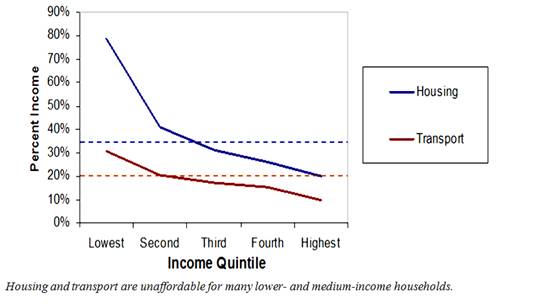 04-21-13 | 10:44 PM
#71
The article that goes with the chart points out that transport is unaffordable or barely affordable for 40 percent of the population--in spite of the fact that large parts of transport expenses are shifted to other sources.
__________________
"Think Outside the Cage"
04-22-13 | 12:39 AM
#72

bragi
Joined: Jun 2006
Posts: 2,911
Likes: 3
From: seattle, WA
Bikes: LHT
I can afford a car, and over the last decade I have had cars intermittently, but for many people, including me, they're a luxury, not a necessity. When I have had a car, they mostly grew moss and sucked up money for no reason at all. (I signed up for a car-sharing service two months ago, and I have yet to use it.) My last car, a 1993 Volvo, was a perfectly good car, but it cost me a good deal in insurance, and every trip to the auto shop, while rare, was $600-$900. A trip to the bike shop, by contrast, is about as rare, and about $30.
Buying even a $20,000 car when you make $80,000/year seems pretty stupid to me.
Buying even a $20,000 car when you make $80,000/year seems pretty stupid to me.
04-22-13 | 09:32 AM
#73
I guess I can afford a car. All of my co-workers who have the same hourly income as me own a car, and some even own two. But I long ago started spending that money that would go for a car on stuff that I like better. So at this point I would have to give up something I like better in order to afford a car. So I guess I can't afford a car after all!
__________________
"Think Outside the Cage"
04-22-13 | 11:22 AM
#74
Senior Member
Joined: Aug 2009
Posts: 4,144
Likes: 3
From: Burnaby, BC
I guess I can afford a car. All of my co-workers who have the same hourly income as me own a car, and some even own two. But I long ago started spending that money that would go for a car on stuff that I like better. So at this point I would have to give up something I like better in order to afford a car. So I guess I can't afford a car after all!
04-23-13 | 11:13 AM
#75

Senior Member
Joined: Mar 2008
Posts: 1,133
Likes: 4
From: Naptown
Bikes: NWT 24sp DD; Brompton M6R
Great link--I bookmarked it because the author had other interesting titles in his planetizen blog, mostly on topics that some people on this forum are interested in.
The article that goes with the chart points out that transport is unaffordable or barely affordable for 40 percent of the population--in spite of the fact that large parts of transport expenses are shifted to other sources.
The article that goes with the chart points out that transport is unaffordable or barely affordable for 40 percent of the population--in spite of the fact that large parts of transport expenses are shifted to other sources.
But you can't use the *average* cost of ownership to determine the cost of ownership for people in the lower quintiles because that figure includes costs only incurred by people in the upper quintiles, which you can't impute to people in the lower quintiles. I.e., the fact that someone in the 2nd quintile buys a $30,000 car will increase the average cost of ownership reflected in the statistics, but won't have any effect on the ownership costs of someone who didn't buy a $30,000 car, and so can't be used to meaningfully determine what their ownership costs are. What you would actually need would be the average costs of ownership of cars owned by people in the lower quintiles.
On the other hand, while gas and oil cost the same for everyone, other maintenance costs may be higher for people in the lower quintiles who are likely driving older cars without warranties.