

When I bought this Nishiki a few months ago I wasn't sure what I had. The high-end Nishiki at the time was the "Professional", and this bike lacked the biplane fork and bamboo script on the downtube. After poking around Bike Forums and the Internet, I found a couple of examples of an identical Nishiki, both of which had been modified over time. One post labeled the bike as a "Nishiki Custom Pro", while another claimed the bike was a special order without decals.
The differences in this bike versus the Professional model of that time are the standard fork crown and the two decals on the seat tube indicating chrome molybdenum and Made in Japan. The chromed lugs, seatstay caps and dropouts are similar. Date codes on the derailleur indicated July and August 1972 manufacture, while the crankset was made in 1971.
When I picked it up it was apparent that it hadn't been used much in 53 years. Other than a layer of light accumulated dust and dirt, everything was as it came from the factory and in excellent condition. Everything but the ancient Wolber tubular tires and Araya rims, however, which were replaced with H Plus Son TB14 rims and some Sapim spokes laced to the original and perfect hubs. Even the seat looked new, with no wear to the label or surface.
The first step was taking it apart, then cleaning and polishing the frame and components. Other than a few tiny paint chips, the finish was in great shape. The frame is completely chromed under the paint and looks beautiful anywhere the chrome shows through. Marion Cycle Works took care of the high-level detailing, bearing overhaul, new cables and final assembly and did an exceptional job. The Nishiki looks new.
The pictures show the finished project, but everything was there when I bought it, so things happened quickly. If anyone has any additional information on this model of Nishiki, I'd like to know about it. One person suggested that a small Japanese frame building company called Miki Sekai was responsible for this frame. The serial number is different from standard Nishiki ones and I have never seen this bike listed in any Nishiki catalog. Whatever it is, it looks great and rides well. I'm happy to have it.

Nishiki after reassembly at Marion Cycle Works


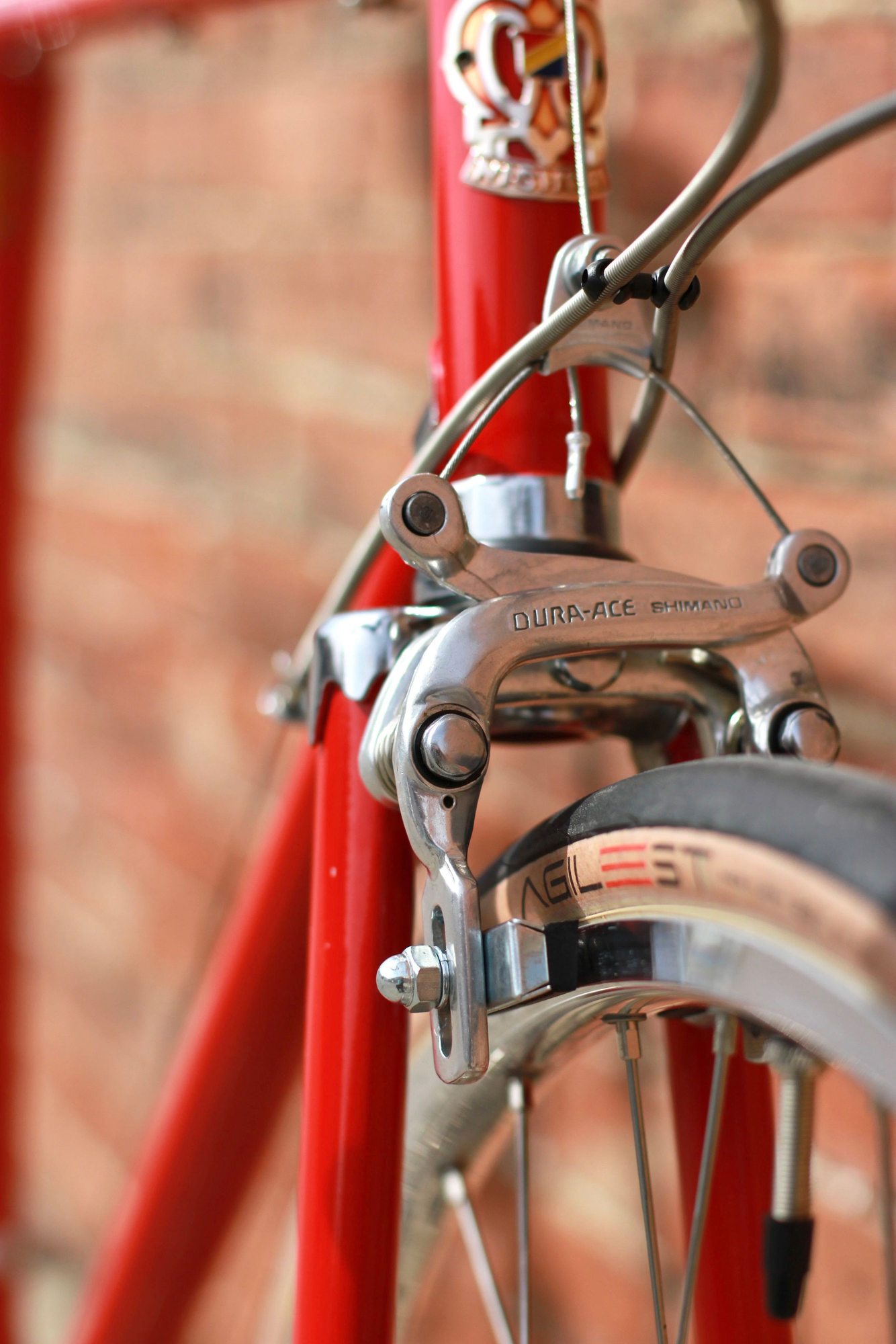
Shimano Dura Ace center pulls
The differences in this bike versus the Professional model of that time are the standard fork crown and the two decals on the seat tube indicating chrome molybdenum and Made in Japan. The chromed lugs, seatstay caps and dropouts are similar. Date codes on the derailleur indicated July and August 1972 manufacture, while the crankset was made in 1971.
When I picked it up it was apparent that it hadn't been used much in 53 years. Other than a layer of light accumulated dust and dirt, everything was as it came from the factory and in excellent condition. Everything but the ancient Wolber tubular tires and Araya rims, however, which were replaced with H Plus Son TB14 rims and some Sapim spokes laced to the original and perfect hubs. Even the seat looked new, with no wear to the label or surface.
The first step was taking it apart, then cleaning and polishing the frame and components. Other than a few tiny paint chips, the finish was in great shape. The frame is completely chromed under the paint and looks beautiful anywhere the chrome shows through. Marion Cycle Works took care of the high-level detailing, bearing overhaul, new cables and final assembly and did an exceptional job. The Nishiki looks new.
The pictures show the finished project, but everything was there when I bought it, so things happened quickly. If anyone has any additional information on this model of Nishiki, I'd like to know about it. One person suggested that a small Japanese frame building company called Miki Sekai was responsible for this frame. The serial number is different from standard Nishiki ones and I have never seen this bike listed in any Nishiki catalog. Whatever it is, it looks great and rides well. I'm happy to have it.
Nishiki after reassembly at Marion Cycle Works
Shimano Dura Ace center pulls

bwilli88
Not lost wanderer.
close


05-02-26
- Join DateJan 2013
- LocationLancaster, Pa
- Posts:3,684
-
iTrader Positive Feedback0
-
iTrader Feedback Score(0)
-
Likes:101
-
Liked:1,422 Times in 721 Posts
Very nicely setup. Love the red.
Needs a different saddle.
Needs a different saddle.

noglider
aka Tom Reingold
close


05-02-26
- Join DateJan 2009
- LocationNew York, NY, and High Falls, NY, USA
- Posts:44,126
-
iTrader Positive Feedback0
-
iTrader Feedback Score(0)
-
Likes:6,957
-
Liked:6,342 Times in 3,399 Posts
I don't remember seeing those Shimano brake calipers on a Nishiki, so I wonder if they were changed. Of course, I haven't seen everything, so maybe that's how it was. I am pretty sure that those calipers were the first components to bear the Dura Ace name.

bikemig
Senior Member
close
05-02-26
- Join DateApr 2012
- LocationMiddle Earth (aka IA)
- Posts:21,770
-
iTrader Positive Feedback0
-
iTrader Feedback Score(0)
-
Likes:8,550
-
Liked:5,672 Times in 2,924 Posts
Great looking bike. The top end Japanese bikes from the 70s are really nice bikes. I'd be sorely tempted to swap out the 144bcd sugino crank for a 110 bcd one and a medium to long cage suntour RD. If the saddle works for you, I'd keep it. Otherwise you never go wrong with a leather saddle on a bike this old.

icemilkcoffee
Senior Member
close

05-02-26
- Join DateAug 2009
- Posts:4,257
-
iTrader Positive Feedback0
-
iTrader Feedback Score(0)
-
Likes:5,855
-
Liked:3,665 Times in 1,885 Posts
What a stunning bike! What size tire is it running? Looks like there’s room for a lot more tire.
Thanks for the comments on the Nishiki. To answer some questions, the saddle was replaced with a Brooks C-17 Special that matches the look of the bike and is more comfortable than the original saddle it came with. I'll hold on to the Fujita seat in case I ever want to go back to the factory specification.
The crankset and gearing is also original, so I'm keeping it since the terrain around here isn't hilly enough to require a wider range.
I've settled on 700x28 Panaracer Agilest tires for all my vintage bikes, even though the Nishiki could handle a 32 or more easily. The 28s provide enough cushion and road feel while still looking like they came with the bike. They do well with 95 rear 90 front air pressure.
The crankset and gearing is also original, so I'm keeping it since the terrain around here isn't hilly enough to require a wider range.
I've settled on 700x28 Panaracer Agilest tires for all my vintage bikes, even though the Nishiki could handle a 32 or more easily. The 28s provide enough cushion and road feel while still looking like they came with the bike. They do well with 95 rear 90 front air pressure.
I have the same bike in a blue color. And like yours unmolested with tubular tires the same fork crown and brakes. I have yet to restore mine. It sounds like they were a bit of a Nishiki unicorn.

John E
feros ferio
close

04-30-26
- Join DateJul 2000
- Locationwww.ci.encinitas.ca.us
- Posts:22,397
-
iTrader Positive Feedback0
-
iTrader Feedback Score(0)
-
Likes:9,791
-
Liked:1,864 Times in 1,138 Posts
I worked at a Nishiki/Peugeot dealership from 1972-1974, and I was riding a 1971 American Eagle Semi Pro (Nishiki Competition) at the time.
I remember when the Road Compe was rushed into production, as a tweaked Semi-Pro. The Professional was a refined version of the Road Compe.
Yours is a particularly well-preserved and beautiful specimen.
Brakes would have been DiaCompe clones of Weinmann 999s.
The basic shortcage V rear derailleur and reverse-shift (normal high) front derailleur also were standard. I now use a fancier Cyclone II on one of my road bikes, but frankly the old early 1970s V-GT and V worked just well, and far better than ANY competition from Europe.
Yes, 54-44 / 14-16-18-21-24 Alpine / 1.5-step gearing was stock, with the newfangled gold-colored freewheel. I copied that gearing when I readied my Semi-Pro for the 1972 Los Angeles Double Century, and it worked out OK for me, although I now use 2x6 or more gears now, with a 38/26 or lower bottom end, and I no longer need a 104" top gear.
I remember when the Road Compe was rushed into production, as a tweaked Semi-Pro. The Professional was a refined version of the Road Compe.
Yours is a particularly well-preserved and beautiful specimen.
Brakes would have been DiaCompe clones of Weinmann 999s.
The basic shortcage V rear derailleur and reverse-shift (normal high) front derailleur also were standard. I now use a fancier Cyclone II on one of my road bikes, but frankly the old early 1970s V-GT and V worked just well, and far better than ANY competition from Europe.
Yes, 54-44 / 14-16-18-21-24 Alpine / 1.5-step gearing was stock, with the newfangled gold-colored freewheel. I copied that gearing when I readied my Semi-Pro for the 1972 Los Angeles Double Century, and it worked out OK for me, although I now use 2x6 or more gears now, with a 38/26 or lower bottom end, and I no longer need a 104" top gear.

georges1
Steel is real
close
05-02-26
- Join DateMar 2013
- LocationNot far from Paris
- Posts:4,470
-
iTrader Positive Feedback0
-
iTrader Feedback Score(0)
-
Likes:9,305
-
Liked:2,570 Times in 1,593 Posts
Very nice bike 
Thanks for chiming in John E. I'm a newbie, so can't post pictures yet. However, I will ad some pics to my gallery if you would like to see it. I'm pretty sure mine is unmolested. Mine has Dura Ace center pulls.