


Question about bicycle repair books
 08-08-25 | 07:38 AM
#51


Senior Member

Joined: Apr 2005
Posts: 17,195
Likes: 761
From: Ann Arbor, MI
Bikes: 1980 Masi, 1984 Mondonico, 1984 Trek 610, 1980 Woodrup Giro, 2005 Mondonico Futura Leggera ELOS, 1967 PX10E, 1971 Peugeot UO-8
Thank you everyone that has replied. Yes I know my new bicycle is a BSO department store bicycle, it's basically all you can find around here. I'm living in a small town, surrounded by farm land. There are no bike shops in my town, or in any of the neighboring towns. I have to travel some distance from my town, before I can find a real bike shop. Even many of the used bicycles available near me, will be the BSO department store bicycles. I don't expect to find too many higher quality used bicycles out in small towns or farmland. Most people living in small town America (and farms) just buy department store bicycles. Unless you're looking for 50 year old (or older) vintage bicycles, when many bicycles were still of decent quality.
I used to live in the Chicago area, but I moved away in 2018, to this small Wisconsin town.
I used to live in the Chicago area, but I moved away in 2018, to this small Wisconsin town.
But those are not the only surviving bike shops in Chicago, just the ones in my old neighborhood.
 08-08-25 | 07:57 AM
#52

Senior Moment
Joined: Aug 2022
Posts: 31
Likes: 39
From: Tallahassee
Another book that I don't think anyone has mentioned is Richards' Ultimate Bicycle Book, by Richard Ballantine and Richard Grant, 1992. Has a good section on maintenance and was my gateway back in the day to doing my own.
08-08-25 | 08:35 AM
#53
Thread Starter
Newbie
Joined: Jul 2025
Posts: 36
Likes: 21
Other vintage book recommendations:
Anybody’s Bike Book, by Tom Cuthbertson copyright about 1968 and several later editions. Excellent for 90% of all problems, but he recommends taking wheel rim issue to a shop. But they are not ThAT hard.
The New Complete Book of Bicycles, by Eugene Sloan, about 1973, has a long section on maintenance and repair with some overhauling.
Effective Bicycling has a long chapter on bicycle maintenance. The author John Forester, passed away, but he gathered experience and knowledge from perhaps the 1940s.
For true antiquity, and a focus on the science and engineering, there is. Bicycles and Tricycles: An elementary treatise on their deign and construction,” by Archibald Sharp in 1896 and reprinted by MIT and David Gordon Wilson. It is about the science and engineering in the formative years of the bicycle as we have one to know it, but it’s not about repair and maintenance.
As well there is the well-illustrated Glenn’s Complete Bucycle Repair Manual. It focuses on examples of the eras of bikes you want to work on covering the Schwinn 3 speeds, single speeds and to-speeds the Peugeot UO-8 (some pics seem to be of Gitane), and good coverage of Sturmey-Archer hubs and some competing German systems. Again, hard and hands-on, all about maintenance procedures and tools without science and tuning such as gearing and tire selection.
I suggest starting with Cuthbertson and Forester. As always, Amazon can be your friend in sourcing used books such as these.
Anybody’s Bike Book, by Tom Cuthbertson copyright about 1968 and several later editions. Excellent for 90% of all problems, but he recommends taking wheel rim issue to a shop. But they are not ThAT hard.
The New Complete Book of Bicycles, by Eugene Sloan, about 1973, has a long section on maintenance and repair with some overhauling.
Effective Bicycling has a long chapter on bicycle maintenance. The author John Forester, passed away, but he gathered experience and knowledge from perhaps the 1940s.
For true antiquity, and a focus on the science and engineering, there is. Bicycles and Tricycles: An elementary treatise on their deign and construction,” by Archibald Sharp in 1896 and reprinted by MIT and David Gordon Wilson. It is about the science and engineering in the formative years of the bicycle as we have one to know it, but it’s not about repair and maintenance.
As well there is the well-illustrated Glenn’s Complete Bucycle Repair Manual. It focuses on examples of the eras of bikes you want to work on covering the Schwinn 3 speeds, single speeds and to-speeds the Peugeot UO-8 (some pics seem to be of Gitane), and good coverage of Sturmey-Archer hubs and some competing German systems. Again, hard and hands-on, all about maintenance procedures and tools without science and tuning such as gearing and tire selection.
I suggest starting with Cuthbertson and Forester. As always, Amazon can be your friend in sourcing used books such as these.
Thank you for the book recommendations. I already have two editions of the Glenn’s Complete Bicycle Repair Manual. I will look into the other books you recommended.
08-08-25 | 09:05 AM
#54
Thread Starter
Newbie
Joined: Jul 2025
Posts: 36
Likes: 21
A few North Side Chicago bike shops still survive since my childhood - one is Gary’s Cycles about 6000 North Clark Street, and another is Roberts Cycles about 7200 North Clark Sreet. Gary’s was where I went as a kid to buy a tube or a tire, or to get the bike fixed, and I worked at Roberts briefly in the late ‘60s.
But those are not the only surviving bike shops in Chicago, just the ones in my old neighborhood.
But those are not the only surviving bike shops in Chicago, just the ones in my old neighborhood.
Thank you for the information about surviving bike shops in Chicago. I also used to live near that Chicago neighborhood many years ago, from 1989 to 1991. I was living near Touhy Ave between Western Ave and Ridge Blvd. Went to Sullivan high school during those years. I would have walked past Roberts Cycle everyday on Clark Street, going to Sullivan high school. Until I started taking the #22 CTA Clark bus in the winter. But I don't remember the bike shop very much anymore, because I lived there over 30 years ago. I can only vaguely remember it, in the back of my mind. I was not paying much attention to all of the individual businesses, I probably should have paid more attention. But anyway I moved to the Chicago suburbs in August 1991, and finally moved to Wisconsin in 2018.
I was not even born yet in the 1960s, I was born in the middle 1970's.
But those bike shops are a little too far away for me to travel to now. I only get to Chicago once a year anymore, it's usually even less often.
08-08-25 | 09:43 AM
#55

Senior Member


Joined: Mar 2016
Posts: 2,067
Likes: 573
Bikes: '87-ish Pinarello Montello; '89 Nishiki Ariel; '85 Raleigh Wyoming, '16 Wabi Special, '16 Wabi Classic, '14 Kona Cinder Cone, 2023 Surly Disk Trucker
For a do-all, cover-all type book it's hard to beat Park Tool's bike repair manual. Easy to read/understand with pictures and their YouTube channel is where you can go and see them do it.
https://www.parktool.com/en-us/produ...-edition-bbb-4
https://www.parktool.com/en-us/produ...-edition-bbb-4
08-08-25 | 10:00 AM
#56
Senior Member
Joined: Apr 2005
Posts: 17,195
Likes: 761
From: Ann Arbor, MI
Bikes: 1980 Masi, 1984 Mondonico, 1984 Trek 610, 1980 Woodrup Giro, 2005 Mondonico Futura Leggera ELOS, 1967 PX10E, 1971 Peugeot UO-8
Thank you for the information about surviving bike shops in Chicago. I also used to live near that Chicago neighborhood many years ago, from 1989 to 1991. I was living near Touhy Ave between Western Ave and Ridge Blvd. Went to Sullivan high school during those years. I would have walked past Roberts Cycle everyday on Clark Street, going to Sullivan high school. Until I started taking the #22 CTA Clark bus in the winter. But I don't remember the bike shop very much anymore, because I lived there over 30 years ago. I can only vaguely remember it, in the back of my mind. I was not paying much attention to all of the individual businesses, I probably should have paid more attention. But anyway I moved to the Chicago suburbs in August 1991, and finally moved to Wisconsin in 2018.
I was not even born yet in the 1960s, I was born in the middle 1970's.
But those bike shops are a little too far away for me to travel to now. I only get to Chicago once a year anymore, it's usually even less often.
I was not even born yet in the 1960s, I was born in the middle 1970's.
But those bike shops are a little too far away for me to travel to now. I only get to Chicago once a year anymore, it's usually even less often.
08-08-25 | 11:12 AM
#57

Senior Member

Joined: Sep 2004
Posts: 3,269
Likes: 1,022
From: Chicago area
Bikes: Airborne "Carpe Diem", Motobecane "Mirage", Trek 6000, Strida 2, Dahon "Helios XL", Dahon "Mu XL", Tern "Verge S11i"
I was in the class of 1968 at ETHS. We sometimes referred to "Sin High School"  which was the home of the "Durty Wurds"... banned from playing at ETHS because of some "snowflake" administrator.
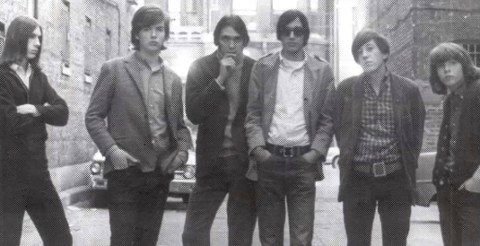
The Durty Wurds in their prime. :-)
The closest I got to streetcars was the tracks that ran down Central Street in Evanston, when I lived on the #1 bus route. The last streetcar in Chicago ran in June of 1958.
I *did* see the trolley buses in Chicago, which ran until 1973. I never rode on one, though.
EDIT: I have the blue Park Tools book, which I've found useful. Also Musson's book on wheel-building, which is an excellent resource. All but one of the bikes I regularly ride have wheels I've built with the help of that book.
I also have the 4th edition of Bicycling Science, which is occasionally helpful but doesn't cover some topics I'd like to learn more about.
Another interesting book of more historical interest is The Dancing Chain- History and Development of the Derailleur Bicycle, by Frank Berto
which was the home of the "Durty Wurds"... banned from playing at ETHS because of some "snowflake" administrator.The Durty Wurds in their prime. :-)
The closest I got to streetcars was the tracks that ran down Central Street in Evanston, when I lived on the #1 bus route. The last streetcar in Chicago ran in June of 1958.
I *did* see the trolley buses in Chicago, which ran until 1973. I never rode on one, though.
EDIT: I have the blue Park Tools book, which I've found useful. Also Musson's book on wheel-building, which is an excellent resource. All but one of the bikes I regularly ride have wheels I've built with the help of that book.
I also have the 4th edition of Bicycling Science, which is occasionally helpful but doesn't cover some topics I'd like to learn more about.
Another interesting book of more historical interest is The Dancing Chain- History and Development of the Derailleur Bicycle, by Frank Berto
Last edited by sweeks; 08-08-25 at 11:22 AM.
08-08-25 | 12:53 PM
#58
Thread Starter
Newbie
Joined: Jul 2025
Posts: 36
Likes: 21
For the time being I will sell off my 27 speed road bicycle (aluminum frame and carbon fiber front fork), and keep my cheap inexpensive $128 dollar department store single speed bicycle with flip flop hub. I bought it for doing leisurely rides in town, and the occasional leisurely ride on bike paths. I purposely decided to get the simplest type of bicycle (single speed), because it has fewer parts to break or malfunction. There are no cheap derailleurs, no cheap suspensions, no cheap disc brakes, no carbon fiber to give me problems.
I have owned cheap department store bicycles before, sometimes they lasted many years with no problems, and sometimes they only lasted a few years before they started developing problems. Thankfully nothing dangerous or catastrophic happened. Just premature worn out parts, usually with the derailleurs and gearing. So I'm not expecting anything special from this department store single speed bicycle. I know what to expect.
Later in the future I might get an old vintage mountain bike from the 1980's or 1990's, and convert it to a inexpensive budget touring bicycle. Assuming I do that, I would definitely look for a high quality name brand mountain bike, with a steel frame - such as Chromoly 4130 or Reynolds 531 steel frame and fork. No suspensions to add weight and complexity. I would want standard 26 inch wheels and tires, because they are very easy to find anywhere in the world. And I would certainly replace the knobby tires with better tires. Something like Schwalbe Marathon road tires or similar. And replace any single wall or steel rims, with double wall aluminum rims with 36 spokes, for the added strength and stable braking power in the wet.
I know most vintage mountain bikes have 18 speeds (I had a few back in the day). If everything was in very good condition, I might keep it as is. But if the parts are worn out, I might just replace with more modern components (probably as 2x drivetrain). I might go with a 2x front chainring, with a 8 to 10 speed cassette in the back.
Of course if I wanted to go touring in poorer parts of the world someday, I know many bicycle tourists and bike packers use 2x or 3x chainring drivetrains with 8 or 9 cog cassettes, because these sizes have been the standard for many years. And thankfully the chains, shifters, and derailleurs, etc are usually more compatible with each other as well, and cheaper to purchase. These types of components can usually be found in pretty much every country around the world. Not so much the newer 1x chainring in the front, or 10,11 or 12 speed cassettes in the back. So perhaps I would build a inexpensive budget touring bike with a 2x chain ring and 8 or 9 speed cassette. And of course a good quality steel frame and fork, because it can be repaired anywhere in the world. But honestly I would probably do most of my riding here in the United States. And if I went overseas, it would be countries like Japan, Australia or Western Europe.
I would also add bar-ends on the handlebars, add fenders, a rack, better saddle, lights for nighttime riding, at least 2 water bottle cages, and large platform flat pedals.
If I had enough storage space and money, I would like to have a few bicycles in my collection, for different purposes. A simple single speed bicycle for causal leisurely riding in town. A high quality mountain bike from the 1980's to 1990's, converted into a budget touring bike. And a vintage 10 speed bicycle from the 1970's, when I want some extra speed and efficiency while riding. And a beat up looking vintage 3 speed sturmey-archer (or Shimano equivalent) internal hub bike for cargo and utility, like grocery shopping or commuting to work, when I don't want to deal with derailleurs. But in all cases, with steel frames and forks, no carbon fiber, no suspensions, nothing that would be a magnet for thieves.
I have owned cheap department store bicycles before, sometimes they lasted many years with no problems, and sometimes they only lasted a few years before they started developing problems. Thankfully nothing dangerous or catastrophic happened. Just premature worn out parts, usually with the derailleurs and gearing. So I'm not expecting anything special from this department store single speed bicycle. I know what to expect.
Later in the future I might get an old vintage mountain bike from the 1980's or 1990's, and convert it to a inexpensive budget touring bicycle. Assuming I do that, I would definitely look for a high quality name brand mountain bike, with a steel frame - such as Chromoly 4130 or Reynolds 531 steel frame and fork. No suspensions to add weight and complexity. I would want standard 26 inch wheels and tires, because they are very easy to find anywhere in the world. And I would certainly replace the knobby tires with better tires. Something like Schwalbe Marathon road tires or similar. And replace any single wall or steel rims, with double wall aluminum rims with 36 spokes, for the added strength and stable braking power in the wet.
I know most vintage mountain bikes have 18 speeds (I had a few back in the day). If everything was in very good condition, I might keep it as is. But if the parts are worn out, I might just replace with more modern components (probably as 2x drivetrain). I might go with a 2x front chainring, with a 8 to 10 speed cassette in the back.
Of course if I wanted to go touring in poorer parts of the world someday, I know many bicycle tourists and bike packers use 2x or 3x chainring drivetrains with 8 or 9 cog cassettes, because these sizes have been the standard for many years. And thankfully the chains, shifters, and derailleurs, etc are usually more compatible with each other as well, and cheaper to purchase. These types of components can usually be found in pretty much every country around the world. Not so much the newer 1x chainring in the front, or 10,11 or 12 speed cassettes in the back. So perhaps I would build a inexpensive budget touring bike with a 2x chain ring and 8 or 9 speed cassette. And of course a good quality steel frame and fork, because it can be repaired anywhere in the world. But honestly I would probably do most of my riding here in the United States. And if I went overseas, it would be countries like Japan, Australia or Western Europe.
I would also add bar-ends on the handlebars, add fenders, a rack, better saddle, lights for nighttime riding, at least 2 water bottle cages, and large platform flat pedals.
If I had enough storage space and money, I would like to have a few bicycles in my collection, for different purposes. A simple single speed bicycle for causal leisurely riding in town. A high quality mountain bike from the 1980's to 1990's, converted into a budget touring bike. And a vintage 10 speed bicycle from the 1970's, when I want some extra speed and efficiency while riding. And a beat up looking vintage 3 speed sturmey-archer (or Shimano equivalent) internal hub bike for cargo and utility, like grocery shopping or commuting to work, when I don't want to deal with derailleurs. But in all cases, with steel frames and forks, no carbon fiber, no suspensions, nothing that would be a magnet for thieves.
