


Correct Tire Pressure.
 10-18-06 | 09:36 AM
#1
Thread Starter
Commuter hits the trail.
Joined: Sep 2006
Posts: 211
Likes: 0
Correct Tire Pressure.
I thought this would be the best forum to know the correct pressure for 700c tires.
I bought Panaracers 700-23c tires and put them on sun mz 14 rims. I put in salsa inner tubes.
I inflated them up to 140 and rode 5 miles. The next morning the tire was flat and wouldn't take any air.
I took it apart and the puncture is on the rim side of the tube, lining up exactly with a spoke, and the rim strip is cut.
Should I run these at a lower pressure? Max is 150, and IIRC rec. is 130.
Or should I just get rim tape?
I don't quite dare take them to 150, would it be o.k.?
Thanks for the assistance.
I bought Panaracers 700-23c tires and put them on sun mz 14 rims. I put in salsa inner tubes.
I inflated them up to 140 and rode 5 miles. The next morning the tire was flat and wouldn't take any air.
I took it apart and the puncture is on the rim side of the tube, lining up exactly with a spoke, and the rim strip is cut.
Should I run these at a lower pressure? Max is 150, and IIRC rec. is 130.
Or should I just get rim tape?
I don't quite dare take them to 150, would it be o.k.?
Thanks for the assistance.

 10-18-06 | 09:39 AM
#3

Know Your Onion!
Joined: Aug 2005
Posts: 2,011
Likes: 0
From: Boston, MA
Bikes: Kestrel Talon, Motobecane Le Champion SL
Rim tape is a good idea.
You're going to ignite a huge debate as to what the proper tire inflation is. Check your tire and your rim max. inflation pressures, then the max you should ever go is to the lesser of those two. Correct inflation (albeit and inexact science) depends on your weight. For comparison, I'm 185 lbs, and I run my tires at 110/120 (front/rear).
You're going to ignite a huge debate as to what the proper tire inflation is. Check your tire and your rim max. inflation pressures, then the max you should ever go is to the lesser of those two. Correct inflation (albeit and inexact science) depends on your weight. For comparison, I'm 185 lbs, and I run my tires at 110/120 (front/rear).
10-18-06 | 09:40 AM
#4

I eat carbide.


Joined: Jan 2006
Posts: 21,677
Likes: 1,417
From: Elgin, IL
Bikes: Lots. Chapter2, Van Dessel, Giant, Trek, etc Dealers for BMC, Chapter2
New rim tape. Velox or cloth equivalent. Done.
__________________
PSIMET Wheels, PSIMET Racing, PSIMET Neutral Race Support, and 11 Jackson Coffee
Podcast - YouTube Channel
Video about PSIMET Wheels
Podcast - YouTube Channel
Video about PSIMET Wheels
 10-18-06 | 09:58 AM
#6
Senior Member
Joined: Sep 2002
Posts: 911
Likes: 0
From: Philadelphia suburb
You are dealing with two different issues, the flat and appropriate pressure. As for the first question, the flat was likely caused by the rim tape problem, so get new tape, as has already been suggested.
Second, there is no one "correct" pressure. For a start, look on the tire sidewall for the manufacturer's recommended maximum pressure. (Sometimes there will be a minimum and a maximum.) But tire pressure is affected by the kind of riding you do, your weight, a choice between comfort and rolling resistance. Consider experimenting--a little higher, a little lower (being careful not to underinflate too much and risk pinch flats). Sheldon Brown offers this: https://www.sheldonbrown.com/tires.html#pressure, then scroll down to the section entitled "Pressure Recommendations."
Incidentally, you are likely to find answers to most of your cycling questions on Mr. Brown's site.
Second, there is no one "correct" pressure. For a start, look on the tire sidewall for the manufacturer's recommended maximum pressure. (Sometimes there will be a minimum and a maximum.) But tire pressure is affected by the kind of riding you do, your weight, a choice between comfort and rolling resistance. Consider experimenting--a little higher, a little lower (being careful not to underinflate too much and risk pinch flats). Sheldon Brown offers this: https://www.sheldonbrown.com/tires.html#pressure, then scroll down to the section entitled "Pressure Recommendations."
Incidentally, you are likely to find answers to most of your cycling questions on Mr. Brown's site.
10-18-06 | 09:59 AM
#7


pan y agua
Joined: Aug 2005
Posts: 31,809
Likes: 1,232
From: Jacksonville
Bikes: Willier Zero 7; Merlin Extralight; Calfee Dragonfly tandem, Calfee Adventure tandem; Cervelo P2; Motebecane Ti Fly 29er; Motebecanne Phantom Cross; Schwinn Paramount Track bike
132psi. Subtract 1lb for every 1000 feet above sea level.
10-18-06 | 10:06 AM
#8
I eat carbide.
Joined: Jan 2006
Posts: 21,677
Likes: 1,417
From: Elgin, IL
Bikes: Lots. Chapter2, Van Dessel, Giant, Trek, etc Dealers for BMC, Chapter2
It's been like almost a month since I last posted this so I guess I'll bring it out again:
https://www.bikeforums.net/road-cycling/229546-tire-psi-vs-rider-weight.html
These equations are linear extrapolations of the recommendations that are on Sheldon's site. The real curves of recommended pressures would probably not be linear so keep that in mind. Basically I'm saying that these equations will get you into a good starting point. Adjust as needed for your specific tires, ride quality, weight, etc...
https://www.bikeforums.net/road-cycling/229546-tire-psi-vs-rider-weight.html
Originally Posted by Psimet2001
Formulas:
Only the intercepts change for tires between 20-28 widths. Larger widths and the slopes change. Obviously these are generalized and assumed to be linear. While not 100% correct they will give you a great place to start.
Tire Width=20: Pressure(psi) = 0.33 * Rider Weight in lbs + 63.33
Tire Width=23: Pressure(psi) = 0.33 * Rider Weight in lbs + 53.33
Tire Width=25: Pressure(psi) = 0.33 * Rider Weight in lbs + 43.33
Tire Width=28: Pressure(psi) = 0.33 * Rider Weight in lbs + 33.33
Tire Width=32: Pressure(psi) = 0.17 * Rider Weight in lbs + 41.67
Tire Width=37: Pressure(psi) = 0.17 * Rider Weight in lbs + 26.67
Example: You are 150lbs running 28's
Pressure (psi) = (0.33*150) +33.33 = 82.83psi (rear)
Front Pressure = .9*Front Pressure = .9*82.83psi = 74.55psi front
You could start by running 85 rear 75 front and adjust from there. For your weight I would step down to 23's which you could run at 92F - 102R. That would be nice and comfortable and have less rolling resistance than the 28's.
Only the intercepts change for tires between 20-28 widths. Larger widths and the slopes change. Obviously these are generalized and assumed to be linear. While not 100% correct they will give you a great place to start.
Tire Width=20: Pressure(psi) = 0.33 * Rider Weight in lbs + 63.33
Tire Width=23: Pressure(psi) = 0.33 * Rider Weight in lbs + 53.33
Tire Width=25: Pressure(psi) = 0.33 * Rider Weight in lbs + 43.33
Tire Width=28: Pressure(psi) = 0.33 * Rider Weight in lbs + 33.33
Tire Width=32: Pressure(psi) = 0.17 * Rider Weight in lbs + 41.67
Tire Width=37: Pressure(psi) = 0.17 * Rider Weight in lbs + 26.67
Example: You are 150lbs running 28's
Pressure (psi) = (0.33*150) +33.33 = 82.83psi (rear)
Front Pressure = .9*Front Pressure = .9*82.83psi = 74.55psi front
You could start by running 85 rear 75 front and adjust from there. For your weight I would step down to 23's which you could run at 92F - 102R. That would be nice and comfortable and have less rolling resistance than the 28's.
__________________
PSIMET Wheels, PSIMET Racing, PSIMET Neutral Race Support, and 11 Jackson Coffee
Podcast - YouTube Channel
Video about PSIMET Wheels
Podcast - YouTube Channel
Video about PSIMET Wheels
10-18-06 | 10:20 AM
#9
Thread Starter
Commuter hits the trail.
Joined: Sep 2006
Posts: 211
Likes: 0
I ride a Kona Dew Deluxe, with a rack and fenders mounted. I believe it weighs about 19lbs.
I weigh about 180.
By psimets calcs, I should be about 113. Hmm...
Edit: Stock the 2006 is 26 lbs, I imagine the 07 is similar. I am probably closer to 28.
I weigh about 180.
By psimets calcs, I should be about 113. Hmm...
Edit: Stock the 2006 is 26 lbs, I imagine the 07 is similar. I am probably closer to 28.
Last edited by Lossy; 10-18-06 at 10:45 AM.

 10-18-06 | 11:40 AM
#12

Ride 365
Joined: Nov 2004
Posts: 1,882
Likes: 0
From: NYC/UpperDutchess, NY
Bikes: '06 Cannondale Six 13 Pro 2, '05 Specialized Allez Elite, '04 Jamis Satellite, 90's Raleigh M-45 single speed conversion, 80's Fuji Team single speed conversion, 70's Schwinn World Sport
I was discussing tire pressure with a racer recently & he claimed that high-end tires are supposedly designed to grip at higher psi's. So he could run his tires at 140psi, while a cheaper tire would have to run at 120 or less.
I don't use 70 dollar tires, so I can't confirm or deny this. Just another variable to consider.
I don't use 70 dollar tires, so I can't confirm or deny this. Just another variable to consider.
10-18-06 | 12:29 PM
#13
I eat carbide.
Joined: Jan 2006
Posts: 21,677
Likes: 1,417
From: Elgin, IL
Bikes: Lots. Chapter2, Van Dessel, Giant, Trek, etc Dealers for BMC, Chapter2
Originally Posted by johnny99
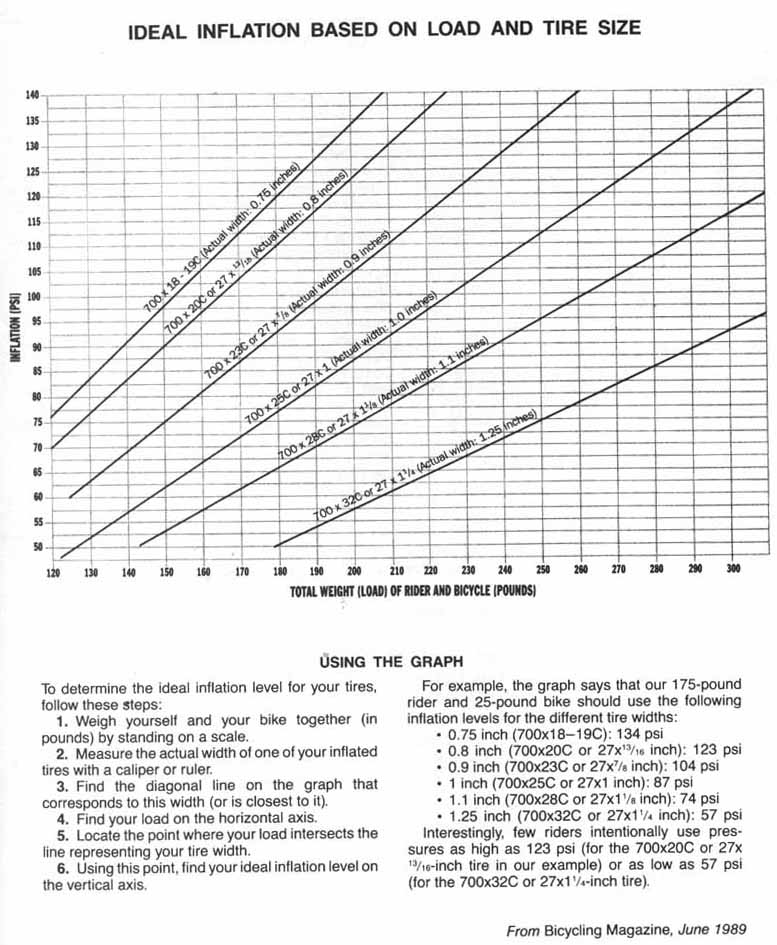
According to that chart, I should be using 80psi. Has tire technology changed that much since 1989?
__________________
PSIMET Wheels, PSIMET Racing, PSIMET Neutral Race Support, and 11 Jackson Coffee
Podcast - YouTube Channel
Video about PSIMET Wheels
Podcast - YouTube Channel
Video about PSIMET Wheels
10-18-06 | 12:36 PM
#14
pan y agua
Joined: Aug 2005
Posts: 31,809
Likes: 1,232
From: Jacksonville
Bikes: Willier Zero 7; Merlin Extralight; Calfee Dragonfly tandem, Calfee Adventure tandem; Cervelo P2; Motebecane Ti Fly 29er; Motebecanne Phantom Cross; Schwinn Paramount Track bike
Originally Posted by Lucky07
I was discussing tire pressure with a racer recently & he claimed that high-end tires are supposedly designed to grip at higher psi's. So he could run his tires at 140psi, while a cheaper tire would have to run at 120 or less.
I don't use 70 dollar tires, so I can't confirm or deny this. Just another variable to consider.
I don't use 70 dollar tires, so I can't confirm or deny this. Just another variable to consider.
Not an engineer but that makes Zero sense to me. The available grip is a function of the coefficient of friction of the material on the road surface, and the size of the contact patch. More pressure = smaller contact patch = less grip.
At best, you might be able to argue that high end tires such as the Michelin Pro Grip for example (compared to Pro Race) have a higher coefficient of friction because of softer tread compound, and therefore you can still have good grip at a higher pressure.
The reason people lower pressure racing in the rain is to increase the contact patch size and increase the grip.
10-18-06 | 01:11 PM
#15
Bolo's tire pressure chart works very well, even though it provides PSI levels for riders who weigh 100 pounds to 150 pounds that are much lower than most lighter riders use. A 100 pound rider might be riding at 80 PSI on the same tire that a 250 pound rider uses at 120 PSI.
The PSI stamped on the tire is a MAXIMUM, based on a hypothical "average" rider and a hypothetical "average" rim. In real life, most riders will get the best performance from a tire at something far below the maximum PSI. But, a 250 pound rider will generally need to ride at, or even above, the maximum PSI to prevent the tire sagging beyond the ideal 15% deflection.
The chart is designed to provide a PSI that yields 15% deflection of the sidewalls under the weight of the rider. At 15% deflection, a tire provides the best balance between shock absorption, cornering ability, braking ability, and rolling resistance.
A puncture to the inside of the tube can be caused by the end of a spoke, or by a burr or sharp edge inside the rim. Find that defect, fix it, and then put in some fresh Velox tape. Using high quality inner tubes reduces the number of flats. I've had much better success with Continental tubes than with the "bargain" brands.
The PSI stamped on the tire is a MAXIMUM, based on a hypothical "average" rider and a hypothetical "average" rim. In real life, most riders will get the best performance from a tire at something far below the maximum PSI. But, a 250 pound rider will generally need to ride at, or even above, the maximum PSI to prevent the tire sagging beyond the ideal 15% deflection.
The chart is designed to provide a PSI that yields 15% deflection of the sidewalls under the weight of the rider. At 15% deflection, a tire provides the best balance between shock absorption, cornering ability, braking ability, and rolling resistance.
A puncture to the inside of the tube can be caused by the end of a spoke, or by a burr or sharp edge inside the rim. Find that defect, fix it, and then put in some fresh Velox tape. Using high quality inner tubes reduces the number of flats. I've had much better success with Continental tubes than with the "bargain" brands.
 10-18-06 | 01:19 PM
#17
I eat carbide.
Joined: Jan 2006
Posts: 21,677
Likes: 1,417
From: Elgin, IL
Bikes: Lots. Chapter2, Van Dessel, Giant, Trek, etc Dealers for BMC, Chapter2
Originally Posted by munkyv22
My bike and I are about 220, so I run 700X32 @ 120.
__________________
PSIMET Wheels, PSIMET Racing, PSIMET Neutral Race Support, and 11 Jackson Coffee
Podcast - YouTube Channel
Video about PSIMET Wheels
Podcast - YouTube Channel
Video about PSIMET Wheels
10-18-06 | 01:21 PM
#18
Senior Member
Joined: Oct 2005
Posts: 5,820
Likes: 133
Its not an exact science, but in general, more air, less rolling resistance, but less traction going around corners. Less air, more grip around corners.
I keep my front kinda soft, 80-90 and the rear pretty high, 110-120. This way, the front, which tends to slide first, has good grip and the rear, which carries most of the weight, has less rolling resistance.
I keep my front kinda soft, 80-90 and the rear pretty high, 110-120. This way, the front, which tends to slide first, has good grip and the rear, which carries most of the weight, has less rolling resistance.
__________________
Il faut de l'audace, encore de l'audace, toujours de l'audace
1980 3Rensho-- 1975 Raleigh Sprite 3spd
1990s Raleigh M20 MTB--2007 Windsor Hour (track)
1988 Ducati 750 F1
Il faut de l'audace, encore de l'audace, toujours de l'audace
1980 3Rensho-- 1975 Raleigh Sprite 3spd
1990s Raleigh M20 MTB--2007 Windsor Hour (track)
1988 Ducati 750 F1
10-19-06 | 03:27 PM
#20
Thread Starter
Commuter hits the trail.
Joined: Sep 2006
Posts: 211
Likes: 0
I wrote to Kona on what the max pressure for the Sun MZ14 rims were. Here is their response:
Just follow the tire pressure noted on the sidewall and you’ll be fine. I’ve seen them run up to rock hard for commuting without a hitch.
If you really need to run high Psi all the time then go with a model that runs disc brakes. Rim brakes wear away the rim and cut grooves into it that will eventually fail. I’ve had tires run at under 50 Psi, and rims still disintegrated in a spectacular fashion.
I already have Disc brakes so this is not a problem for me.
Just follow the tire pressure noted on the sidewall and you’ll be fine. I’ve seen them run up to rock hard for commuting without a hitch.
If you really need to run high Psi all the time then go with a model that runs disc brakes. Rim brakes wear away the rim and cut grooves into it that will eventually fail. I’ve had tires run at under 50 Psi, and rims still disintegrated in a spectacular fashion.
I already have Disc brakes so this is not a problem for me.
10-19-06 | 08:59 PM
#21
Senior Member
Joined: Aug 2005
Posts: 93
Likes: 0
From: Northwest NJ/Adirondacks
I run my front around 115-120 and my rear at around 130-135 on Bontrager Race Lite's. I weigh 157 and my bike weighs about 18 pounds. Of course, I'm 17 and my body can handle road vibrations and such that would leave sometime 3x my age crippled for a week. I haven't had many grip issues, but I don't race either, I'm planning on racing some crits next spring, and imagine that I'd run a lower pressure there for better cornering.
I generally use the visual deflection rule more than actual pressure. If I get 2-4mm's of deflection when I lean on the tire, I roll out, unless its a recovery ride and I want a slower, more comfortable ride, then I let it slide down to 4-8mm's. It all depends on how much comfort you're willing to sacrifice for decreased rolling resistance. I know that at this point, I don't see myself running anything below around 110psi, front or rear, unless it's a rainy fall day with lots of leaves on the road.
I generally use the visual deflection rule more than actual pressure. If I get 2-4mm's of deflection when I lean on the tire, I roll out, unless its a recovery ride and I want a slower, more comfortable ride, then I let it slide down to 4-8mm's. It all depends on how much comfort you're willing to sacrifice for decreased rolling resistance. I know that at this point, I don't see myself running anything below around 110psi, front or rear, unless it's a rainy fall day with lots of leaves on the road.
10-19-06 | 09:04 PM
#22

Clinically Insane
Joined: Jul 2005
Posts: 765
Likes: 1
Originally Posted by merlinextraligh
Not an engineer but that makes Zero sense to me. The available grip is a function of the coefficient of friction of the material on the road surface, and the size of the contact patch. More pressure = smaller contact patch = less grip.
At best, you might be able to argue that high end tires such as the Michelin Pro Grip for example (compared to Pro Race) have a higher coefficient of friction because of softer tread compound, and therefore you can still have good grip at a higher pressure.
The reason people lower pressure racing in the rain is to increase the contact patch size and increase the grip.
At best, you might be able to argue that high end tires such as the Michelin Pro Grip for example (compared to Pro Race) have a higher coefficient of friction because of softer tread compound, and therefore you can still have good grip at a higher pressure.
The reason people lower pressure racing in the rain is to increase the contact patch size and increase the grip.
10-20-06 | 11:26 AM
#23

Making a kilometer blurry
Joined: May 2006
Posts: 26,170
Likes: 93
From: Austin (near TX)
Bikes: rkwaki's porn collection
Originally Posted by San Rensho
Its not an exact science, but in general, more air, less rolling resistance, but less traction going around corners. Less air, more grip around corners.
I keep my front kinda soft, 80-90 and the rear pretty high, 110-120. This way, the front, which tends to slide first, has good grip and the rear, which carries most of the weight, has less rolling resistance.
I keep my front kinda soft, 80-90 and the rear pretty high, 110-120. This way, the front, which tends to slide first, has good grip and the rear, which carries most of the weight, has less rolling resistance.
Another factor to consider is the road surface. Really bad Texas chipseal is so rough that you might want to go with lower pressure just due to comfort. My Tour de Gruene partner goes much faster on the final 5 mi of the course with his tires running about 20psi lower. His Cannondale just beats the tar out of him otherwise.
10-20-06 | 01:49 PM
#25

In Real Life
Joined: Jan 2003
Posts: 52,159
Likes: 772
From: Down under down under
Bikes: Lots
Originally Posted by Psimet2001
It's been like almost a month since I last posted this so I guess I'll bring it out again:
https://www.bikeforums.net/showthread.php?t=229546
These equations are linear extrapolations of the recommendations that are on Sheldon's site. The real curves of recommended pressures would probably not be linear so keep that in mind. Basically I'm saying that these equations will get you into a good starting point. Adjust as needed for your specific tires, ride quality, weight, etc...
https://www.bikeforums.net/showthread.php?t=229546
These equations are linear extrapolations of the recommendations that are on Sheldon's site. The real curves of recommended pressures would probably not be linear so keep that in mind. Basically I'm saying that these equations will get you into a good starting point. Adjust as needed for your specific tires, ride quality, weight, etc...
Well, according to those forumla, I should be running my tires at about 90 psi .......... and guess what ............. I feel most comfortable when my tires are somewhere between about 90 and 100 psi!!
 Nice to have the confirmation that I'm running the correct tire pressure for me!
__________________
Rowan
My fave photo threads on BF
Century A Month Facebook Group
Machka's Website
Photo Gallery
Rowan
My fave photo threads on BF
Century A Month Facebook Group
Machka's Website
Photo Gallery