


Geometry Questions
 10-13-16 | 10:58 PM
#1
Thread Starter
Senior Member
Joined: Oct 2016
Posts: 106
Likes: 2
From: Arizona
Geometry Questions
Hi, guys. Noob here. If this is posted in the wrong section, or has been covered better elsewhere, I sincerely apologize. I am definitely ready to get back into cycling, and I know I want a fixed gear next. I absolutely love riding them, and I'm ready to own one. I am fairly confident that I don't want traditional track geometry - that will most likely be too aggressive. But I've been on fixed gears that feel too relaxed, and I didn't really love it - it took away from that "oneness" with the bike that is so crucial to this type of riding. Btw, it was a Retrospec Mantra V2, so maybe that was part of the problem. I'm so sorry for the long winded post, but I don't quite understand what I'm looking for. I promise I've googled this, and compared dozens of bikes for similar numbers, but I don't understand what makes a certain bike aggressive vs a different bike being more slack. Is there a head tube/seat tube angle range that I want to stick with? Or are chainstay lengths really important? Is it easier to mess with stem lengths and make an aggressive bike more relaxed, or vice versa? I will definitely do the fit calculator and make sure my bike is the right size, but I want to make sure the geometry is desirable.
I'll happily answer any questions regarding my riding experience, or more specifically what I'm looking for, but I figured this was borderline rude (lengthwise) as a 2nd forum post, and I really appreciate the expert advice from the community. Thanks a bunch.
First member to suggest I buy a Kilo TT gets a free puppy
I'll happily answer any questions regarding my riding experience, or more specifically what I'm looking for, but I figured this was borderline rude (lengthwise) as a 2nd forum post, and I really appreciate the expert advice from the community. Thanks a bunch.
First member to suggest I buy a Kilo TT gets a free puppy
Last edited by rEVOLVED; 10-13-16 at 11:39 PM.
 10-14-16 | 07:21 AM
#2

Full Member


Joined: Jan 2015
Posts: 268
Likes: 8
From: Toronto
Bikes: Schwinn Voyageur SP | Sekine SHS-271 | Wabi Special
I'll only speak from my experience--riding true track geometry (75 deg. seatube angle, 75 degree headtube angle) on the road is fun for short distances (<40km), but starts to become uncomfortable over long distances. This is comfort relative to a road frame with less steep angles. Track geometry is designed for sprinting, and a track bike does exactly that (and well).
Too relaxed--which I would consider 71/72 deg. seattube +headtube angle--will feel a little more sluggish. I've found that the 73/73 deg. angles on my Wabi strike the right balance of comfort and zippiness. However, chainstay length is indeed an important factor. Road geometry will traditionally have a longer chainstay length than track, and that extra stability on the road frame will accrue over the course of a long ride and make it more enjoyable.
Do NOT 'mess with stem lengths' to compensate for frame geometry. Your stem length is a product of your reach (torso+arms), and once dialled in should be left alone. Even if you did, it's going to change very little and will leave you feeling sore.
So, what sort of riding are you planning on doing? Ultimately that will dictate what frame geometry is best. One example being time trial bikes--notice the very steep seattube angles? Well, they're designed for setting speed records--not commuting to work each day.
And if you really want to go down the knowledge hole, I recommend picking up Michael Kolin's book "The Custom Bicycle".
Too relaxed--which I would consider 71/72 deg. seattube +headtube angle--will feel a little more sluggish. I've found that the 73/73 deg. angles on my Wabi strike the right balance of comfort and zippiness. However, chainstay length is indeed an important factor. Road geometry will traditionally have a longer chainstay length than track, and that extra stability on the road frame will accrue over the course of a long ride and make it more enjoyable.
Do NOT 'mess with stem lengths' to compensate for frame geometry. Your stem length is a product of your reach (torso+arms), and once dialled in should be left alone. Even if you did, it's going to change very little and will leave you feeling sore.
So, what sort of riding are you planning on doing? Ultimately that will dictate what frame geometry is best. One example being time trial bikes--notice the very steep seattube angles? Well, they're designed for setting speed records--not commuting to work each day.
And if you really want to go down the knowledge hole, I recommend picking up Michael Kolin's book "The Custom Bicycle".
10-14-16 | 08:40 PM
#3
Thread Starter
Senior Member
Joined: Oct 2016
Posts: 106
Likes: 2
From: Arizona
Great information. Thank you so much. I've been seeing a lot in the 74 range. Many bikes I'm comparing are 73.5/73 or 75/74 (ht/st), with chain stays ranging from 400-420. The differences seem small on paper, but I have no idea what this all means in the saddle. For clarification, I am looking for a commuter that can get me 2-5 miles with ease, and do 20+ mile trips comfortably. More than anything, I want a bike that is simplistic fun. Not looking for specific make/model recommendations, just overall geometry advice.
10-14-16 | 09:09 PM
#4

Senior Member
Joined: Oct 2014
Posts: 764
Likes: 5
From: Long Beach
Bikes: Fitz randonneuse, Trek Superfly/AL, Tsunami SS, Bacchetta, HPV Speed Machine, Rans Screamer
Compare the amount of fork offset between the bikes. Some track style bikes have dead straight forks (wheel would be in the same spot even turned around backwards). Another one may have a lot of offset, like a vintage road bike. They have completely different feel, much more so than other geometry changes.
I won't attempt to describe the difference as people use the same terms to describe opposite things.
I won't attempt to describe the difference as people use the same terms to describe opposite things.
10-14-16 | 09:16 PM
#5

Veteran Racer

Joined: Jul 2009
Posts: 11,866
Likes: 923
From: Ciudad de Vacas, Tejas
Bikes: 34 frames + 82 wheels
The only pertinent number is headtube angle and it must be paired with the proper fork rake to get a good stable ride without it being sluggish. A steeper head angle requires less fork rake to get sufficient trail to be stable at speed. As to ride harshness, that's more a matter of vertical frame stiffness, and generally steel frames like the Wabis make for better smoother road bikes than the typical aluminum frames with oversized tubing.
__________________
What, Me Worry? - Alfred E. Neuman
I see the light at the end of the tunnel, but the tunnel keeps getting longer - me
What, Me Worry? - Alfred E. Neuman
I see the light at the end of the tunnel, but the tunnel keeps getting longer - me
Last edited by TejanoTrackie; 10-14-16 at 09:22 PM.
10-14-16 | 09:20 PM
#6
Veteran Racer
Joined: Jul 2009
Posts: 11,866
Likes: 923
From: Ciudad de Vacas, Tejas
Bikes: 34 frames + 82 wheels
Compare the amount of fork offset between the bikes. Some track style bikes have dead straight forks (wheel would be in the same spot even turned around backwards). Another one may have a lot of offset, like a vintage road bike. They have completely different feel, much more so than other geometry changes.
I won't attempt to describe the difference as people use the same terms to describe opposite things.
I won't attempt to describe the difference as people use the same terms to describe opposite things.
10-14-16 | 10:38 PM
#7
Thread Starter
Senior Member
Joined: Oct 2016
Posts: 106
Likes: 2
From: Arizona
The rake and trail are two things that I truly don't understand. Please, don't bother trying to clarify - I just haven't done the reading yet. Maybe I will look into that. I have some brand specific questions, but I'm reluctant to rehash old threads here. Any serious advice on how to get some input besides lmgtfy? Should I just go for it?
10-15-16 | 01:57 AM
#8

Super-duper Genius
Joined: Aug 2016
Posts: 1,759
Likes: 1,054
From: Muskrat Springs, Utah
As Tejano noted, fork offset (also called rake) can be achieved a number of ways:
- Curved fork legs
- Legs angled forward as they come out of the crown
- Crown design (legs positioned forward of the steering column)
- Dropout shape and location (axle positioned on front of the legs)
- Any combination of the above
Steering trail is the difference between the tire's contact with the ground (which is straight below the axle) and the imaginary intersection with the ground of a line drawn through the center of the head tube. More trail equals better stability at speed, but heavy or sluggish steering. Little trail makes for nimble but sometimes twitchy handling. For a given head tube angle, more offset equals less trail (and vice-versa). Or if you prefer, for a given offset measurement, steeper head tube equals less trail, and shallow head tube equals more trail.
Most modern road bikes have a head tube angle of about 73 degrees. Track bikes have a little more, and touring or comfort bikes, a bit less. Fun fact: ever notice that the most common angle for quill stems was 17 degrees? It's because 17 plus 73 equals 90 degrees, which makes the top of the stem lie parallel to the ground. The most important thing to remember is that along with the head tube angle, you must consider the fork offset to see how a bike will really handle.
- Curved fork legs
- Legs angled forward as they come out of the crown
- Crown design (legs positioned forward of the steering column)
- Dropout shape and location (axle positioned on front of the legs)
- Any combination of the above
Steering trail is the difference between the tire's contact with the ground (which is straight below the axle) and the imaginary intersection with the ground of a line drawn through the center of the head tube. More trail equals better stability at speed, but heavy or sluggish steering. Little trail makes for nimble but sometimes twitchy handling. For a given head tube angle, more offset equals less trail (and vice-versa). Or if you prefer, for a given offset measurement, steeper head tube equals less trail, and shallow head tube equals more trail.
Most modern road bikes have a head tube angle of about 73 degrees. Track bikes have a little more, and touring or comfort bikes, a bit less. Fun fact: ever notice that the most common angle for quill stems was 17 degrees? It's because 17 plus 73 equals 90 degrees, which makes the top of the stem lie parallel to the ground. The most important thing to remember is that along with the head tube angle, you must consider the fork offset to see how a bike will really handle.
10-15-16 | 02:45 AM
#9

Calamari Marionette Ph.D
Joined: Dec 2013
Posts: 7,861
Likes: 41
From: Coeur d' Alene
Bikes: 3 Chinese Gas Pipe Nerdcycles and 2 Chicago Electroforged Boat Anchors
As Tejano noted, fork offset (also called rake) can be achieved a number of ways:
- Curved fork legs
- Legs angled forward as they come out of the crown
- Crown design (legs positioned forward of the steering column)
- Dropout shape and location (axle positioned on front of the legs)
- Any combination of the above
Steering trail is the difference between the tire's contact with the ground (which is straight below the axle) and the imaginary intersection with the ground of a line drawn through the center of the head tube. More trail equals better stability at speed, but heavy or sluggish steering. Little trail makes for nimble but sometimes twitchy handling. For a given head tube angle, more offset equals less trail (and vice-versa). Or if you prefer, for a given offset measurement, steeper head tube equals less trail, and shallow head tube equals more trail.
Most modern road bikes have a head tube angle of about 73 degrees. Track bikes have a little more, and touring or comfort bikes, a bit less. Fun fact: ever notice that the most common angle for quill stems was 17 degrees? It's because 17 plus 73 equals 90 degrees, which makes the top of the stem lie parallel to the ground. The most important thing to remember is that along with the head tube angle, you must consider the fork offset to see how a bike will really handle.
- Curved fork legs
- Legs angled forward as they come out of the crown
- Crown design (legs positioned forward of the steering column)
- Dropout shape and location (axle positioned on front of the legs)
- Any combination of the above
Steering trail is the difference between the tire's contact with the ground (which is straight below the axle) and the imaginary intersection with the ground of a line drawn through the center of the head tube. More trail equals better stability at speed, but heavy or sluggish steering. Little trail makes for nimble but sometimes twitchy handling. For a given head tube angle, more offset equals less trail (and vice-versa). Or if you prefer, for a given offset measurement, steeper head tube equals less trail, and shallow head tube equals more trail.
Most modern road bikes have a head tube angle of about 73 degrees. Track bikes have a little more, and touring or comfort bikes, a bit less. Fun fact: ever notice that the most common angle for quill stems was 17 degrees? It's because 17 plus 73 equals 90 degrees, which makes the top of the stem lie parallel to the ground. The most important thing to remember is that along with the head tube angle, you must consider the fork offset to see how a bike will really handle.

 10-15-16 | 08:59 AM
#10
Thread Starter
Senior Member
Joined: Oct 2016
Posts: 106
Likes: 2
From: Arizona
Thanks for the responses so far. Here is what might be most helpful. Can somebody tell me things to avoid at all costs for a commuting style fixed gear? Whether it be particular models, or angles, or quill stems, or whatever. Alternatively, I would love some model suggestions and reasons for choosing that model. I'm in the $500 range, but less is definitely better. 4130 definitely preferred.
Kilo TT Pro and Kilo WT I'm sure will get a lot of love, but it is so hard for me to buy anything sight unseen. and the WT is really pushing my budget. I fear the TT will be too aggressive. Besides the 520, I don't see anything on the bike being a must have.
Fuji Bikes all look decent to me, especially the Feather. I find it incredibly sexy, but that quill stem seems to push the bars so far forward. I would like to put pursuit or bullhorns on whatever I buy, and some 28c Gatorskins or Thickslicks a year or two in.
I know State Bicycle Co. gets a lot of hate here, and I understand. But to me, they are definitely a step above the other "build your own fixie" websites. By a long shot. State is local to me, and I've ridden several of their bikes. I don't mind the lifestyle fixed gear hipster look, and I must say their bikes ride silently, smoothly, and incredibly confidently. But the components are no name, and the tubing isn't Reynolds until you get into the higher end models. For those who don't know, they just improved stuff for 2016. They finally double butted their tubing, sealed the hubs, machined the braking surface, and took some weight off the wheels. Has anybody ridden the new models as well as similarly priced brands/models? Due to my circumstances and lack of experience, I know more about this brand than the ones only offered online for my location. Sorry if I sound like I am biased towards State. I do want some honest answers, and I'm not stubborn or sold on anything yet.
I really don't want this to become a Kilo TT/bash all other models thread, but I would love some valuable feedback, given my situation.
Kilo TT Pro and Kilo WT I'm sure will get a lot of love, but it is so hard for me to buy anything sight unseen. and the WT is really pushing my budget. I fear the TT will be too aggressive. Besides the 520, I don't see anything on the bike being a must have.
Fuji Bikes all look decent to me, especially the Feather. I find it incredibly sexy, but that quill stem seems to push the bars so far forward. I would like to put pursuit or bullhorns on whatever I buy, and some 28c Gatorskins or Thickslicks a year or two in.
I know State Bicycle Co. gets a lot of hate here, and I understand. But to me, they are definitely a step above the other "build your own fixie" websites. By a long shot. State is local to me, and I've ridden several of their bikes. I don't mind the lifestyle fixed gear hipster look, and I must say their bikes ride silently, smoothly, and incredibly confidently. But the components are no name, and the tubing isn't Reynolds until you get into the higher end models. For those who don't know, they just improved stuff for 2016. They finally double butted their tubing, sealed the hubs, machined the braking surface, and took some weight off the wheels. Has anybody ridden the new models as well as similarly priced brands/models? Due to my circumstances and lack of experience, I know more about this brand than the ones only offered online for my location. Sorry if I sound like I am biased towards State. I do want some honest answers, and I'm not stubborn or sold on anything yet.
I really don't want this to become a Kilo TT/bash all other models thread, but I would love some valuable feedback, given my situation.
10-15-16 | 10:19 AM
#11
Veteran Racer
Joined: Jul 2009
Posts: 11,866
Likes: 923
From: Ciudad de Vacas, Tejas
Bikes: 34 frames + 82 wheels
10-15-16 | 10:38 AM
#12
Super-duper Genius
Joined: Aug 2016
Posts: 1,759
Likes: 1,054
From: Muskrat Springs, Utah
I can only speak from my very limited fixed gear experience and say the Surly Steamroller might be just the ticket for you. It's what I ride, and I absolutely love it.
It's made of 4130 and has very neutral geometry. Comfortable but efficient. Not lazy or sluggish, and not razor sharp (read: only good for racing on a track). For a lot of years, you could get it in any color you want, as long as it's dark red. Eventually, they came out with a second color, which was sort of a cream. (These models got nicknamed Creamroller.)
Surly makes the fork and stays wide enough to fit some pretty big tires and/or fenders (like at least 32c), and they call this their "Fattys Fit Fine" geometry. Doesn't mean you have to put big tires on, though. The fork is drilled for a brake caliper. Seat stay bridge is also caliper-ready, but you have to come up with cable guides and a housing stop if you want a rear brake.
If you look around, you should be able to find a used complete bike for well under $500. Buying new, you'll be into the frame set nearly that much.
It's made of 4130 and has very neutral geometry. Comfortable but efficient. Not lazy or sluggish, and not razor sharp (read: only good for racing on a track). For a lot of years, you could get it in any color you want, as long as it's dark red. Eventually, they came out with a second color, which was sort of a cream. (These models got nicknamed Creamroller.)
Surly makes the fork and stays wide enough to fit some pretty big tires and/or fenders (like at least 32c), and they call this their "Fattys Fit Fine" geometry. Doesn't mean you have to put big tires on, though. The fork is drilled for a brake caliper. Seat stay bridge is also caliper-ready, but you have to come up with cable guides and a housing stop if you want a rear brake.
If you look around, you should be able to find a used complete bike for well under $500. Buying new, you'll be into the frame set nearly that much.
10-15-16 | 11:46 AM
#13
Veteran Racer
Joined: Jul 2009
Posts: 11,866
Likes: 923
From: Ciudad de Vacas, Tejas
Bikes: 34 frames + 82 wheels
^^^ Problem is OP says maximum budget for a complete bike is $500. Were it not for that constraint, I'd recommend a Wabi Classic. Also, seems like OP is best served by buying local.
10-15-16 | 12:06 PM
#14
Thread Starter
Senior Member
Joined: Oct 2016
Posts: 106
Likes: 2
From: Arizona
Steamroller and Wabi Classic are basically gold standards from what I see on here. The Wabi, IMHO, is gorgeous, and the Steamroller seems incredibly well suited to grass, gravel, and rough roads. Honestly, I'd rather buy something like the State, the Kilo, or a sub $500 bike first, give myself a few years to prove that I'm committed to this style of riding, and then get a brand new Wabi or Steamroller or whatever else looks good to me at that point in time.
Am I right to think that the Kilo TT Pro is pretty aggressive? Is the WT similar to the Steamroller "feel wise?" Also, can anybody speak to the Fuji Feather, specifically the quill stem?
Am I right to think that the Kilo TT Pro is pretty aggressive? Is the WT similar to the Steamroller "feel wise?" Also, can anybody speak to the Fuji Feather, specifically the quill stem?
10-15-16 | 12:36 PM
#15
Veteran Racer
Joined: Jul 2009
Posts: 11,866
Likes: 923
From: Ciudad de Vacas, Tejas
Bikes: 34 frames + 82 wheels
The Kilo WT geometry is identical to the Steamroller, so the ride and handling are the same.
10-16-16 | 12:26 AM
#16
Senior Member
Joined: Oct 2014
Posts: 764
Likes: 5
From: Long Beach
Bikes: Fitz randonneuse, Trek Superfly/AL, Tsunami SS, Bacchetta, HPV Speed Machine, Rans Screamer
No, I have seen fixies around town (and sometimes in historic pictures) with no offset. Completely unlike the contemporary straight bladed style. It would handle like ass, but it allows closer drafting.
10-16-16 | 12:37 AM
#17
Banned
Joined: Jun 2010
Posts: 43,586
Likes: 1,380
From: NW,Oregon Coast
Bikes: 8
an offset at the crown and straight blades still gives a trail plot on the ground.
a matched sprint track bike is different from a pursuit race bike.
stayer bikes for motor pacing have a fork that appears backwards and often a 24" wheel
there is a very stable ride to closely follow a motor bike. (with a roller in case the bike wheel touches it..]
a matched sprint track bike is different from a pursuit race bike.
stayer bikes for motor pacing have a fork that appears backwards and often a 24" wheel
there is a very stable ride to closely follow a motor bike. (with a roller in case the bike wheel touches it..]
10-16-16 | 07:35 AM
#18
- Soli Deo Gloria -
Joined: Aug 2015
Posts: 14,779
Likes: 743
From: Northwest Georgia
Bikes: 2018 Rodriguez Custom Fixed Gear, 2017 Niner RLT 9 RDO, 2015 Bianchi Pista, 2002 Fuji Robaix
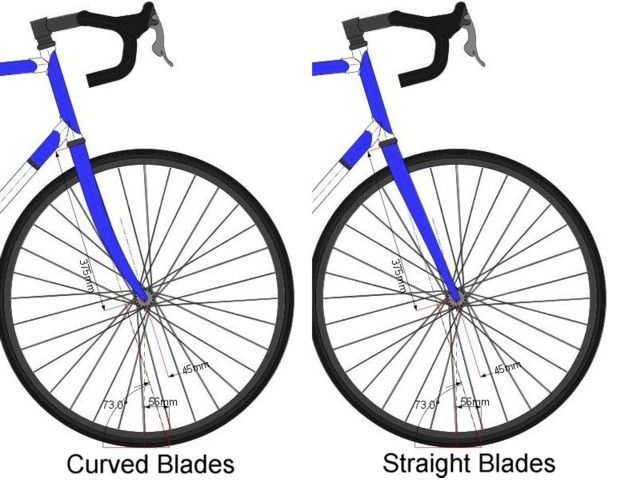
Trail/offset on a straight blade fork is achieved by connecting the steerer tube to the crown at an angle, just as @TejanoTrackie noted in post number 6.
The image below shows curved and straight blade forks with exactly the same offset.
The difference may be ride quaility and aesthetics.
-Tim-
The image below shows curved and straight blade forks with exactly the same offset.
The difference may be ride quaility and aesthetics.
-Tim-
10-16-16 | 11:28 AM
#19
Thread Starter
Senior Member
Joined: Oct 2016
Posts: 106
Likes: 2
From: Arizona
Let's see if we can move past this fork offset debate and into some more OP-based geometry questions. I had my wife help me with the Bike Fit Calculator, and I'm a bit more confused now. Some of the measurements they list aren't shown on any bike geometry charts - stem length, BB saddle position, etc... Are some of these measurements more specific fine tuning measures that I can take once I have the right sized frame, or am I missing something?
Has anyone gone with Competitive Cyclist's fit calculator recommendations and been satisfied? I'm looking at the Eddy or the French for a fixed gear commuter.
Has anyone gone with Competitive Cyclist's fit calculator recommendations and been satisfied? I'm looking at the Eddy or the French for a fixed gear commuter.
10-16-16 | 11:37 AM
#20

Senior Member
Joined: Dec 2014
Posts: 4,347
Likes: 22
Bikes: Felt TK2, Felt Z5
Steamroller and Wabi Classic are basically gold standards from what I see on here. The Wabi, IMHO, is gorgeous, and the Steamroller seems incredibly well suited to grass, gravel, and rough roads. Honestly, I'd rather buy something like the State, the Kilo, or a sub $500 bike first, give myself a few years to prove that I'm committed to this style of riding, and then get a brand new Wabi or Steamroller or whatever else looks good to me at that point in time.
Am I right to think that the Kilo TT Pro is pretty aggressive? Is the WT similar to the Steamroller "feel wise?" Also, can anybody speak to the Fuji Feather, specifically the quill stem?
Am I right to think that the Kilo TT Pro is pretty aggressive? Is the WT similar to the Steamroller "feel wise?" Also, can anybody speak to the Fuji Feather, specifically the quill stem?
10-16-16 | 11:41 AM
#21
Veteran Racer
Joined: Jul 2009
Posts: 11,866
Likes: 923
From: Ciudad de Vacas, Tejas
Bikes: 34 frames + 82 wheels
You need to see the big picture here. What really matters is the relative position of the three contact points of the bicycle with your body, namely pedals, saddle and handlebars at the point where you normally place your hands. This involves a combination of adjustments and component size selections. For example, if you compare two frames with different length top tubes, then you will need a longer stem on the frame with a shorter top tube to get the same amount of reach to the handlebar. The best way to figure this out is to go to a bikeshop and get fitted, then record the needed measurements. All of my road bikes have same overall setup, even though the frame sizes vary.
10-16-16 | 02:53 PM
#22
Calamari Marionette Ph.D
Joined: Dec 2013
Posts: 7,861
Likes: 41
From: Coeur d' Alene
Bikes: 3 Chinese Gas Pipe Nerdcycles and 2 Chicago Electroforged Boat Anchors
Steamroller and Wabi Classic are basically gold standards from what I see on here. The Wabi, IMHO, is gorgeous, and the Steamroller seems incredibly well suited to grass, gravel, and rough roads. Honestly, I'd rather buy something like the State, the Kilo, or a sub $500 bike first, give myself a few years to prove that I'm committed to this style of riding, and then get a brand new Wabi or Steamroller or whatever else looks good to me at that point in time.
Am I right to think that the Kilo TT Pro is pretty aggressive? Is the WT similar to the Steamroller "feel wise?" Also, can anybody speak to the Fuji Feather, specifically the quill stem?
Am I right to think that the Kilo TT Pro is pretty aggressive? Is the WT similar to the Steamroller "feel wise?" Also, can anybody speak to the Fuji Feather, specifically the quill stem?
Quill stems are readily available in many lengths, clamp sizes, and angles, so no issue there.
10-16-16 | 02:58 PM
#23
Calamari Marionette Ph.D
Joined: Dec 2013
Posts: 7,861
Likes: 41
From: Coeur d' Alene
Bikes: 3 Chinese Gas Pipe Nerdcycles and 2 Chicago Electroforged Boat Anchors
10-16-16 | 04:48 PM
#25
Thread Starter
Senior Member
Joined: Oct 2016
Posts: 106
Likes: 2
From: Arizona
If you guys don't mind, I would love some more bike suggestions. Probably no need to start another thread. I have decided to stay at $500, so I won't be doing a Wabi or Steamroller. My wife says if I am still riding SS/FG in a few years, I can get the Wabi.
State - Good price point, I've ridden it and like it, and it's local. But it gets mostly bad reviews from real cyclists.
Kilo TT (base, pro, or stripper) - Gets lots of love on BF, and has Reynolds 520. However, I've heard it's pretty "tracky," which gives me doubts.
Kilo WT - Same pros/cons as TT, but this one probably has my preferred geometry, and the large tire options are cool, though I'll probably stick to 28c on any bike I get.
Fuji Feather - I find this thing downright sexy, but the quill stem gives me doubts (am I being stupid?). I can try to find my color/size on sale, but if I don't, I think it runs closer to $600.
Thank you all!
State - Good price point, I've ridden it and like it, and it's local. But it gets mostly bad reviews from real cyclists.
Kilo TT (base, pro, or stripper) - Gets lots of love on BF, and has Reynolds 520. However, I've heard it's pretty "tracky," which gives me doubts.
Kilo WT - Same pros/cons as TT, but this one probably has my preferred geometry, and the large tire options are cool, though I'll probably stick to 28c on any bike I get.
Fuji Feather - I find this thing downright sexy, but the quill stem gives me doubts (am I being stupid?). I can try to find my color/size on sale, but if I don't, I think it runs closer to $600.
Thank you all!