As I'm often asked what the differences are between the P13 geometry change in 1971, I thought I'd post this simple visual tutorial.
First, two things:
- The "old" P13 geometry is identical to the P15's. Where do you think the P15 got it from?
- The "new" P13 geometry resulted in revisions to both fork AND frame geometries.
Secondly, for those of you who prefer bulleted lists, following is the entire run-down of what is different on the later P13 design:
- Fork blade bend changed (though rake remained the same at 2") and blades shortened for 700C wheels
- Rear triangle shortened for 700C's
- Dropout eyelets eliminated
- Brazed-on top tube cable stops deleted in favor of clips. Why? The earlier braze-on routing runs on the right side of the frame, resulting in an unsightly cable crossover - if the bike is retrofitted with Campagnolo brakes.
For the visually-oriented, let's start with the forks. In the foreground is a 1972 P13 with the new Italianesque bend; behind it is a 1970 with the English-bend blades. Despite the difference in appearance, both forks share the same 2" rake. The revision took place in 1971; however, some early "new" P13's came with the "English"-bend blades associated with the earlier P13.
Nevertheless, this difference is one of the quickest manners of spotting a new-geometry P13. Keep in mind that fork rakes did change again in 1977, but that's not part of this specific explanation:

The '72 has 700C wheels spec'ed from factory; the '70 has 27"s. The bridge spacing is greater on the '70 (note the 28C IRC tires vs. the 22C Gommitalias), which is carried over to the front as well. This is the reason the "old" geometry P13 needs a drop bolt in the back if someone so wishes to convert it to Campagnolo brakes - even with 27" rims, Nuovo Record calipers will not reach.
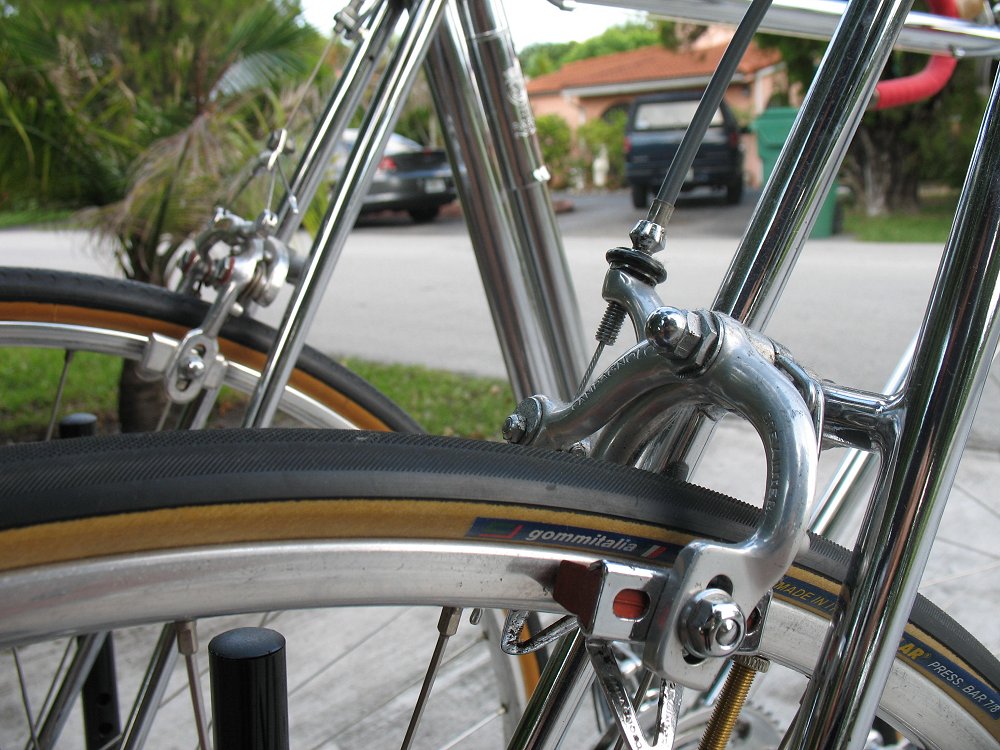
As you can see, this carries over to the fork crown clearance:
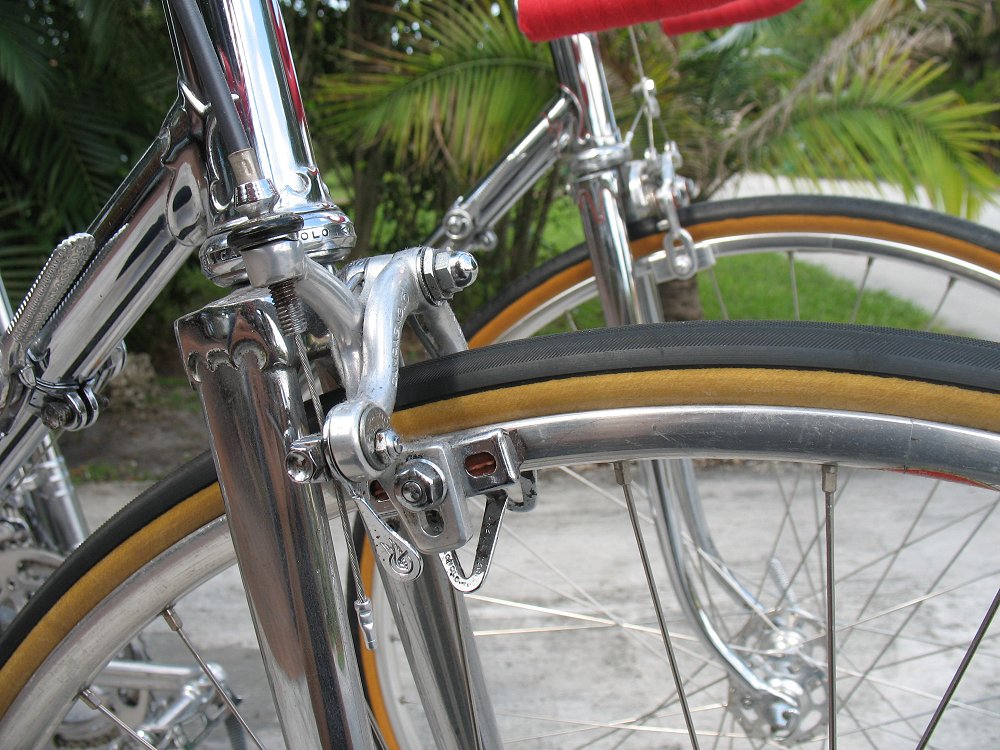
Someone looking to retrofit an old geometry P13 is well advised to know that Campagnolo Record calipers (or any standard reach, traditional Campag sidepull) will not reach a 700C rim mounted to the same bike. This is why some hack mechanics would drill a Paramount's front fork for a recessed brake, then install a rear drop bolt up front. This practice is
frowned upon - especially when a Campagnolo caliper will reach the 27" rim that one of these frames was intended for.
At any rate, below is a '70 that was modified in that fashion - drilled fork w/drop bolt and 700C's. Whoever did the conversion filed deeper slots in the brake calipers as well, severely weakening them.
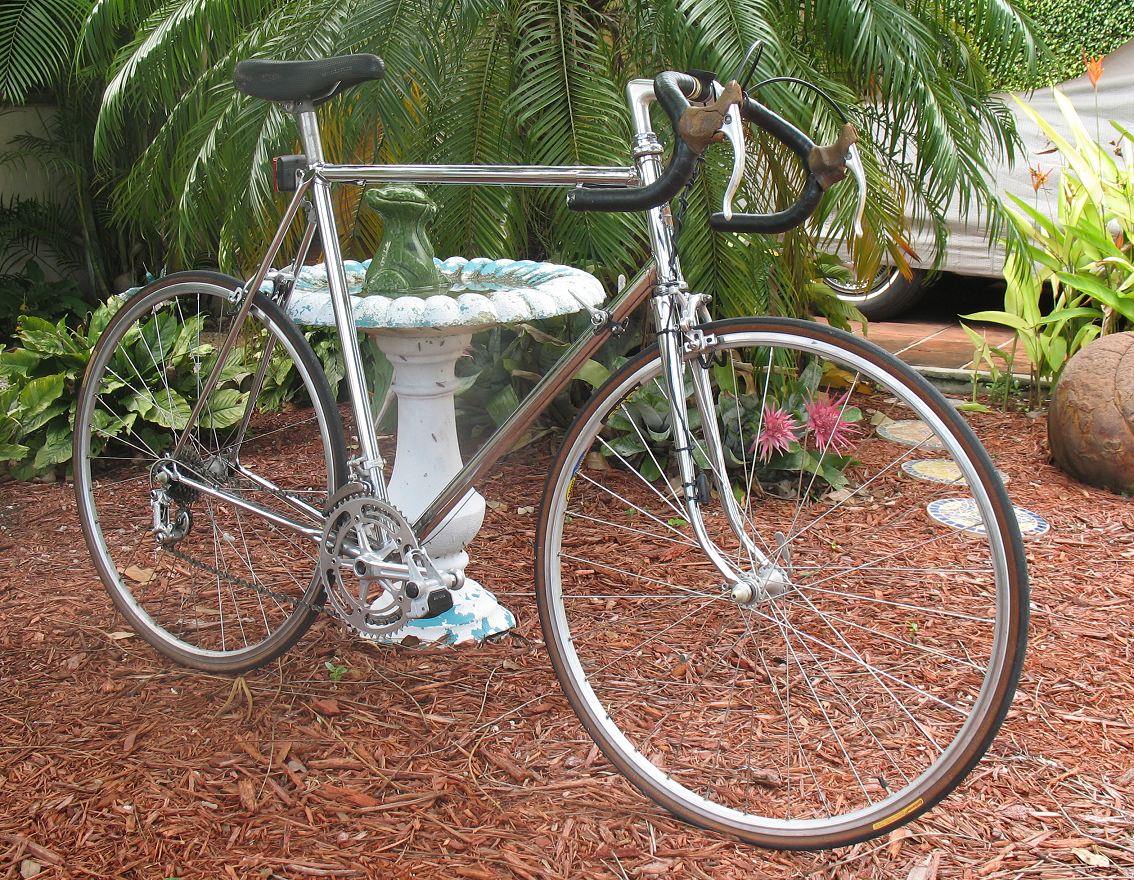
The '72 runs shorter chainstays as well, given the smaller 700C rims. Again, keep in mind that the '72 in the pictures wears 700C's, and the '70 has 27" wheels.
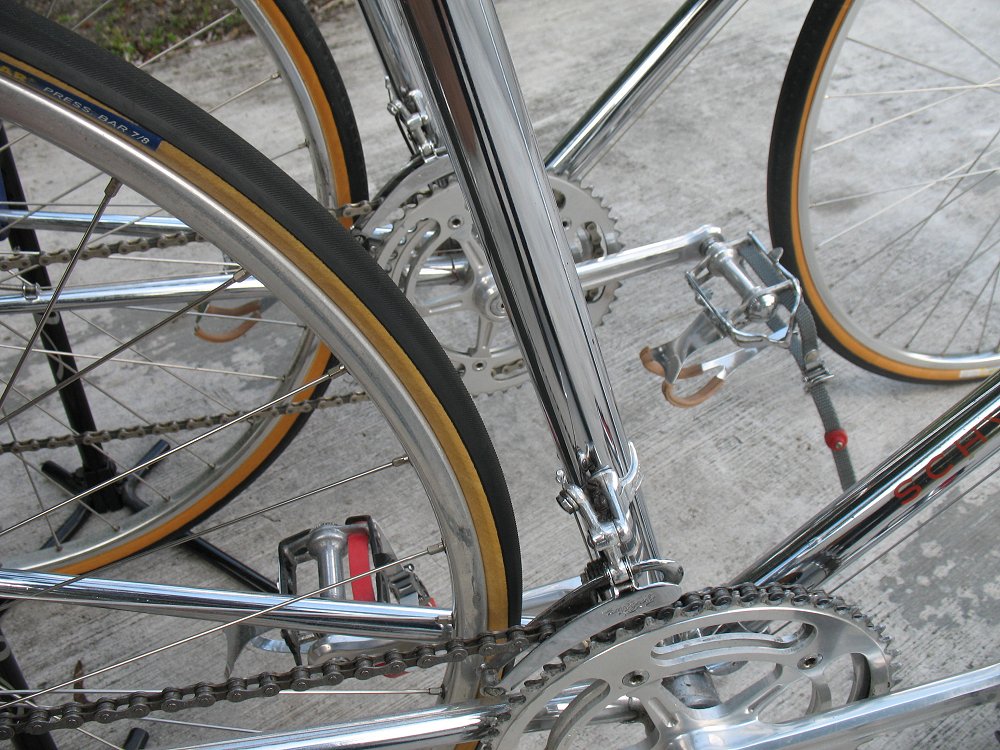
While the fork geometry is probably the only good feature so far for quick spotting, the top tube is a pretty good giveaway too: "Old"-geometry P13's (generally) run braze-on cable stops on the top tube, angled off to the right; the "new" geometry uses top tube cable clips, unless modified by a framebuilder.
The braze-on stops on the pre-'71 P13s also yield another strange visual cue when someone is insistent on running Campagnolo sidepulls - a rear Campag brake requires left-hand cable entrance; the right-justified cable stops don't accommodate this too well.
Of note, the 1981-83 Paramount-based Superiors, which run Nuovo Gran Sport brakes out of the box, use cable stops that are offset to the left, for this very reason.

-Kurt