Here is how to measure Proper Chain Length. The information comes from Sheldon Brown's web page on derailleur adjustment. Scroll down to find Chain Length.
http://www.sheldonbrown.com/derailer-adjustment.html
Chain Length
If you replace your chain or sprockets, you should check your chain length. New chains come longer than they need to be for the vast majority of bicycles. You will almost certainly need to shorten a new chain before installing it on your bicycle. If your large sprocket sizes are anywhere near the maximum your rear derailer can handle, the chain length can be quite critical.
If the chain is too short, it will be at risk for jamming and possibly ruining the rear derailer if you accidentally shift into the large-large combination. Never run with a chain that is too short, except in an emergency.
If the chain is too long, it will hang slack in the small-small combinations. You should never use those combinations anyway, so this is not a serious problem. If you exceed the recommended gear range for a particular rear derailer, you may have to accept droop in these gears.
The best technique for setting chain length is to thread the chain onto the large/large combination, without running it through the rear derailer. Mesh the two ends on to the large chainwheel so that one complete link (one inch, -- one inner and one outer half-link) overlaps. In almost all cases, this will give the optimum length.
Inner and Outer half-links must alternate:
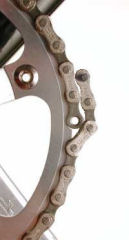
Full-link overlap, correct
with chain on the large chain-
wheel and sprocket but not yet
run through the rear derailer.

Overlaps by a
half link.
Already too short
unless it could overlap
by a
full link as at left.

Will connect, but
too short except on
a bicycle with a
non-derailer drivetrain. Start with the shortest chain that would permit connection, allowing one extra complete link as shown in the photo at the left above, so the bottom of the chain droops if you align it as in the picture at the right. Then thread the chain through the rear derailer and connect it. Turning the crank by hand, check that the chain will shift to the large-large combination using the front derailer or rear derailer, or both at once, without binding.
Work by shortening the chain, rather than lengthening it. Making the chain too short, then lengthening it is a time-waster. The narrowest chains, used with cassettes that have 10 sprockets -- sometimes 9 -- must be joined using special one-time-use replacement pins or master links. You probably only get one of these with a new chain, so it is important to get the length right on the first try.