I'm just returning from an out-of-state trip helping my brother to move, but I had taken a photo of the bending tool in action.
It's basicly a pair of steel strips (1/4" flat stock) tied together with a 10mm bolt acting as a pivot.
Also on the same 10mm pivot bolt there is a stack of 1-1/2" fender-washers acting as a mandrel for the rods to be bent around (see photo).
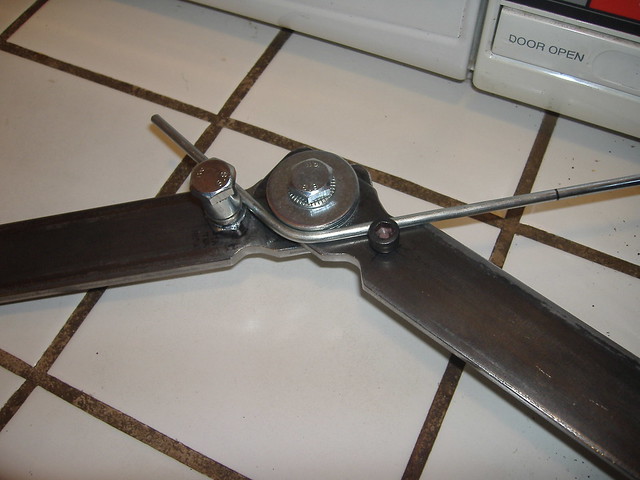
The two other bolts (one on each leg of the tool) act as pegs, holding and bending the wire around the mandrel.
One peg (the smaller one, a 5/16" socketed bolt) holds the rod stationary...
...while the other peg (another 10mm bolt, and with a roller on it) moves around the mandrel, wrapping the rod around it.
The 5/16" bolt head can be adjusted to a height that suits the rod diameter, thus acting to wedge against the rod. Thus adjusted, it actually digs in a bit and prevents the rod from being dragged around the mandrel (which would allow the bend location to sort of wander randomly).
As built, the tool produced a perfect hook the very first time I used it. It takes less than 30 seconds to do the two bends once the two marks have been Sharpied onto the rod.
The tool also made hooks from 1/4" rod, but I found that I had to tweak the Sharpie-mark location slightly for the thicker rod.
The thinner 3/16" rods made hooks that easily handled a 40-lb bike though, so I don't really need to make any out of the 1/4" rod now.
I did calculations for the long pipe and found that it would sag 2.85" for a centered (i.e. worst case) load of 200Lb.
Fourteen heavy bikes weigh far more than that though, so I loaded it up and then additionally hung my body's 155lb from the center. It didn't yield though, only sagged more then sprung back fully when I let go!
I'll soon add another photo of the now-fully-loaded rack.
Note that steel won't yield over long periods of time, unlike plastics, wood or even normal aluminum. A car can sit for 100 years and it's springs won't sag. Only very large numbers of stress cycles (millions) and/or "overload beyond the yield stress" and/or intense heating will cause steel to yield, so normally it always springs back completely, like a spring, when the load is removed!
Anyway, I'm pleased with the outcome, having built several of these racks now for a total material cost of less than $50 each, including hooks (and after adding 4 inches of vinyl tubing to cover each hook).
Any of the material dimensions could be changed (increased) to improve durability under more extreme loadings, and to improve the ruggedness aesthetic, but the test-loading did include an assortment of rather overweight bikes, most in the 30-plus pound range.
A central support, as suggested by RosyRambler (either another A-frame, or suspended from rafters), would perhaps be a great idea to preserve storage space height under the suspended bikes.
Comments and suggestions most welcome.
<a href="
http://www.flickr.com/photos/18079002@N04/6768737983/" title="HOOK-BENDING TOOL by dddd2002, on Flickr"><img src="
http://farm8.staticflickr.com/7026/6...481e106462.jpg" width="500" height="375" alt="HOOK-BENDING TOOL"></a>