Step Three: Sourcing the drivetrain
Gates holds the patent rights to the belt drive system, and are all-around great people to work with. They're very enthusiastic to help you find the right parts and give you the right advice for your build.
I used their iPhone app to calculate a couple of different sprocket, cog, and belt options to hit my target gain ratio and beltline. I settled on a 20 tooth cog for the hub, a 55 tooth sprocket for the crank, and a 113 tooth belt.
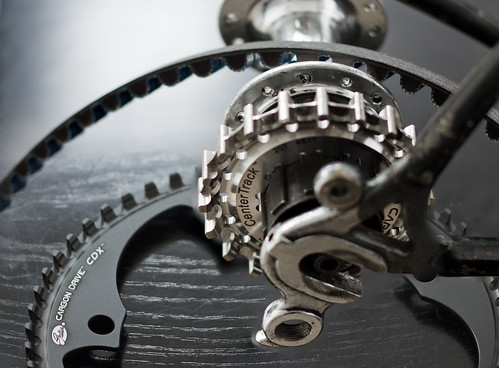
I decided to go with the newest Gates Carbon Drive technology, called CenterTrack. These belts feature a groove down the center, which helps to keep the belt on the ring when the beltline is less-than-perfectly-straight. Since there's no more retaining wall on the side of the rings, dirt and mud are ejected from both sides of the ring. Not that I plan on riding my single-speed road bike in the mud.
Most Gates cogs fit Shimano Hyperglide (9 spline) cassette freehubs. I would have loved to find a single-speed (short) freehub that met my design criteria for less than $1M, but one did not present itself after hours of internet research. I decided to go with a regular freehub, with the intent to use spacers to fill in the wasted space on the cassette.
Here's a photo of the loot, raring to go (click to enlarge).
Next up, finding a single-speed crank, cog spacers, then tweaking the beltline.