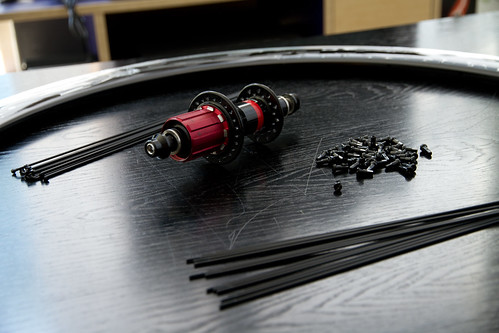
This is how it all begins: a Newsonsportec
40mm Deep V rim, a Novatec
F482SBSL rear cassette hub (Shimano, 9-spline Hyperglide), some
brass spoke nipples, and a pile of spokes cut to precise lengths according to calculations made with
EDD, the online spoke calculator.
 (Click to enlarge)
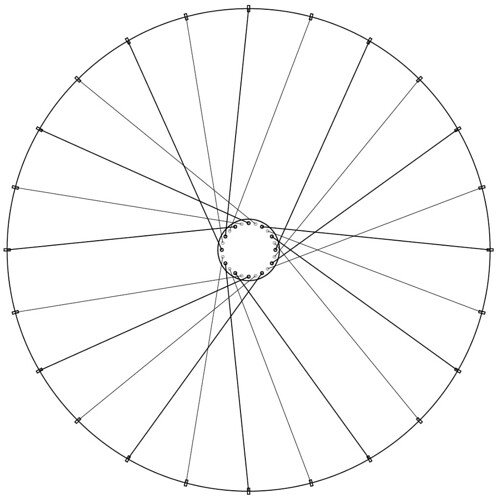
I prepared a scale illustration of the spoke pattern before doing the build. Laying it out this way allowed me to try various combinations of hub diameter, spoke count, and interlacing techniques. It also let me visualize the angles at which the spokes would leave the hub, to ascertain whether a given pattern was buildable or not.
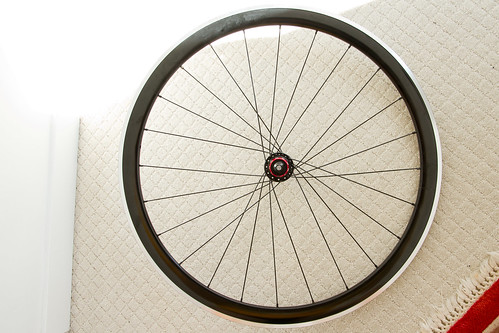
The one that I settled upon was a 24-hole, two-leading two-trailing (2L2T) pattern. On a 24 hole rim (and only on a 24 hole rim) this pattern produces a three-leaved trillium shape.
Word to Ontario. The pattern also produces really pronounced parallel lanes between the leaves. I nestled the valve in one of these lanes for easy access when pumping the tires.
 (Click to enlarge)
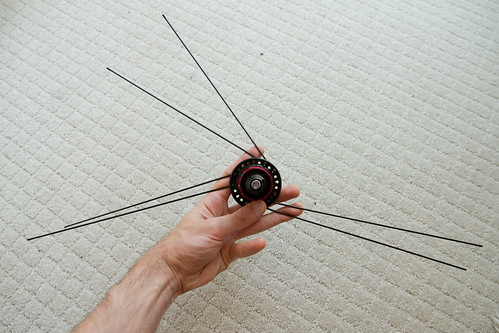
The first step is to thread the drive-side, trailing spokes (the ones that shoot off in the direction opposite from that in which the wheel turns). Here they are, ready to go according to
the pattern. There exists
some debate about whether the trailing spokes should run along the inside of the hub or the outside of the hub. I ran them on the inside.
 (Click to enlarge)
Simply thread the spokes through the correct holes according to
the plan, and screw the spoke nipples on enough turns that they won't fall off of their own accord.
Flip the wheel over, and install the trailing spokes of the non-drive side according to
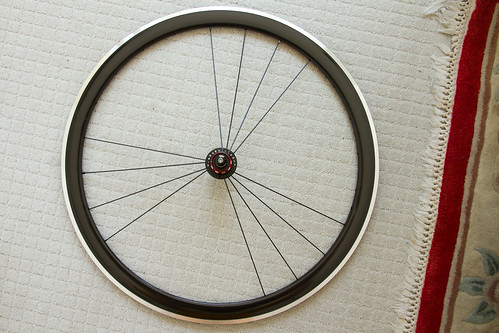
the plan. Here are all of the trailing spokes installed, as viewed from the drive-side.
 (Click to enlarge)
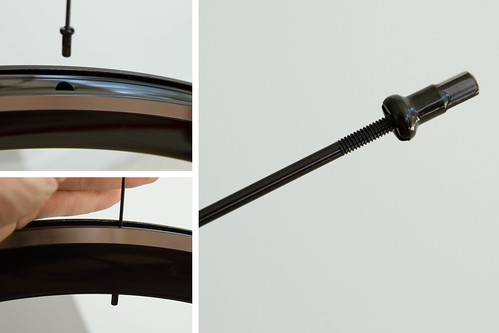
After having installed two sets of trailing spokes, the difficulty level of the wheelbuild increases; you no longer have as much room to move. Because I'm installing spokes on a deep-V rim, this means that I could no longer thread spokes all the way through the rim to the other side, to be able to screw spoke nipples on their ends.
Hence, you need a way to seat the spoke nipples first, then bring the spokes up to them. My technique involved screwing a spoke nipple onto a spare spoke, lightly and backwards, using that spare spoke to drop it into the hole, then unscrewing the spare spoke and lifting it out, leaving the nipple in place.
Whatever you do, you'll likely end up dropping a nipple or two
inside the rim, and having to shake it out.
 (Click to enlarge)
At the point at which you install the leading spokes, you begin to have to cross the spokes in a very calculated way. The established wisdom is that you stay on the outside of the wheel for each of the spokes you cross on the way to the target hole, except for the last crossed spoke, which you cross underneath. I decided to ignore this wisdom and to do something different. If you're really interested, you will have to
zoom way in to this photograph to be able to see what's going on.
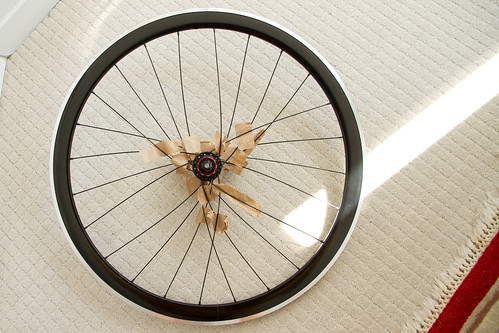
You have to bend the spokes a tremendous amount to be able to do the interleaving, and things start to get really tight. The pieces of paper are there to prevent the spoke paint from scratching off as spokes begin to rub together. I should have used plastic or foam strips instead, because the spokes tore through the paper pretty easily.
And we're done installing spokes! Time to bring them up to tension.
 (Click to enlarge)
What you want is for a spoke to be very easy to manipulate as you bring it up to tension, then very difficult to adjust when you're finished. For this reason, wheelbuilders use lubricants that dry out over time. I used plain old linseed oil.
I used a syringe to administer the oil. With deep-V rims, this technique is pretty useless; you can't see what's going on in that dark hole, so you can't aim the syringe. For the second wheel, I simply dipped the spoke threads in oil before installing them. It was messier, but it meant the spokes were easier to work with.
 (Click to enlarge)
Here's how to proceed.
- Tighten each spoke nipple with ascrewdriver (slotted through the hole on the outside of the rim) until there are only a few threads showing. I tightened them until there were two threads showing, which ended up being too few; the wheel started to get tight prematurely. Go with three or four.
- Go around the wheel again, this time tightening the spokes with a spoke wrench. Use one full turn on each to start, then fewer turns on each subsequent pass.
- Repeat #2 until the spokes sing a prescribed note when you pluck them. Look up the note for your particular spoke length on this table. My spokes needed to ring between A440 and G#. If you're amusical, then perhaps you should consider cultivating some musical skill; it leads to a richer life, and properly tensioned wheels.
- Detension the spokes, and repeat from #2 as many times as you like.
 (Click to enlarge)
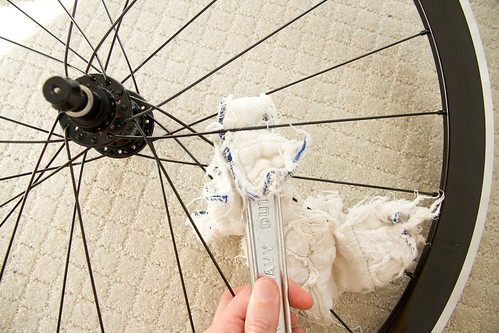
If you've studied materials engineering, you'll be able to cite all kinds of properties of stainless steel, using words like "yield," "cold-formed," "memory," and "plastic deformation," to explain why you need to stress-relieve the spokes in a new wheelbuild. Whether you have or you haven't, grab a cloth and a monkey wrench, and get to work.
Find all of the places where your spokes cross. The idea is to use a wrench as a lever to twist them around each other
even more tightly. This may feel wrong. Just do it. The materials engineers say so.
The cloth is just there so you don't scratch the paint off the spokes.
 (Click to enlarge)
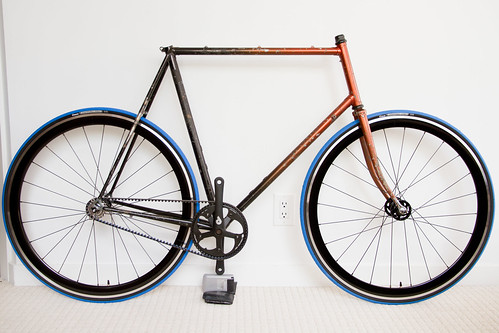
Huzzah! Now that the wheels are done, it's time to tire them up with Presta valve Kenda inner tubes, Vittora
Zaffiro Pro tires, and Reynolds rim tape.
Unless your hands are bionic, or you're
this guy, you will need a tire iron for the last little bit. Just be aware that your chance of puncturing the inner tube with a tire iron is approximately 100%, unless you keep the inner tube slightly inflated and try your very hardest to avoid pinching it.
Also, pro wheelbuilders pay attention to little details, like making sure that any prominent markings on the tire sit between the same spokes on each wheel. I chose to situate the brand name of the tire directly opposite the valve stem.
Repeat for the front wheel, and that's it!
Next step, truing the wheels – making them spin straight and round.
 (Click to enlarge)