Originally Posted by
proileri
Actually, I do know what he's talking about. This is the so-called observation angle, or how wide the light scatters from the reflector.
Bicycle reflectors are designed to reflect any incoming light back in a cone of about 3 degrees from parallel to the incoming light. If they wouldn't function at a slightly wider angle, they would be very difficult to spot - unless you are shooting laser beams from your eyes!

At about 100 ft a 3 degree angle reaches 6' from parallel, enough to be visible to the driver. This means that even a single facet reflector is visible at 100 ft out, or further, even with one headlight out. If the reflector has more than one facet, another facet will be in better reflective angle (at some point) when the car gets closer than 100 ft.
See the link in my signature for more detailed analysis

I think you're describing CPSC wide-angle bicycle reflectors. You're not quite grasping their design, though. Cube-corner reflectors reflect towards the light source. A CPSC wide-angle reflector does exactly that, but it has two of its three sections with the cube-corner reflectors angled to the left and right. Since the plastic cube-corner reflectors aren't metallized on their reflecting surfaces, but instead rely on the difference in refractive index between plastic and air, only 1/3 of the surface will reflect brightly from the rear.
As an example:

The reflector in the lower center that's performing well here is DOT Class II conspicuity tape, which
does have metallized reflective surfaces on its micro-cubecorner reflectors and will reflect from wild input angles. The others are plastic, and suffer the effects of Total Internal Reflectance, which you can read about at a real reflector expert's site:
http://www.bikexprt.com/bicycle/reflectors/index.htm But in all cases, "dim-out" will be a problem at closer ranges when the light source is a significant distance from the viewer, such as a driver whose driver-side headlight is burned out. Mr. Allen also points out the case of a semi driver, who sits much higher than his headlights.
A light, meanwhile, has none of those problems. Hmmm. And they can flash to attract attention early, not just fade into view. HMMMM. And they don't rely on the other guy to have his/her lights on, in order to work.
HMMMM!
Another illustration about the problem of TIR with plastic reflectors:
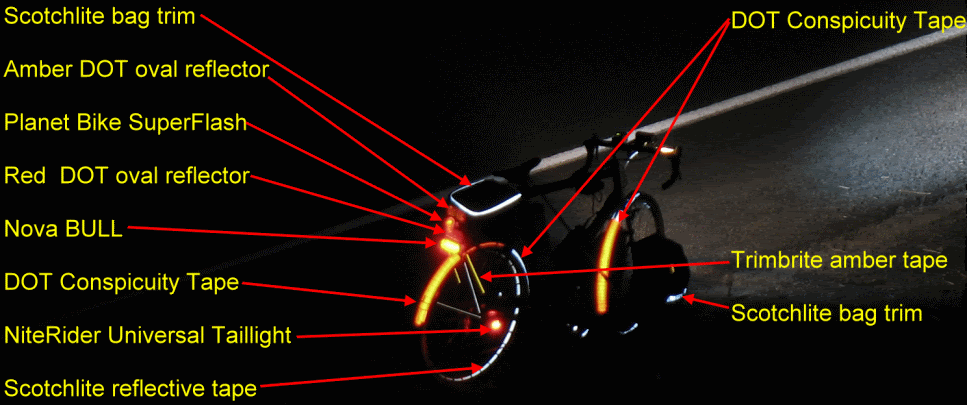
The DOT-spec reflectors aren't doing squat here, are they? They're beyond the limits of TIR. Useless pieces of plastic, from this angle. The glass-bead high-intensity reflective tape works. The microprismatic tape works. The lights REALLY work
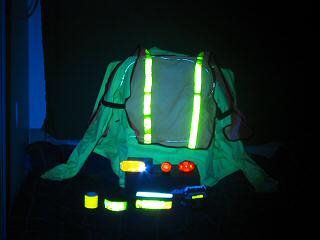
And a third comparison for good measure... in this photo, the stuff's about 25 feet away from the camera, and being illuminated quite strongly by a 400-lumen light that's about 6 feet to the right of the camera, something like a passenger-side headlight on a car. The reflective stuff is reflecting back to the light source. The camera's seeing almost none of that. The actively-lighted items HMMM are still working.
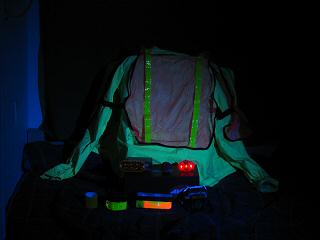
If the light were lined up with the camera, it would look like the shot below:
For those who want a minimalist setup, you can find some lights that have legit reflectors integrated. Of the ones I'm aware of, the Planet Bike BRT-5 is a good all-around pick, better than the similar Cateye LD500, and surprisingly better than the recent Cateye LD560/570 as well (in terms of both reflectivity and light output). But a Cygolite Hotshot and a piece of microprismatic reflective tape will outperform it on both fronts.
Mind telling us which model of Nova Bull you have, MechBgon?
This one here:
http://www.strobe.com/component/opti...facturer_id,0/ (not in blue, obviously!) If you want one to play around with, I would've given you mine, but I'm afraid I finally tossed it when I was on a "stuff-reduction" rampage
