Originally Posted by
mechBgon
The reflector in the lower center that's performing well here is DOT Class II conspicuity tape, which
does have metallized reflective surfaces on its micro-cubecorner reflectors and will reflect from wild input angles. The others are plastic, and suffer the effects of Total Internal Reflectance, which you can read about at a real reflector expert's site:
http://www.bikexprt.com/bicycle/reflectors/index.htm But in all cases, "dim-out" will be a problem at closer ranges when the light source is a significant distance from the viewer, such as a driver whose driver-side headlight is burned out. Mr. Allen also points out the case of a semi driver, who sits much higher than his headlights.
Thanks for the post, those are some good pics for analyzing reflector performance

You make good points, but let me approach this while considering the most usual situations and distances involved on the road:

This pic is a few feet away, from about 35 angle, which is about the max angle for a 2-facet CPSC reflector. However, as you can see, the reflectors still function at this difficult angle. On the road would mean that the car is just about zooming past you, and the reflectors are still well visible. 2-facet CPSC reflectors (I have one in my hand ATM, it's a E(3)-approved one for road vehicles) are designed with partially overlapping fields of reflection: both facets are visible to about 25 degrees from parallel, and one facet is still visible to about 35 degrees.
The second thing you can see in this pic is the wide angle of a film (= soft) reflector. It has only one facet, yet it's visible to about 35 degrees. I have measured a film reflector ("bubble wrap tape") to be visible to about 45 degree angle from parallel. However, the trade-off here is the brightness - it's the same thing as with headlights: wider angle means lower brightness. You can see that the film reflector is not as bright as the CPSCs.
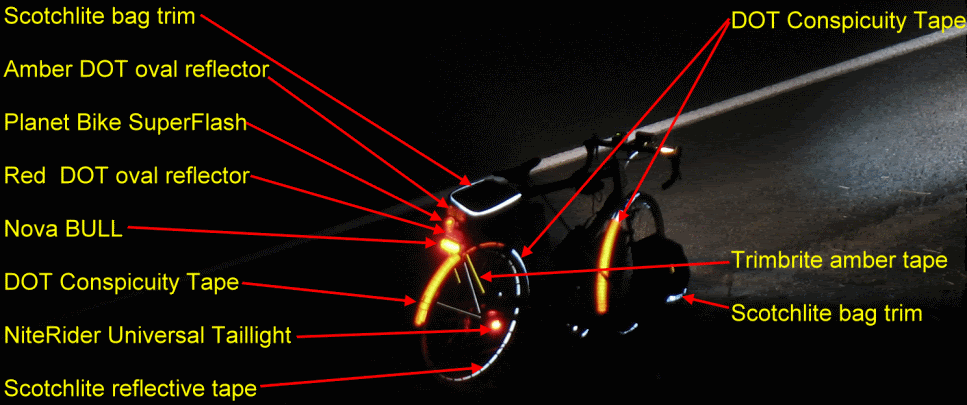
The second pic gives us a nice real life viewing angle - if you're a 747 pilot looking down at someone cycling on the runway

As you can see, we are probably starting to be a bit outside 35 angle, so the CPSC reflectors have or are starting to drop off. It's nice to see the performance of the film reflectors, though. As you can see, the DOT Conspicuity Tape is pretty much the most visible thing in the pic, even from a strange angle - although the tail lights are somewhat directional, and their performance suffers a bit too from such an angle, I think. Even the humble thin Scotchlite tape and trim does quite well from such close range.
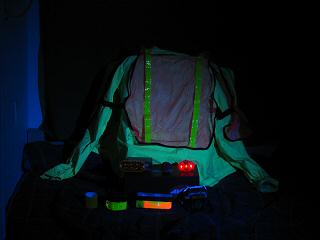
With this pic, unfortunately, 25 ft is not a good distance for estimating reflector performance. It's a fraction of a second away on the road, which makes it meaningless. Could you make the same pic from at least 50-100 ft away?
Which reflectors are those in the pic, by the way? I'm thinking the red one is a LED light, and on the same height are two hard reflectors. What I'm surprised is that the curved film reflectors are not that well visibl - could this be because of the strong 400 lumen reflection off the jacket that makes them just appear non-reflective in the pic?
In my tests, I've established that hard reflectors have their primary reflection at 2.5 degrees from parallel, and film ones have their primary reflection at about 3.8 degrees and secondary weak reflection to about 4.75 degrees. Assuming 6' distance (semi truck driver height, or blown driver side head light in a passenger car), the drop-off distance is 70 ft for film reflectors and 140 ft for a hard reflector.
This is of course assuming the reflector is right in front of the passenger side headlight - if the cyclist is on the shoulder, the angle becomes smaller, as does the drop-off distance. No difference with the semi truck light height, though.
Originally Posted by
dougmc
OK, I believe that you know what he's talking about. However, his concerns about the observation angle are valid, and the number of facets really don't play into it -- it wasn't really the right thing to bring up at that point.
Ah yes, sorry, my mistake! You are correct that extra facets don't increase the observation angle, they only do increase the entrance angle.
What I ment to say was that after 50 ft or so, it doesn't matter if one headlight is out, and that at 50 ft you're visible anyways. What I ment about facets was that in addition to widening the long range arc, they give a bit of extra visibility when the car starts to pass you, as one of the facets reflects the scattered light from a headlight. Better option, however, is to use a second, film-type reflector, that's visible to wider angle.