BigChainring made a good point about how so few of the entry-level bikes that wore Prestige mech's were likely set up properly.
Since the flexible nature of the Prestige shifters transduces
any added cable friction into unwanted lever flex and hysteresis (lack of motion accuracy of derailer travel), the cables firstly must be operating smoothly. In this light, the Prestige derailers can work better than they ever did back in the day just by using modern cable housing!
I have yet to meet a vintage bike mechanic who copped to ever having adjusted a rear Prestige's A or B-pivot tension setting (which is so critical to shifting response).
The adjustment is per the post~2001 Campag method of tightening the A-pivot spring for use with smaller freewheels, but on the Prestige models there is a hex locknut (against the cage plate) to be loosened before turning the pivot shaft with a 5mm Allen key (which tensions the spring and requires the removal of one of the upscale Competition's red plastic plugs).
The limit screw bosses on the rear Prestige tend to crack, but go on working just fine that way, just as a split Campag pulley usually go the distance until worn out. I use a LOT less lever force after fitting the modern cable housing, and so can't imagine breaking these bosses or the levers for that matter with the lever moving so much more easily.
I find no improvement whatsoever to the durability of the Competition model of
either the front or rear Prestige mech. The Competition rear mech's pullies are more susceptible to crumbling away from their ball-bearing hubs (the basic Prestige has no metal hub for the teeth to be molded onto).
The Competition rear mech has thicker cage plates, but these are amply sturdy on the basic Prestige, and the basic Prestige also has the very same metal reinforcements added to the para-links.
The front plastic Simplex mech's do crack from the clamping forces, but usually from overtightening and seemingly in a gradual fashion. It makes sense to install one onto a cleaned seat tube free of wax to avoid having to clamp it so tightly, or best onto a freshly-painted surface for extra adhesion(?). This is an unfortunate failure of engineering imo, but I've also seen a couple of the cheaper, all-metal Simplex mech's crack at the end of
their clamp plates.
I've been riding my recent Steyr Clubman hundreds of miles lately with it's original, basic Prestige mech's, and they now work very well over 52-36t chainrings and a 13-24t five speed freewheel.
The front mech offers somewhat sluggish downshifting immediately after being pelted with wet, sandy road dirt, but becomes normal again shortly thereafter. A sealed ferrule atop the aft end of the front mech's cable housing greatly prevents this from acting worse.
Front shifting leaves nothing else to complain about, even as most of the miles have been ridden over hilly terrain amongst a competitive group of riders and racers. These are intense, 2-hour rides over ever-rolling terrain, which doubly emphasizes shifting performance.
The rear shifting benefits from the use of a 9-speed modern chain and from the previously-mentioned adjustment (tightening) of the A-pivot spring tension (to suit the now-smaller 24t Uniglide freewheel). The shifting would be better imo with a retrofriction shifter or other metal friction shifter with a more positive or "crisp" friction mechanism. These plastic levers have that vague feel that offers no immediate tactile feedback, that "creak" that tells you that lever motion has commenced, but this is not the fault of lever flex imo. The Prestige shifters suck even more for their tendency to snag a long-fingered glove's fingertip on the stop plate.
Overall, these derailers handle my hill-country gearing with ease (and did so even when I was still using a 28t in back, albeit with less shifting precision over the smaller cogs resulting from the larger pulley-to-cog gap).
Oh, and the Ofmega derailers were made by Simplex btw, perhaps all of them.
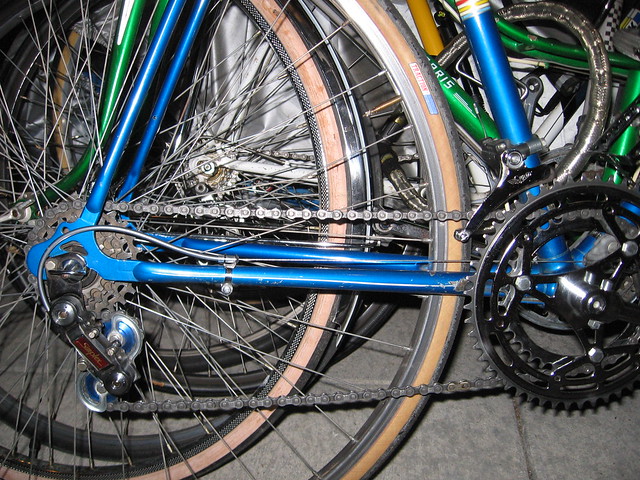
Photo from today, note that the pullies are modern, thinner ball-bearing replacements which btw pull the cage plates closer together around the 9-speed SRAM chain. There's 3 French bikes behind it, ORLY (Motebecane), LOOK (steel, btw) and PEUGEOT ('79 PX10E), and the Orly's still riding on ~40-yr-old Wolber tires.