Yay, I seem to have found a public copy of the Korff paper. Have at it.
 http://img2.tapuz.co.il/forums/1_168859045.pdf
At the risk of oversimplifying, the key diagram is this one, drumroll please....
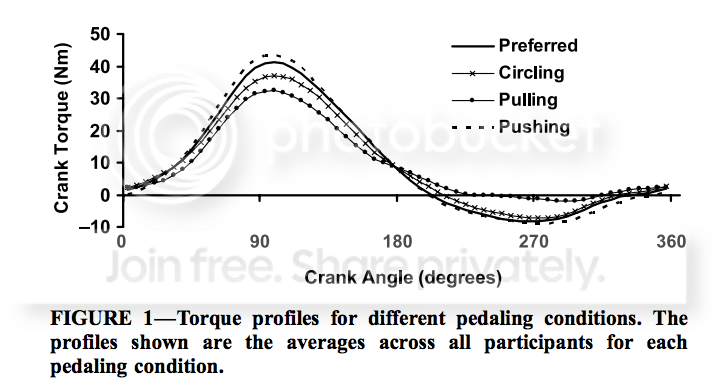
This was (as noted) a steady-state effort at 200W.
What you will hopefully notice is:
• You don't supply constant torque during a pedal stroke.
• Intentionally pulling on the upstroke reduces the power output on the downstroke.
• Even when pulling up hard on the upstroke, the rider
still barely produces positive torque on the upstroke.
• The general shape of the graph ought to look familiar by now.

The power advantage is that
intentionally pulling on the upstroke lifts the leg more successfully. Thus, the other leg doesn't waste as much power on the downstroke, because it doesn't have to do as much work lifting the leg.
This, I suspect, is the type of evidence that leads Pruitt to say "no one supplies power on the upstroke, including top track sprinters @ 130rpm."