Originally Posted by
Velognome
I often wondered about that and have noticed: English Road/Path frames having round fork blades....ok for the Path/Track use part of the equation.
BUT
Hetchins' used round fork blades on almost all of their road bikes until the late 60's. I've noticed the same on other English makes as well.
As far as the "aero" aspect....what track bikes need to be less aero dynamic than a road bike?
All this leads me to believe it is more stylistic and evolutionary in regards to exploring the best use of material.
Jan Heine published a pretty neat article,
Fork Blades Optimized for Comfort and Speed several years ago in
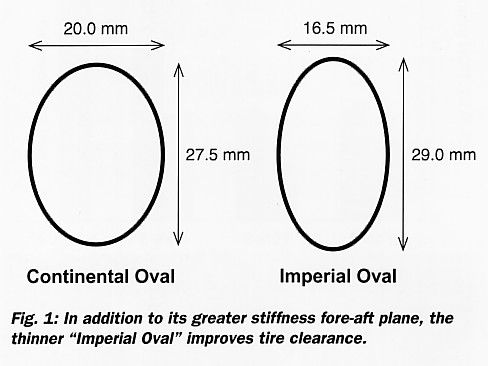
Bicycle Quarterly, and noted that the Imperial Oval blades (16.5mm x 29.0mm) while lacking lateral stiffness for hard cornering, offers more longitudinal stiffness and clearance for bigger tires than the Continental Oval (20.0mm x 27.5mm). The optimization of fork blade cross sections for different applications has evolved from experience over many decades. I do think it's rather odd that round cross section blades would be widely used on road forks since the longitudinal stiffness of an oval cross section is so superior in dealing with potholes and other irregular surface anomalies encountered on the road.