Originally Posted by
Scooper
Jan Heine published a pretty neat article,
Fork Blades Optimized for Comfort and Speed several years ago in
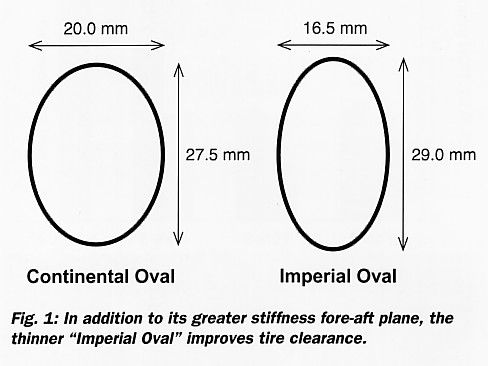
Bicycle Quarterly, and noted that the Imperial Oval blades (16.5mm x 29.0mm) while lacking lateral stiffness for hard cornering, offers more longitudinal stiffness and clearance for bigger tires than the Continental Oval (20.0mm x 27.5mm). The optimization of fork blade cross sections for different applications has evolved from experience over many decades. I do think it's rather odd that round cross section blades would be widely used on road forks since the longitudinal stiffness of an oval cross section is so superior in dealing with potholes and other irregular surface anomalies encountered on the road.
Owning a number of bikes with Reynolds Imperial oval and "Continental" oval (like Columbus and some Vitus) I really find it difficult to feel any difference. I have never seen any test data to back it up. In the 70's we liked Columbus blades as they just looked "More Beefy"
Track blades in round section were in 22.2 and 24 mm. Columbus making the two variations before Reynolds was widely known to do. The smaller was mated to the SL tube set, the 24 MM to the PS heavy ga. track tube set. I had both of those, the thinner for a Pursuit bike, (suitable for omnium racing too) and the bigger for a true Sprint bike. I still have that one, and its 19lbs with light wheels, steel Campagnolo pedals and steel Cinelli bar and stem, 55 cm size. A true example of "track Iron"
A club member ordered a pair of Hetchins in 1974 and he got his preferred set up, 22.2 round blades for both road and track bikes. The idea that the round blade cannot take the stress of braking is just bikeshop mechanic BSing. A local shop (John's Pasadena) custom ordered plenty of Schwinn Paramounts in the 60's and early 70's with round fork blades.
Oval blades are better aero slightly. Colnago for a time sent track bikes out with road section blades.
In short, I put it down to styling and convention.