Originally Posted by
Grand Bois
I always thought that the idea behind the steep head tubes was to make the bike more maneuverable and thus more suitable for criterium racing. I''m having trouble understanding how it can help you "attack that hill".
It may be hard to understand and agree with all of this, so feel free to ask questions. Some of these concepts are not so intuitive, and are left out of most discussions concerning frame geometry. I've been experimenting with all of the below for some years now, and some of the discussed effects are relatively subtle and minor.
Strictly in terms of criterium racing, which is a very high-intensity and thus necessarily-short race with emphasis on attacks, sprints, and with the rider being constantly positioned for aerodynamics and the sudden delivery of acceleration, the advantages with respect to climbing are surprisingly much the same.
While climbing steeper sections off of the saddle, both the head- and seat-tube angles are preferably steep, not so much for maneuverability but for keeping the bike steering mostly straight, in an effortless way as the rider leans the bike to-and-fro in response to heavy pedaling. The steeper head tube angle tracks/corrects these leaning motions with less arm effort, so the more-instant centering reduces front tire scrub.
The effect of shorter chainstays is similarly related, in that the shorter lever arm distance from the rear axle to the bb puts less lateral pedaling loads into the bike's front end, directly reducing front-end push, reducing steering effort and tire scrub. Short stays are thus indeed great for climbing.
The steeper head and seat tube angles both allow a more-forward rider position, which makes the transition to standing (while also leaning forward) much less of an effort, thus allowing more-frequent transitions as needed, with less wasted energy and lost momentum.
And, at the highest pedaling force levels, the more forward-positioned rider will have to exert less, if any, pulling force on the bars.
A steeper head tube angle also allows neutral steering
with longer stem lengths, which can both calm a twitchy bike's steering at speed and allow a more-forward rider position, primarily when the rider is out of the saddle.
A steeper head tube angle also allows for closer drafting, by shortening the wheelbase, pulling the front axle back relative to the handlebars and thus also relative to the rider.
A steeper seat tube angle of course moves the seatpost forward, but also moves the head tube forward for any given top tube length.
So there is great advantage to allowing the rider to lean forward more either when racing in a criterium or when attacking a steep hill.
The same doesn't so much apply to riding centuries, so as with my Merckx Century model, just the seat tube angle has been relaxed, pulling the seat tube and head tube rearward relative to the bb. After all, a rider's arms would tire if they had to put in 100 miles and perhaps six hours in such a forward position, but for the short effort of a criterium or for climbing steep switchbacks, the steeper frame actually reduces the rider's fatigue, even in their arms!
These ultra-steep PX10's seem to have been modeled after true "team" geometry, which of course favors the fittest riders who can produce the sustained pedaling torque to
directly offset any tendency for too much of the rider's weight to fall on their arms.
That these bikes can also assist the amateur rider in certain specific situations of more-intense pedaling effort makes them a potentially amusing ride for more-spirited club events.
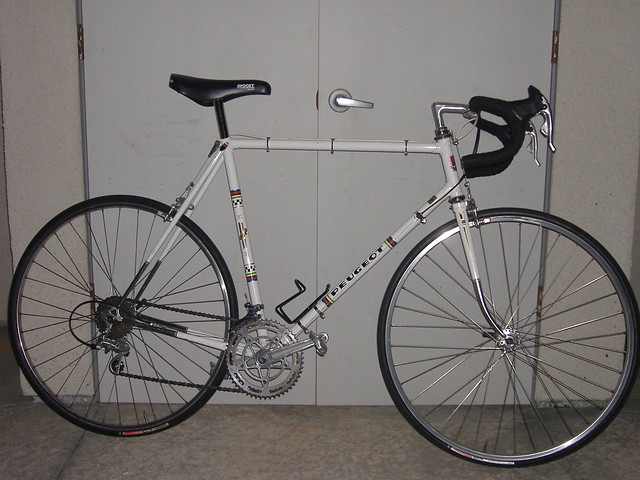
BTW, I compared the dimensions of the pictured PX10LE (older photo btw) with the "pro" bikes in a Cervelo/Trek dealership recently, and in order to get the handlebars as forward of the bb as on this Peugeot, I would have had to also use a much-longer stem on a larger frame which also had a too-much-longer head tube. The "effective" difference in forward reach for like-sized frames was literally several cm!
That said, I can easily put in a fast 3hr ride on this PX10LE, which over-taxes my arm muscles less than it spares my leg muscles.
It is effective, if also rather harsh and twitchy. In short, it's more of a pro's bike than a pleasure ride.