It is confusing, because it's a complicated matter compounded by a lack of precise definition being used. I think there are a couple of important issues to sort that can help bring clarity.
First, the oft repeated and conventional wisdom that Lemonds have long top tubes (TT) and slack seat tubes (ST) is derived from an era in bike design when the majority were shorter and steeper, a situation very different from where we are today. Lemond was an era before sloping TT and before frame size designations lost any connection to actual tube lengths; the old standard was same length TT and ST, so a 56 frame had a 56cm TT and 56cm ST. That is the context within which "Lemond geometry" means something. Today, "Lemond geometry" means nothing, because you find the standard to be something like a size 56 with a 53cm ST and 54.5cm ETT.
Mention of ETT brings us to the definition issue. It needs to be clear, when talking about ST angle (STA), whether one is also talking about keeping TT length and position the same. If TT length and position remain the same, then yes, slackening STA will reduce distance from saddle to head tube (HT) centerline (HTC) because slackening would take place at the bottom bracket (BB) by moving it forward. Think of it this way: the ST/TT junction is the pinned pivot, so to adjust the STA, you swing the bottom, the BB, fore or aft.
Now, the other given is that the rider will have a fixed seat position relative to BB, meaning that if the BB is swung either fore or aft of that ideal relative seat/BB location, the seat will need to follow. Going back to the the slackening ST example, doing so will require the saddle to be pushed forward to maintain the saddle/BB relationship. Remember, the TT length we said was fixed, so of course, moving the saddle further forward effectively shortens the reach distance to HTC.
Of course, TT length and location need not be fixed, so you can slacken (or steepen) STA and keep reach (to HTC) the same by lengthening the TT, steepening the HTA, etc. Because of these variables, it's really most helpful to know your preferred "frame reach," which is the horizontal distance from BB centerline (BBC) to HTC:
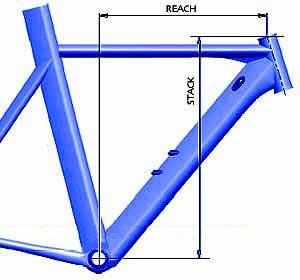
Knowing frame reach simplifies things, and removes the necessity of knowing a bunch of other frame dimension and geometry info, and allows for apples-to-apples comparison.
Without knowing more about how Rms13 likes to fit on the bike and having more specific physical dimensions, it's hard to say what will fit and what won't. My recommendation would be to try to compare STA and TT between the bike that fits and the new one, and see how close the reaches are. I know Lemond did not publish reach measurements-- it is becoming more standard today, however-- so short of finding a true to size diagram off which to measure, there's no easy way to do this. I suppose there are frame reach calculators out there, but I've not used one. A quick Google turned up this one:
bb2stem: Stack & Reach Calculator v1.00
Hope that helps.