Originally Posted by
79pmooney
Have you guys ever looked at the power measurements of a racer's pedaling stroke?
Yep. Lots of 'em, based on pedal-based power meters. Researchers have been using pedal-based power meters for years, and the results are consistent and clear. They all look like this:

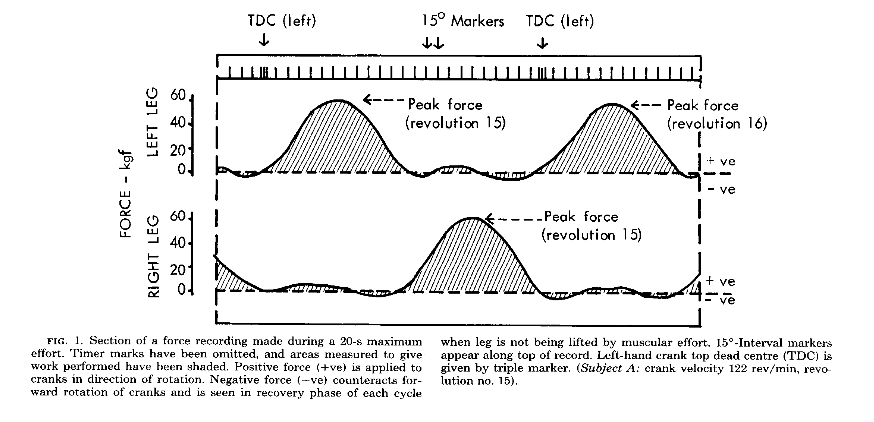

I believe this is the 2nd study I've seen which specifically shows how intentionally pulling up reduces peak power, and still doesn't really get the upstroke into positive territory.
Up and across the bottom and top are all real numbers, less than the downstroke, but quite real.
I'm afraid that's not actually the case.
No one, including top pros, and including track cyclists, are actually applying more than a token amount of power directly to the drivetrain on the upstroke. (cf
Book excerpt: The biomechanics of pedaling, from Andy Pruitt?s Complete Medical Guide for Cyclists - VeloNews.com)
Pedaling in circles is good technique, but it's not because that actually applies force to the drivetrain. What you're doing on the upstroke is
lifting your leg. For a 175-pound male, a single leg may weigh 10 pounds, and it's gotta get back up to the 12:00 position somehow. Instead of expending some of the force from the downstroke to lift the leg, you're using your leg muscles to lift it.
Foot retention helps, but not because it gets more power to the pedal. Retention lets you maintain contact, have better control of the pedal stroke, and keep your foot in the right spot for your fit.
If you look at the first chart (which is Fig 1 from the study the OP discussed), you'll see that the pros lose less power on the upstroke than the amateurs. And no, you really can't know this is going on without using pedal-based power meters that give you a full graph of independent left- and right-leg power.