Originally Posted by
dddd
The zombie thread awakens!

Thanks verktyg for the info on those early 1970's Maxy cranks with the big ring made from flat stock and swaged on.
So lucky I'm light, because I've ridden a
couple of pair of these cranks hard, really hard, and have yet to spin one. Only a couple of thousand miles each though.
The ~1973 arms do say "forged" (see below) on mine, and so slender as to be scary!
Somewhat surprises me that many people raced on them, but certainly in some locales a lot of lower-level parts are used for racing.
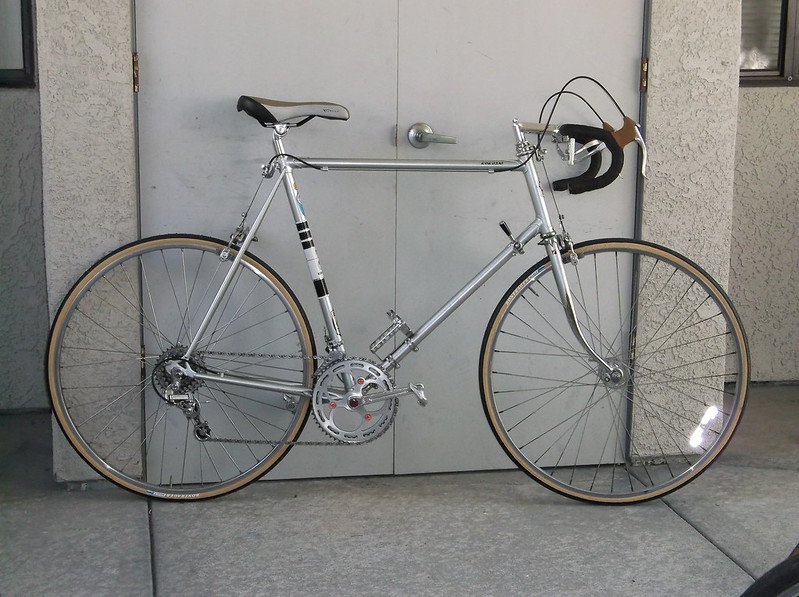
David,
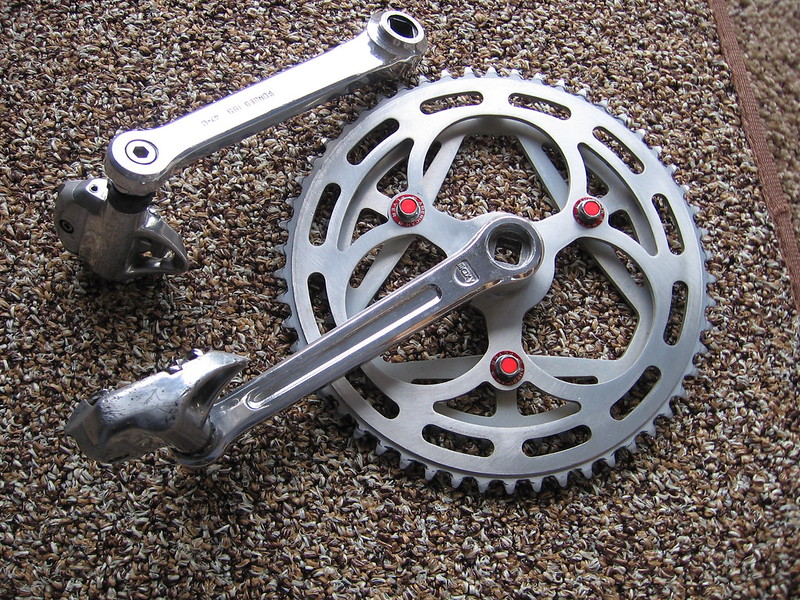
Yours are the improved Maxy version 1.5 cranks... They have the red rings around the bolts and the day-glo red inserts in the bolt heads. Also compare the large chainrings.

Gitane was having a problem getting Stronglight 93 cranks in the early 70s. That's why they switched to Sugino Mighty Compe cranks on their Tour de France bikes around 1973.
Peugeot used Stronglight 93 and 49 cranks on a lot more models so they had more juice with Stronglight than Gitane, Motobecane and Raleigh (Moto and Raleigh switched to SR cranks on many models).
The Interclub was Gitane's amateur racing model. It was marketed to competed against Peugeot AR-10 (steel cranks) and
PR-10 (Stronglight 49 alloy cranks).
In 1973 Gitane "improved" the Interclub cranks, switching from cottered steel to Sugino Maxi alloy cotterless cranks. Those first Maxy cranks were the problematic ones. I spun out one arm on a new Interclub that I was test riding after assembling it!

I have a lot of experience working forged and die cast aluminum parts. There are some distinct differences in the appearances...
For example pressure die cast (
melt forged) parts are near net size when they come out of the molds. There's minimal machining required - tapping the pedal threads and extractor threads plus broaching the spindle squares. Some of the cheap, early die cast cranks weren't even broached!
Also they are frequently "tumble polished" to remove casting flash and give a polished appearance.
Takagi was another Japanese producer of low cost cranks. The back side of these die cast cranks show no sign of machining but there are marks from tumbling.

Forged crank arms require a lot more machining (which leaves tool marks even on Campy cranks).
 "...on mine... so slender as to be scary!"
See what I said about Japanese people, bikes and components in the early 70s.
As I mentioned, there wasn't much sport cycling in Japan. Most of the millions of bikes in use were 50 lb. black and rust, single or three speed rod brake models.
The man in Japan - 1964...

This was a club ride in 1964. Half on the riders were Americans. Notice the difference in physical size between the Japanese and American riders (30 to 50 Lbs. heavier). Most of the bikes had European components.

The Japanese bike component industry didn't start producing performance parts until the early 1970s and it took them an number of years to begin gaining market share in the West.
Most of what the made was for export and to the specs of importers, many of whom didn't have a clue... Thus the problems with early cast aluminum cranks.
If you compare the crank arms on the later Maxy models they're more robust. They most likely used stronger aluminum alloys too.
Columbo moment... Both SR Sakae Ringo and Takagi made cottered cast aluminum cranks. They had humongous heads where the cotters went through. Another example of no sporting tradition in Japan. One of the big reasons for cotterless cranks was to eliminate the problems with cotters coming loose!
verktyg

Chas.