Originally Posted by
steelbikeguy
how much noise is there? what is the rms or peak value of the G readings while at rest?
Has the scale factor been checked in a basic way? i.e. place the sensor on a level surface in all 6 orientations (with the sensor's X, Y, and Z axes placed so that they are oriented with, and then against, the gravity vector), and verified that the reading is 1G in the selected axis, while the other axes read 0 G.
The size of the bumps encountered when these measurement were made wasn't disclosed, but I'm wondering if it makes sense that the longitudinal acceleration was nearly as great as the vertical acceleration.
You and others have raised some very good questions. I'll try to answer all (or as many as I remember at the moment).
The accelerometer really is very quiet, much quieter than the values in those graphs. If I rotate it 90deg the values on the non-vertical axes really do zero out as expected. In other words, to well within the precision shown in those measurements it is quite accurate, or at least sufficiently precise, non-noisy, and accurate. The basic scale can be seen by the fact that it reads 1 in the vertical direction, and the claimed resolution is .008g IIRC.
The limitation for this kind of work seems to be the sampling rate 50Hz. (The spec says "200 samples/sec burst mode" but I don't yet know how to do that or how to record it.)
The bumps I encountered were mostly small, under, say, two inches because I don't like abusing my wheels. It does make sense that the longitudinal variation was so large, for just the same reason a well-sailed catamaran can go much faster than the wind when sailing obliquely to it. Until the comparatively massive rider and bike begin to move upward at a bump the wheel is constrained to move in whatever arc the flexing of the fork allows it to move. With a large angle between thrust and movement arc the wheel must move significantly more horizontally to accommodate any vertical movement.
The question of whether the added mass of the sensor on the DO affected the response is a valid one. I assumed that it was so light and the mount so rigid that its mass had no effect. I checked that today with two experiments. First I mounted the sensor and flicked it with my finger. The recorded result was just a single pulse in all cases. That tells me that if it resonates at all then it is at a frequency and decay rate too high to be seen in the 50Hz sampling rate. Then I mounted my Galaxy phone to the top of the stem, started Kewlsoft's accelerometer program, lifted the bike by the stem and thumped the tire with a rubber mallet. Kewlsoft's program (or the accelerometer in the phone) seems to have a sampling rate about 410 samples/sec, so there should be no Nyquist Frequency interference for this experiment. I measured the Bianchi's fork with and without the sensor, then swapped the wheel for a sew-up wheel that normally lives on my Motobecane. The three results are shown here, a sloppily thrown together composite of three graphs:
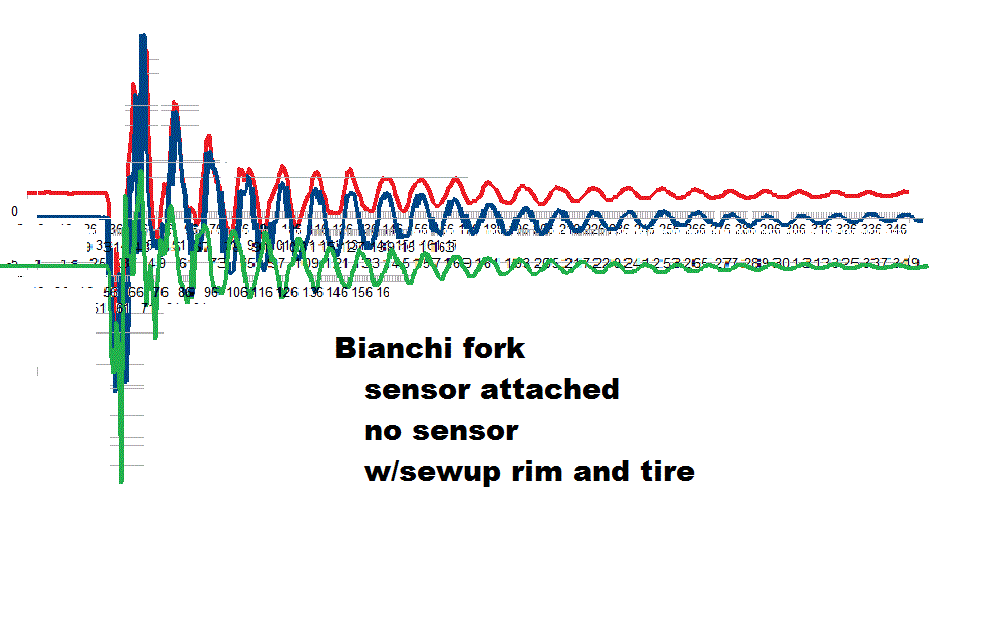
The oscillation frequency and decay rate are essentially identical with or without the sensor. With the lighter sew-up wheel the frequency is slightly but observably higher, not a surprise.
Then I did the same test for several other bikes in the basement. It is a flawed experiment in that mounting the phone firmly to the stem is not easy. All (I think) of the bikes have a handlebar bag attached which could have affected how the front end resonates, though the effect should be minimal because the bags are light and empty and not solidly attached. The results are shown here:

The Grandis with slightly heavier clincher wheels has a slight lower frequency than the Bianch, Moto, or Masi with sew-ups. (The Masi fork is stamped Reynolds; I don't know what the others are.) The curious one is the Peugeot PFN-10, Vitus 181 tubing and a seamed fork. The behavior seems to be bimodal and decays much faster, but I have no measurement value to prove that and the starting amplitudes are not normalized. (I wonder, is the headset loose? Have to check!)
It appears that the Bianchi's frequency is more like 29Hz, not the 17Hz I posted yesterday. I had tried to read that 17Hz from a decaying frequency response graph but obviously misjudged the point on the graph. It is above the Nyquist frequency of the Pocketlab (in non-burst mode) so any behavior above about 20 Hz can't be judged from the Pocketlab data.
I'd like to investigate the shape of bump response with more data by riding slower tomorrow, but dang they are predicting 1-2 inches of snow tonight.