Originally Posted by
nfmisso
First of all NOTHING is perfect, we are humans (well most are), not GOD.
If you have access to the equipment to do this project properly, you can more easily just make a new hub with the geometry you desire.
There is torque fed from one side to the other because neither the spokes nor the hub are infinitely rigid. Spokes less rigid, and that results in torque through the hub to the NDS flange.
Perfect in engineering terms is an approximation of way better than needed. Lathe runout at that short piece of a bike hub is minimal and exceeds what typical hubs have out of the factory. For all intents and purposes a good lathe will ensure a very true hub without runout.
Originally Posted by
Dan Burkhart
I don't have the answer for you but [MENTION=395449]Curtis Odom[/MENTION] might be able to guide you. He builds hubs with separate flanges and sleeves and certainly knows how to graft them together.
I don't think Curtis has been active on the forum lately, but I am in contact with him from time to time, so he is still around.
Thank you, will get in touch with him.
Originally Posted by
CliffordK
There are several manufacturers that have used a carbon fiber sleeve connected to two aluminum or titanium flanges.
Nuke Proof?
Apparently their biggest issue was broken flanges, not a slipping sleeve.
If I was doing it I'd probably design it so your sleeve fits over the top of the hub spindle/shaft. Perhaps cut a square stop near the flanges on both ends.
As noted for the CF, a tight fit and epoxy should be fine. Especially if you have about 1 1/2 inches of overlap on both sides.
Getting them precisely true would be an issue, but perhaps not bad if you have quite a bit of overlap.
I'd probably first chuck up the uncut hub in your lathe, and clean up the center shaft before cutting (square, uniform thickness, stops on ends). Then cut, epoxy, and press back together with a properly sized tube of 6061 or 7xxx.
Give yourself just enough play that you don't bend anything when pressing together.
You might be able to weld, but some types of cast aluminum weld poorly, and it may well not be necessary, especially with lots of overlap and a good epoxy joint. Also, weld heat could be an issue.
Keep in mind that the two flanges are twisted 1/2 spoke to each other.
You could radial lace the NDS, but I'd probably just do the same cross pattern on both sides because of the potential of issues with radial lacing old hubs.
Thank you for input. Was trying to avoid welding for the exact same reason (warpage and unknown material i'm working with). The fact that carbon sleeved hubs and radial laced NDS exists gives me confidence to proceed as planned without welding.
Originally Posted by
AnkleWork
Why so indirect? If the problem is bent axles, wouldn't the direct solution be to get a stronger axle?
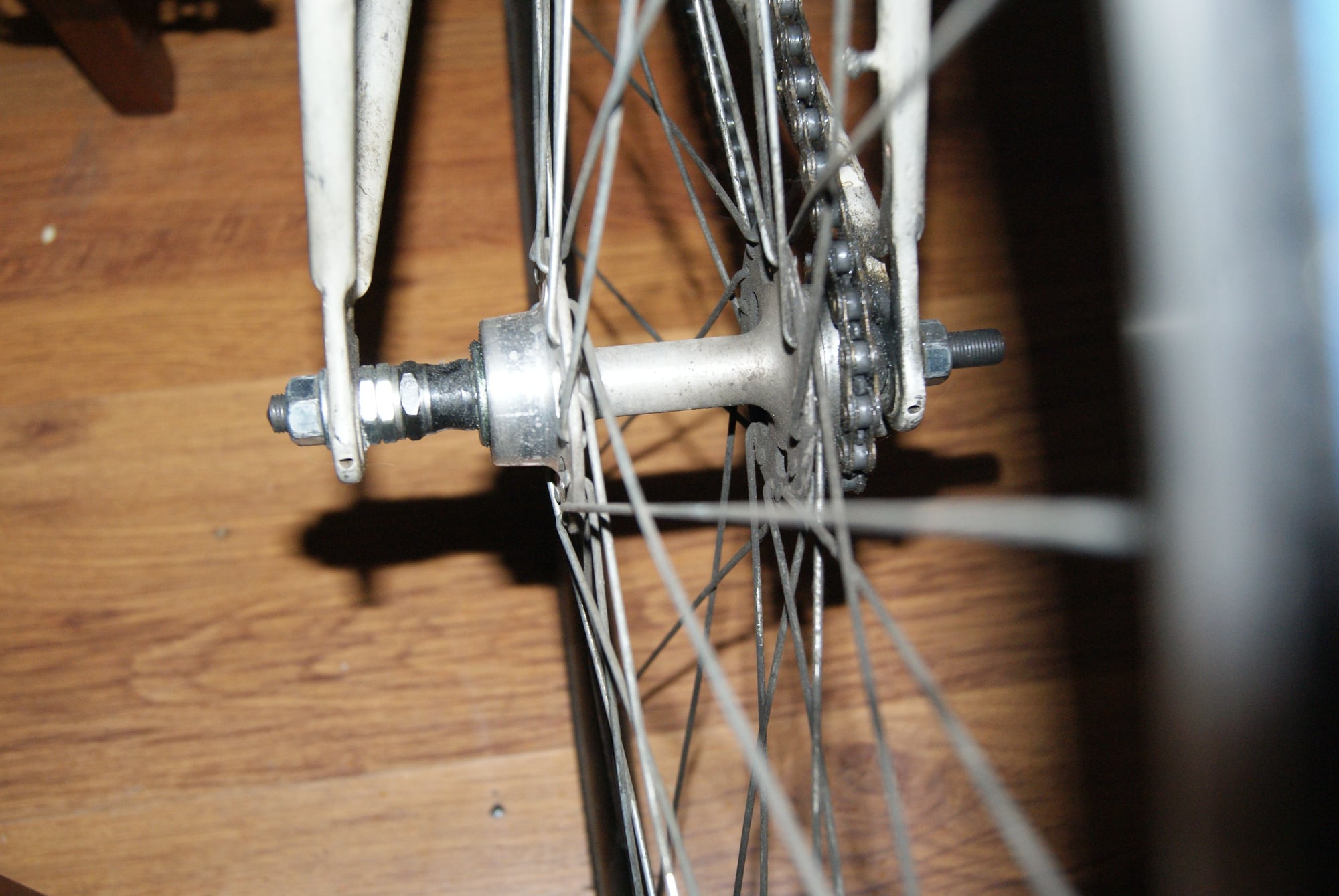
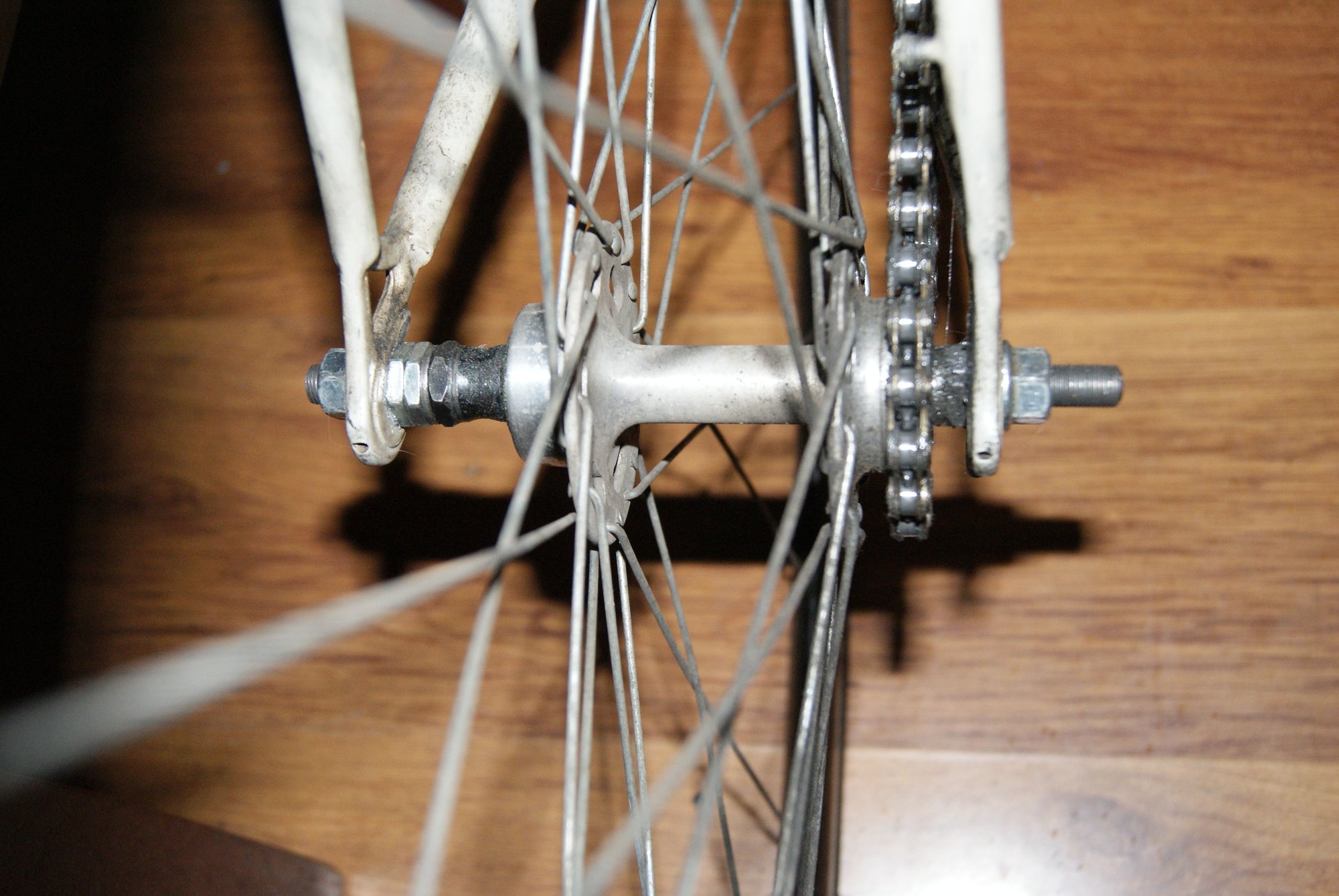
The axle is badly supported at NDS with a lot of spacers. Can't remove them since the OLD will change, won't bend the frame just for that, and can't get the hub centered as it will mess with the chainline.
I figured a picture worths 1000 words so here they are.