Originally Posted by
Bill Kapaun
If you think about it, it doesn't really matter where the end of the spindle is- (imagine the taper continuing to a point....)
It's the length where that "magic dimension square" is that stops the crank arm from further travel when properly torqued.
There's more to it than the crank position relative to the taper. There's the question of whether the crank or chainwheel will clear the chainstay. Although, there's the question whether the crank and spindle tapers match (ISO vs. JIS). That's a couple of mm clearance in either direction.
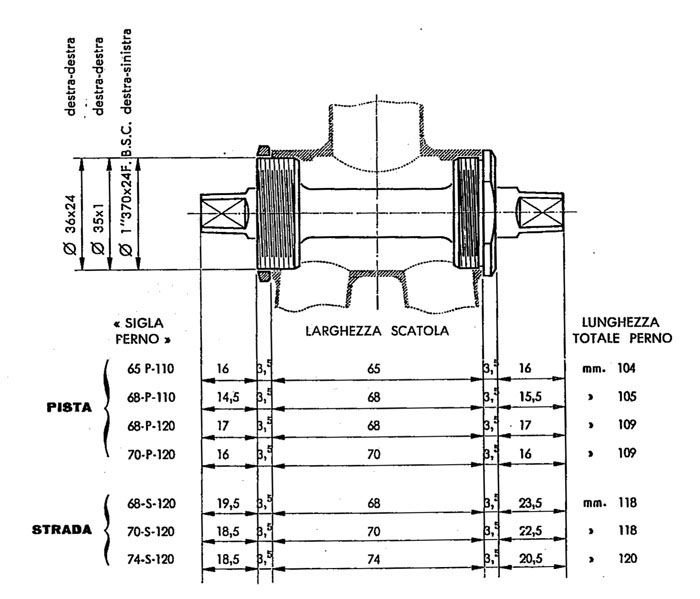 Here's are Campy's bottom bracket clearances. A 110 mm length spindle is for a single speed. Campy typically had the shortest spindles and tightest clearance between chainstay and crank/chainwheel.
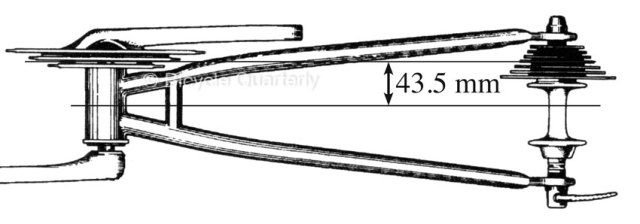 Here's a typical chainline diagram.
If the driving side is too close to the bottom bracket, then the crank or chainwheel won't magically clear the chainstay, as it does in this diagram. N.B. the chainstay is crimped to give smaller chainwheels clearance for doubles and triples.
That's why I'm puzzled why the non-driving side is longer than the driving side. Look at the dimensions, when non-symmetrical spindles were the order of the day. The driving side was longer to insure the clearance. Putting the spindle in backwards and not having chainwheel clearance was a rookie mistake.