Originally Posted by
The Golden Boy
It can't be a Tange steerer.
This fork has a Tange steerer, a 1985 Trek 620 fork is going to have a Reynolds steerer.
Unless Tange did the brazing for Trek in the sub manufacture of the frame and stamped the steerer. (John has said the 600 series frames had the rear end and fork brazed in Japan, with the final brazing and assembly in Waterloo)
If you're really really sure its a Trek fork, one of the models that isn't in a catalog is the 1986 Trek 620 Cirrus- it's a leftover 620 frame- painted in the 1986 Trek 400 color scheme (a brighter blue than the 85 620 with silver head tube and lug windows). I would *assume* its a stock leftover 620 fork- but if Trek was trying to sell leftover frames...
In any case- I really wouldn't worry- it looks like a top end touring fork- the mid-fork braze ons are really tell-tale. And regardless, it's a good match for that frame.
My theory, from experience and some observation, is that any of the 600 series Treks were not "pure" in build source like 700+ series bikes. My 1981 610 had DB 531 main tubes and
hi-ten forks and stays. As you mention, John said that the 600 was built in pieces from a few places (I found that same quote). Also in that thread, it was a Lotus owner who had his bike's frame and fork made from Columbus tubing, with the Columbus dove stamped into the steerer, while
there was also "TANGE A4" "MADE IN JAPAN" stamped into the steerer. And if Reynolds in 1985 was like they were in 1974 (with my Paramount), only when fully stripping away the paint and primer does one see "REYNOLDS BUTTED TUBING" faintly stamped in the individual tubes (some of them, at least in my case).
The Stronglight headset that came with this fork, as well as the crown design, match other 1985 Trek 620s. See this example:
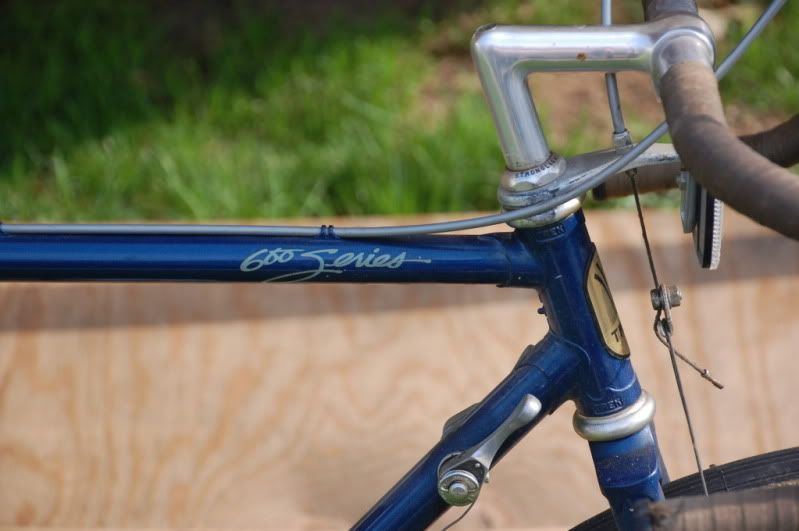
The color is a dead match as well. Only Cannondale had that nearly identical of a blue (even the metallic flake) during that time, but none of their ST frames had canti brake accommodations (that wouldn't happen until later. No other Japanese manufacturer at this level (like a Miyata 610 or 1000) had this paint color. I doubt any European makes did as well. And since Tange was good about their dating, a fork produced in 1984 for the upcoming 1985 model year would not, logically, find itself a leftover for a 1986 model year.
All this points to, and further corroborates my original thinking, that this fork being from a 1985 620. You can of course disagree as is yours or anyone else's prerogative, but it's a 1985 620 fork constructed of Reynolds tubing, made/constructed by Tange for Trek.
Thank you for the information on the Shimano and Suntour canti brakes. They are beautiful pieces and I enjoy learning more about the truly nice ones. I will look for them as this project progresses.