My experience with small wheels are with nominally 24" wheels (actually closer to 22.5", the 520 rim ISO family and 25/28mm profile tires). What I have found is that with their lesser rotating inertia they feel "quicker" in directional change. I equate this as being roughly "one step" different then a 700c wheel with the same rim/tire widths. So a 700c steering angle of 72.5 might be like that of a 71.5 on a 24" wheeled bike (everything else being the same. This is a seat of the pants and many year opinion from selling dozens of Terry bikes and making more then a few frames for the wife with 24" ft wheels.
The 650c wheeled bikes I've serviced, sold and made (only two frames at this point) seem to follow this opinion but about half way between the 700c and the 24" handling feel.
I certainly agree that trail isn't the only main factor at play in defining handling. The steering geometry isn't the complete picture either. Weight distribution as defined by front and rear (chain stay) centers as well as seat set back with bar reach/height are also strong factors. It is in these dimensions that my skill set begins to diminish

As the small wheeled frames I've built are all (but for one) the same rider I had a pretty good sense what she liked for these numbers. I employed the time tested method of copying a known fit with only minor tweaks. Since one main reason to use a small ft wheel for many riders is to shorten the reach to the bars (and keep toe overlap from becoming an issue) the reduction of ft center has been followed by a bit of rear center reduction. But I tend to run longer chain stays then is trendy so this bit is not as much a change then some might read into my comments. In no way do I see a small rear wheel as a reason to have way short stays.
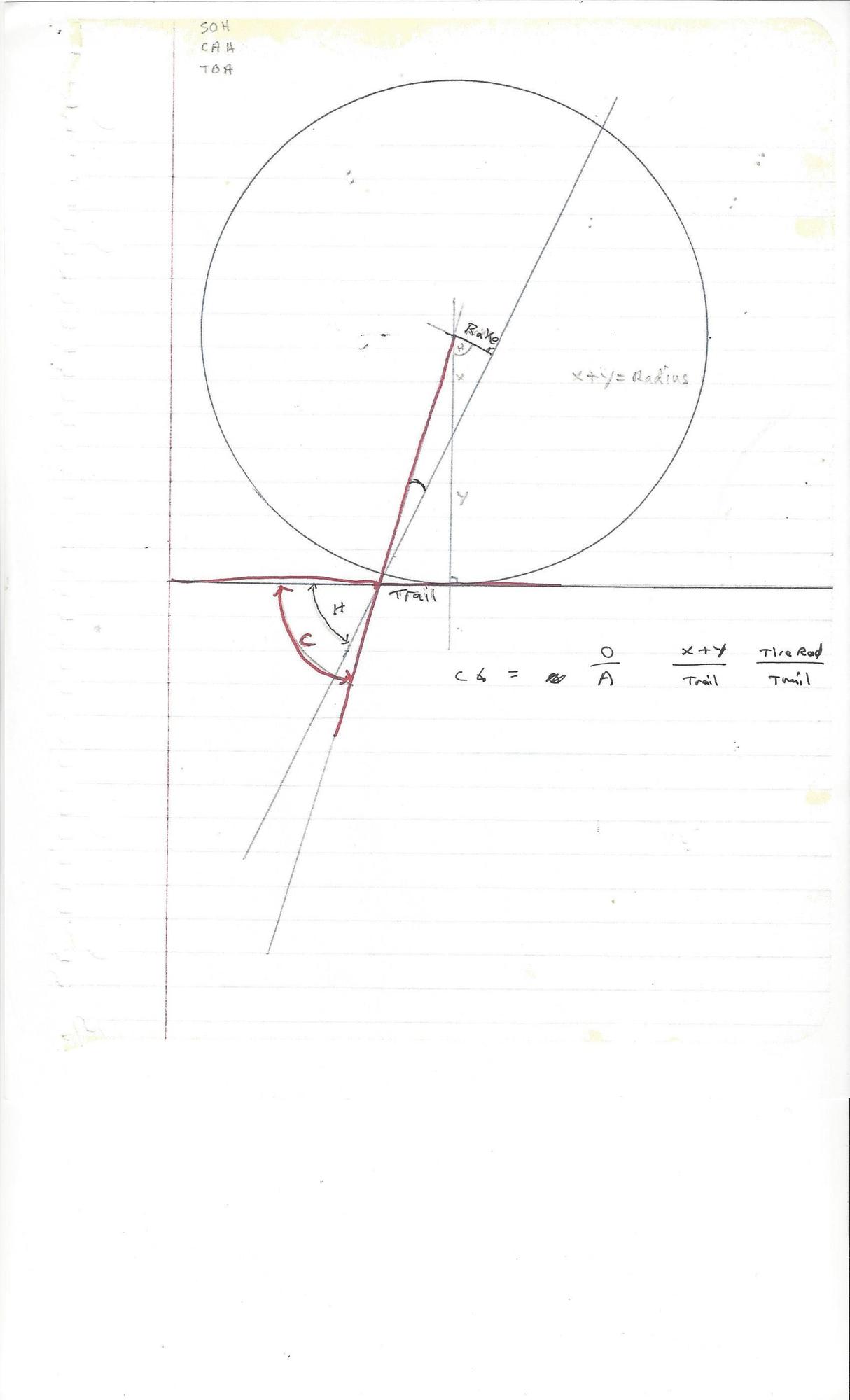
As to steering geometry in general I'll pass along what both Bill Boston and Georgena Terry have followed and add my opinion/numbers. There's a dimension that is not usually talked about called by BB and GT "castor angle" This isn't what car geometry calls castor, is in this case it is the angle with the ground that a line that passes through the steering axis contact point on the ground and also through the front axle. See attached diagram. BB (and GT) mention that a castor angle of about 81* gives "neutral" handling (whatever that means). When I talked with GT many years ago (and more recently in designing a couple of 26"/559 wheeled bikes) she says she follows this geometry guideline.
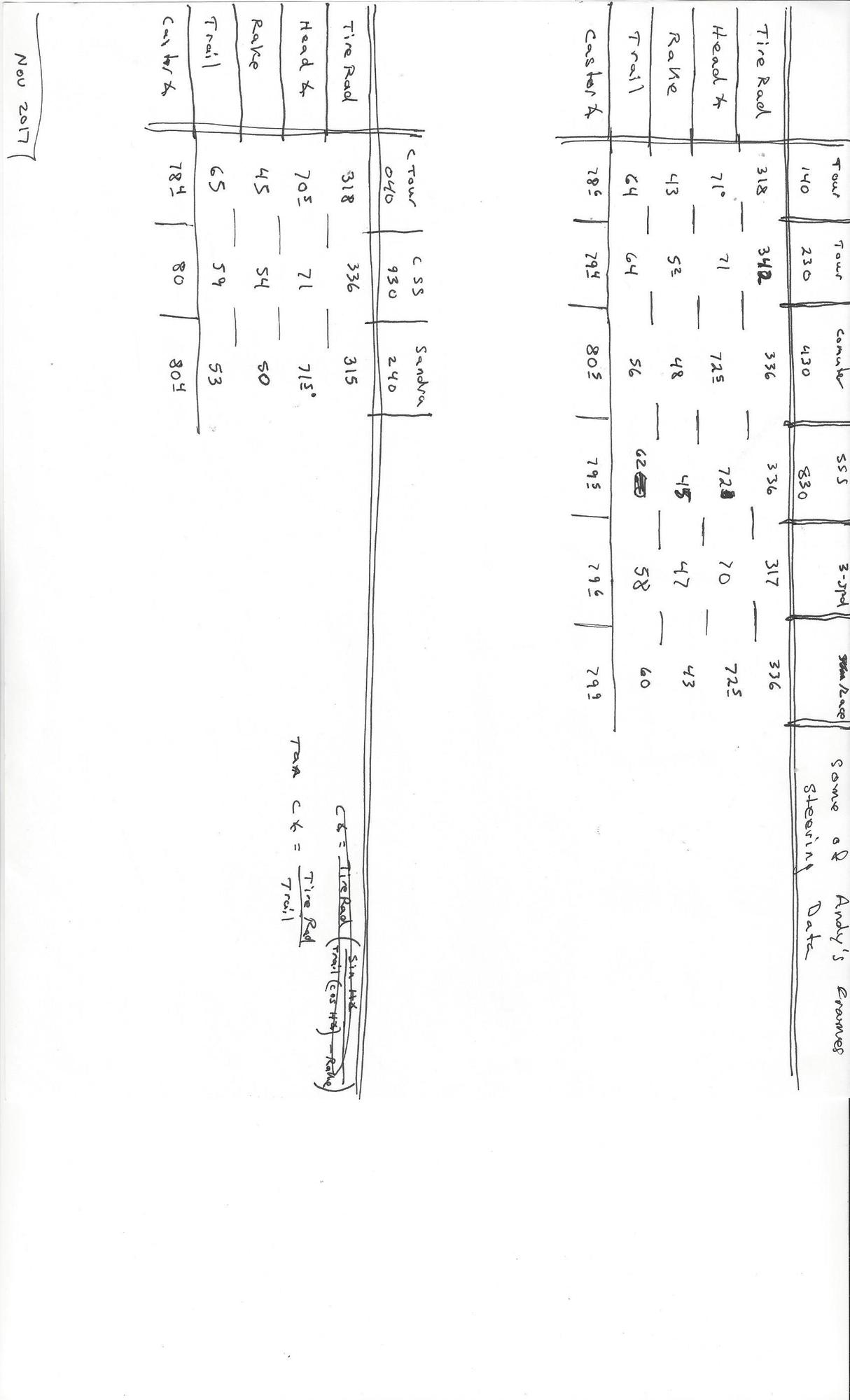
I have found that I prefer slightly longer trails then what are considered "neutral" handling ones so my frames have tended to have slightly lower castor angles. I made a chart of some of my more recent frames and their data (tire radius, head angle, rake, trail and resulting castor). See attached chart. You'll see that most of my frames have slightly less castor, between 78.4* and 80.5*. (The tire radiuses are 700c=336/342, 26"=315/318 there are no 24" wheeled frames listed because my second wife doesn't need that short a reach so uses 26" or 700c ft wheels).
What this means for 20" wheels? I'm not sure but if I had zero foundation I would look at the castor of 80*-81* and see where that puts rake/trail then look at published data and if at all possible test ride bikes that mimic known data. Andy