Originally Posted by
DaveSSS
All you need to do that is a precision measuring device like I have and access to every type of shifter made for more than 20 years and lots of time. My measurements of Campy 10 and 11 shifters, made many years ago were as accurate as I could do with a precision rule, but repeating the same test with a much more accurate measuring device showed some small errors.
The OP had preconceptions of the expected results and set out to prove them. I did my tests with no idea of what the results would be and made many repeated runs through all shifts and took the average of all runs.
There are many lists of shifter cable pulls out there, but most are probably not very accurate and many only list the average cable pull. The average means little.
Who's keeping the spreadsheet? Here are the measurements I made:
Shimano 11-speed road cable pull, as measured off a 5800-series 105 shifter:
Code:
Position  pull (mm)
1->2        3.12
2->3        2.63
3->4        2.41
4->5        2.48
5->6        2.50
6->7        2.42
7->8        2.49
8->9        2.55
9->10       2.48
10->11      2.46
(how do you do a monospace font? or other advanced formatting?)
This is assuming that the cog position starts from smallest to largest, so opposite from conventional "gear" where 1st gear would be the lowest gear, thus the largest cog.
Also note that my setup wasn't all that great, I measured with a digital caliper from the downtube cable stop to a piece clamped to the shift cable. The problem is that the cable stop wasn't very flat. Measurements could vary by +/-0.2mm. I'm not sure if that was my measuring technique, or just the shifter variability. I also only took a set of six measurements, shifting up and down across the range three times.
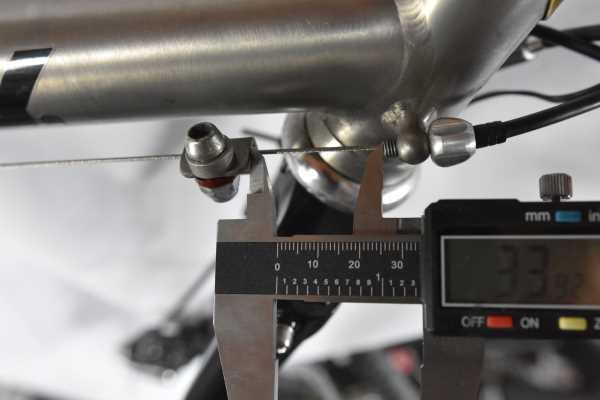 Measuring with a caliper. Yes, this is the bike I just added the disc fork to, mentioned in my other recent thread in this forum.
Here are my measurements for a 10-speed SRAM S-700 shifter. This is the Exact Actuation technology, so should be the same for 10-speed mountain or road shifters and work with 10-speed (and below) mountain or 11-speed (and below) road derailleurs.
Code:
Position  pull (mm)
1->2        2.90
2->3        2.96
3->4        3.00
4->5        2.82
5->6        2.96
6->7        2.94
7->8        2.96
8->9        2.90
9->10       3.24
And Shimano 9-speed Deore shifters, so also works for road and mountain 9-speed:
Code:
Position  pull (mm)
1->2        3.18
2->3        2.19
3->4        2.11
4->5        2.12
5->6        2.37
6->7        2.51
7->8        2.97
8->9        4.01
I've since come up with a method of measuring the shift cable travel on a bike with exposed downtube cables that doesn't require good caliper technique and can be done with no special equipment and without modifying the bike. So pretty much anyone can do it.
Tape a ruler to the downtube and a vernier scale to the shift cable, and you only need to shift, then read out the dimension on the scale. The challenge is reading the scales. I've designed scales that can be printed for measuring to 0.02mm and 0.05mm accuracy.
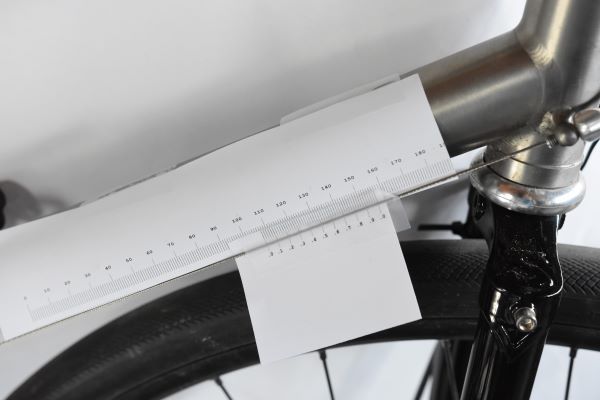 Vernier measurement
It does make things easier if you can mount the bike on a stand and remove the rear wheel, that way you can just shift without having to turn the cranks. Backing out the adjustment screws on the derailleur also helps give better readings for the top and bottom shifts, but they're not so important.
I left the ruler pretty long so it's easier to verify that your printer is rendering at pretty close to a 1:1 scale.