Been there. Done that, but not quite as severely. You did it big time. I think that the judges would give you a 7 of 10 style points, where 10 is the loss of a digit or limb. I hope you heal rapidly and completely.
Your sharing may help several people avoid this disaster, so thanks.
Practically, this points out that
1) Folks applying large forces in the vicinity of sharp bike objects should be aware of potential injuries like this and take steps to avoid, to wit:
2) One should have a safety chain to put around the chainring. Home mechanics if possible. Shops, for sure.
3) One should avoid applying a lot of torque to a crank when balancing the force with the pedal or crank ON THE SIDE OPPOSITE THE WRENCH. This means
a) If you can, get the wrench handle set up nearly parallel to the crank arm on the same side. This results in applying two forces in opposite directions. So tightening (or loosening) involves squeezing the arm and wrench rather than trying to apply 100 lbs or more of force to the wrench arm on one side of the crank, and balancing this with more than 100 lbs force using the crank arm on the side opposite the wrench. So that if something lets go you are applying a couple hundred pounds of force in the same direction.
b) I find squeezing the crank arm and wrench together is easy and best for me but I have large hands. If squeezing doesn't work for you then with the wrench and crank arm on the same side you can at least have one hand straight out bracing the crank arm, and the other straight out pulling(best) or pushing (ok). With both arms straight, the force is through your shoulders, and if something lets loose there's not a lot of travel that your arms traverse before the force is disippated.
4) Best to do work so that if something does let loose the hand that is freed and traveling at high velocity is not oriented to travel towards the chainwheel, or the floor, or your chin.
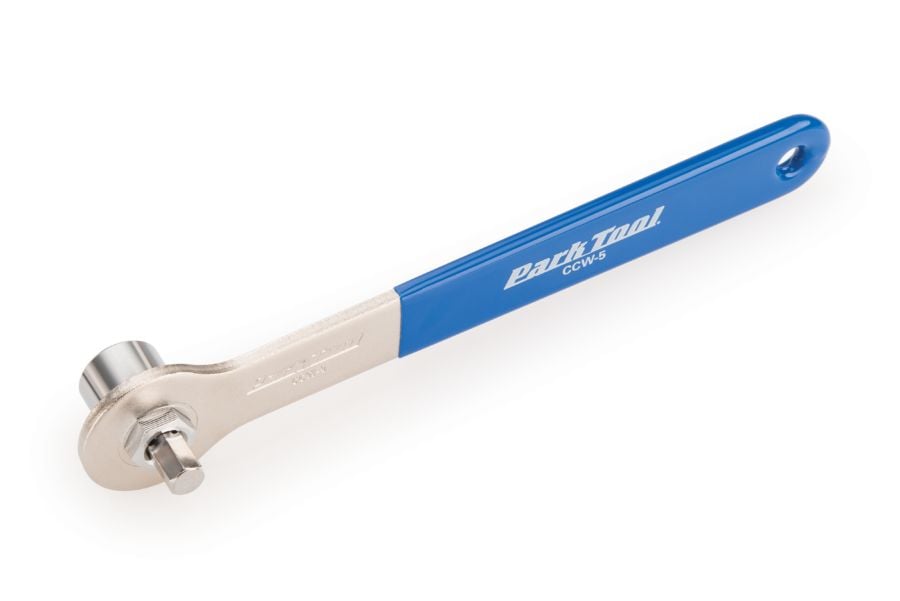
This also points out why you should use as short a socket as possible so that the force of the wrench is entirely tranlsated to bolt torque, and so that you don't have to use one hand to balance the socket end of the wrench. The Park Tool is nice because the socket is so shallow and very little axial moment is introduced. This also pointed out to me just how well-suited-to-purpose the old stamped steel wrenches were. Force was applied just about as close to the center plane of the bolt head as possible.
Don't ask me how I know this stuff or why I thought through it in such detail.