Originally Posted by
balles3188
Yes, I have heard many times that the 105 rule is not so important... so, what should I consider to choose the right wheels? Basically I want to choose the proper wheels for a 28mm tire.
Another option would be to mount a 32mm tire in my existing wheels for all days (DT Swiss C1850 - 22mm inner with). I would save money... and there would be much difference comparing this with for example 28mm tire and WR45?
Thanks!!
Balles3188,
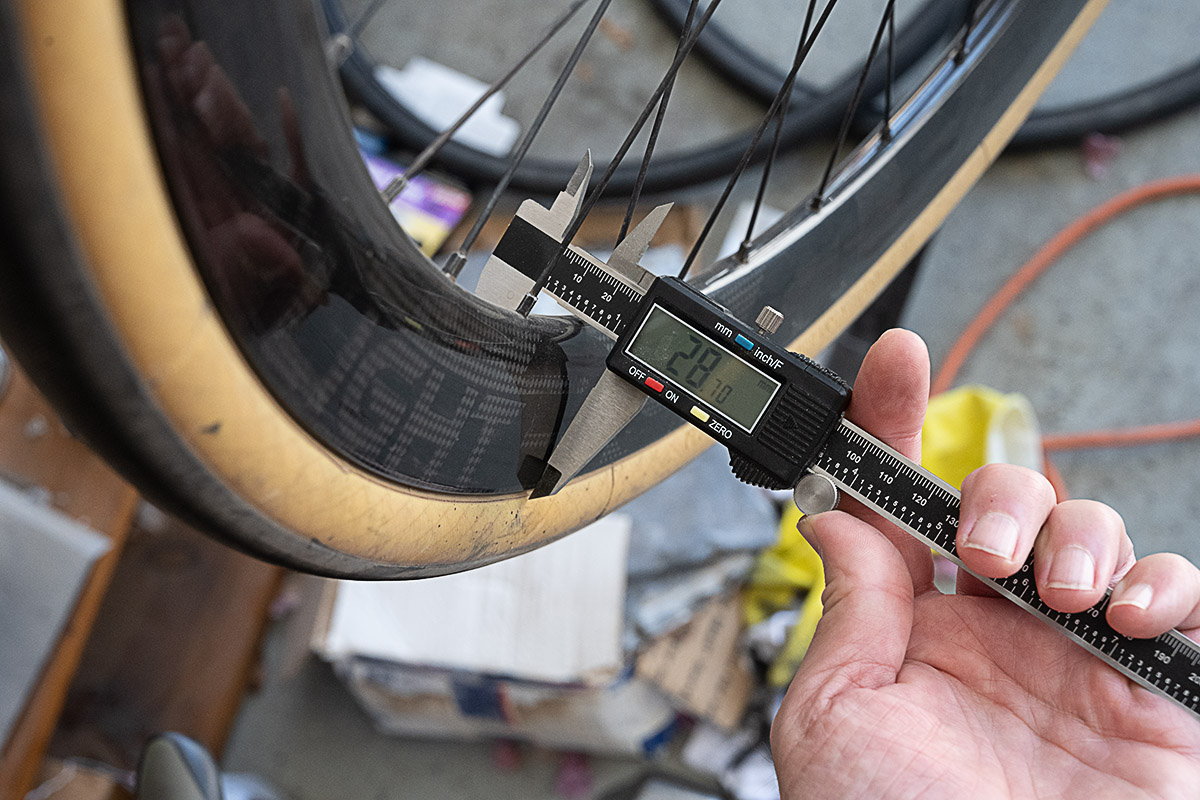
Here are a couple of things that may help you put things in context. This is a nominal 32mm Compass (now Rene Herse) Stampede Pass tire mounted on a LightBicycle RR46 rim, which I believe is the same rim as the AR 46. This rim is nominally 28mm wide. As you can see, the tires actually measure out at a bit over 34mm inflated to approximately the max pressure listed on the sidewall (as a SuperClyde cyclist I pretty much need to be at max pressure for a tire, if you're lighter you could easily go a little lower).
You tell me, does this tire bulge way out beyond the rim? The numbers don't lie, this tire certainly bulges out beyond the rim width, but compared to all the narrow alu-rimmed wheels you've owned in the past on this type of bike, it just doesn't seem like that big a deal to me. I know if this were measured in a wind tunnel you'd see some aerodynamic penalty due to this, but since I'm not racing nor going for the hour record, in practice this is something I take notice of, but don't let it bother me too much. My speed and duration on the bike are far more limited by other things (like still being a Superclyde) than they are by these 3mm per side bulge.
Now, if you put a 28mm wheel on there that actually measured at 28mm, this tire/rim combo would be perfect even according to the guys who fret over that 105% rule. In practice a good 28mm tire like the GP5K is probably going to measure out at 30mm or so. Would it be a dealbreaker if it bulged out by 1mm? Probably in theory there would be some consequence, but if you're fretting over that 1mm bulge, you're on a professional racing team and it's not your problem anyway because your team will have people paid to think about this for you. In practice you will never ever notice it at all.
When I built these wheels in 2017 that 46mm deep, 28mm wide rim was the best LightBicycle had on offer. They now have the
WR50 rim available, that's 32mm wide and 50mm deep. For my purposes, knowing I'm probably never dropping below 32mm tires again in my lifetime, that would be the absolutely perfect choice. And to be honest, given how Conti GP5K tires always measure out at least a couple mm wider than their nominal width, I'm sure these would even be fine with 28mm GP5K tires too, and certainly for their 32mm versions.
My bike could easily fit these. You'd have to figure out if your bike could. If it couldn't, then you're going to have to use one of the 28mm wide rims. If your bike could handle these, I could see no downside, unless you think you may go back to 25mm tires or whatever. I know I'll never ride 25s again, but I have no idea where you're at on this.
Anyhow, here's what a pair of Compass (Rene Herse) Stampede Pass 32mm tires look like up close mounted on the Light Bicycle 28mm wide rim. Compare that bulge with whatever you're riding now and decide for yourself whether it's a big deal or not. To me it's not a big deal. Depending on how wrapped around the axle people get about aerodynamics and what in theory is good or not for speed, others will differ.