using the sheldon brown one, I save screenshots of the chart that gets made from putting in a specific bike info, so I have a reference for a bike.
Here is my Kuw after I changed the granny to a 24, so 50/40/24 with a 13-30 7 spd cassette and 700x28 wheels and tires
and then my more recent heavy touring bike, 44/32/22, with a 11-34 9 speed cassette and 26x2in wheels and tires (for some reason, couldnt attach this bikes chart...no matter, you get the picture)
the % numbers you see on the charts is the % jump between each gear, which is nice to know and useful if you start to be attentive to this stuff and figure out how sometimes on older bikes, the % jumps were kinda big--which in real life is where its hard to find in some given conditions one gear is too low and the next one is too high....more modern bkes with more speeds tend to have smaller jumps than back in the day, or at least manageable jumps but with a much much wider range of gears, ie cassettes of 11-42 for example.
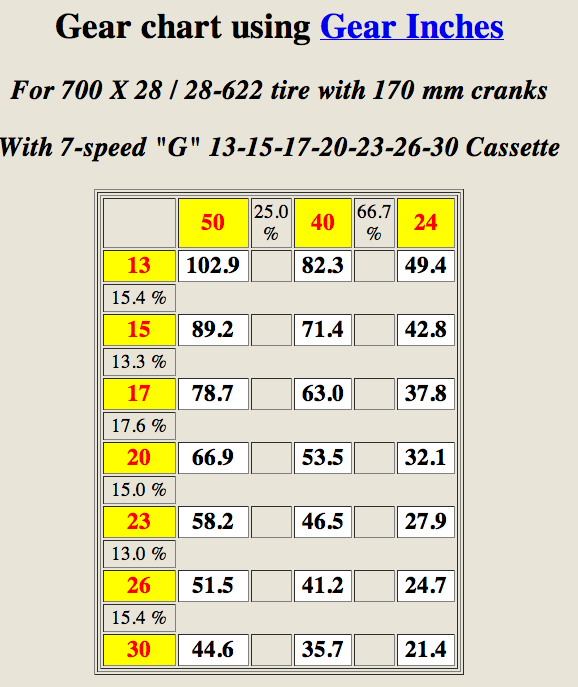
While that works, I never found it to be that helpful. It’s too hard to see which gear would be the “next” gear to use. For example, the 50/26 combination is 52 inches. The only combination that is close is the 40/20 combination. But to get to it would require a downshift on the front and a double upshift on the rear. Alternatively, 2 up shifts on the back could be done first, followed by a downshift in the front. The former is too difficult...since you usually need an easier gear...and the other is too much of a hassle.
But there’s a better way to use the gearing...with and without the gear chart. Notice that a shift down on the back in the 50 tooth gear is about the same a downshift in the front. It’s actually best with this crank and cassette in the 20 tooth cog. The 50/20 is 67”. The 50/23 is 58”. The 40/20 is 53”. It a bit bigger jump to shift off the outer ring to the middle ring but not huge. I’d ride this gearing as a “crossover” (not to be confused with crosschaining). In a “crossover”, you
cross over from the outer chainwheels to the middle chainwheels and then proceed with downshifting on the rear. Going up in gear you cross over to the outer chainwheels at the same point.
If you use the graphic gear calculator linked to above, the
speed difference (at 90rpm) shows how the crossover idea works in this same drivetrain
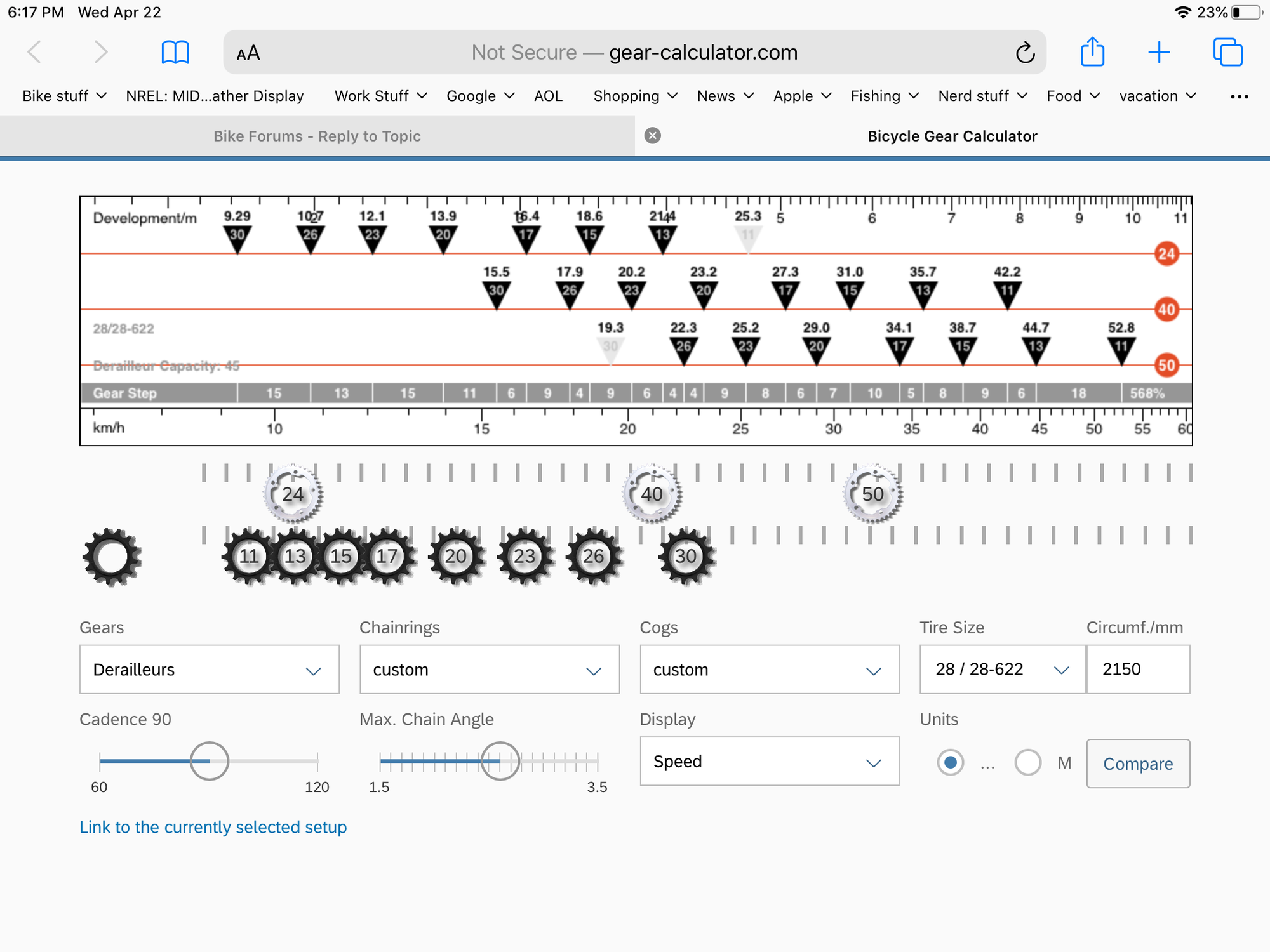
Using the middle of the cassette is a bit arbitrary. It does give some latitude when it comes to downshifts or up shifts.
If you fiddle with the chainring slider, you can see that a 42 tooth ring results in a closer ratio that would be an even better “crossover’