TL;DR: I built a wheelset designed to be tough and durable for "superclyde" class cyclists who nevertheless want to take advantage of as much aero and other benefits as can reasonably be salvaged by a superclyde-proof wheelset. Photos are attached below if you just want to scroll down and see the pics.
***************
This post is about a wheelset I just built and test rode. I've called it the AeroClyde wheelset. It departs from most if not all of the commercially available wheelsets, so I will explain my choices, describe the components, and show the build. Since this build is atypical I thought it might be of interest to others, particularly heavier riders who want some nice wheels and don't want to crush all the nice wheels out there designed for thin people.
I am no expert on any aspect of any of this, and don't even pretend to be on the internet. This is only the second complete wheelset I've ever built, with five total wheels now under my belt. This design and build represents opinions I've formed as a superclyde cyclist who wants to, and likes to ride fast (fast for me anyway). I've read a lot and researched and just put together my idea and decided to just do it and see how it turned out. I realize my opinions may not agree with those of other people, including those with much more experience than I have, so I'm prepared to listen, learn, and revise my opinions as appropriate. Bring it on.
Purpose: Build a wheelset whose first priority is toughness and durability for a superclydesdale, but which also uses quality components, and salvages as much aerodynamic and weight benefits as can still be had while satisfying the first priority of toughness and durability. This is not meant to be the toughest or most durable possible wheelset: it is merely what I believe to be a tough and durable wheelset that is a good compromise between aerodynamic and weight considerations and the other extreme of being built like a tank. For the toughest and most durable wheelsets talk to the touring and tandem guys and see what they build.
There is a market for aerodynamic carbon and other wheels for the typical cyclist that use deep-section carbon wheels, low spoke counts, lightweight components, etc. to provide aerodynamic and other benefits to enthusiast cyclists willing to pony up lots of cash. The various ENVE and other wheelsets come to mind. I'm sure these are great wheels, but people like me can never ride them (or even afford them).
For the clydesdale and superclyde cyclists there are wheelsets that are typically very heavy, tanklike builds with very high spoke counts, very heavy duty rims, spokes, hubs, etc. They'll probably last forever, but aren't exactly ideal if you want to ride fast.
What I hadn't seen was the ENVE-like equivalent wheelsets optimized for really heavy riders. I weighed 283 lbs this morning. Even if I had the money for an ENVE wheelset, which I don't, I'd have no business actually riding it. My weight is falling a little day by day as I continue cycling and eating well, but even if I achieve my "dream" weight I will still probably never be lower than, say, 230-240 lbs or so. This means I can never hope to benefit from any of the typical high-end wheelsets, which are all designed and built for typical lightweight cyclists, with low spoke counts that a guy like me has no business ever riding.
When I ordered my Lynskey I told the salesguy what I weigh and said that my goal with this new bike was to have a tough, durable, comfortable, high quality bike that I could ride hard and expect to have it last, be fun and enjoyable, etc. We decided on the Stans Grail wheelset, which was the toughest Lynskey had to offer in a pairing with this bike. They special-ordered 32-spoke front and rear wheels, 2 cross, and those wheels have been great so far, with over 600 miles ridden on them in the last four weeks since I got the bike. I'm sure they'd last for a long time, and I had no criticisms of them at all, except that even this wheelset, the toughest Lynskey had to offer with their bikes, has an official weight limit of 230 lbs. I'm still over 50 pounds beyond the weight limit of this wheelset!
Requirements:
36 spokes both front and rear. I was constantly tempted to revise this downward, knowing I could probably get away with it. I resisted every such temptation.
The highest-performance rim I could find which would give the most aerodynamic and weight benefits while being affordable and available in a 36-spoke drilling, and also being tough, stiff, and durable enough for long-term use by a superclyde.
High quality hubs.
Spokes that took advantage of any weight and shape benefits while also finding durability and strength bonuses wherever possible.
Brass nipples for ease of building and durability.
I was constrained by the following:
15x100mm thru-axle front hub required for my bike
12x142mm thru-axle rear hub required
36-spoke drilling available
disc brake version, preferably Shimano centerlock (because I like it better than 6-bolt)
Components: I selected the
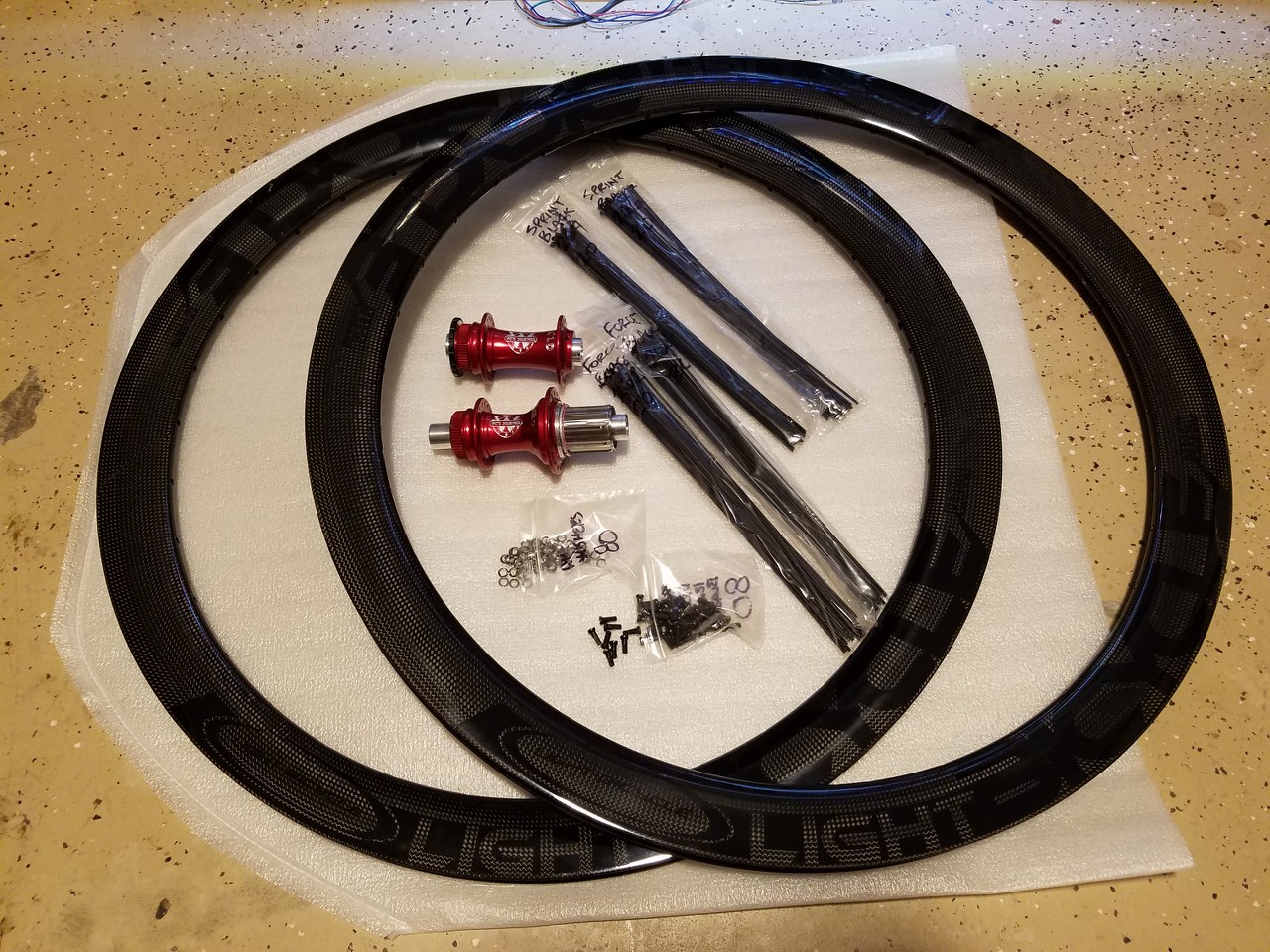
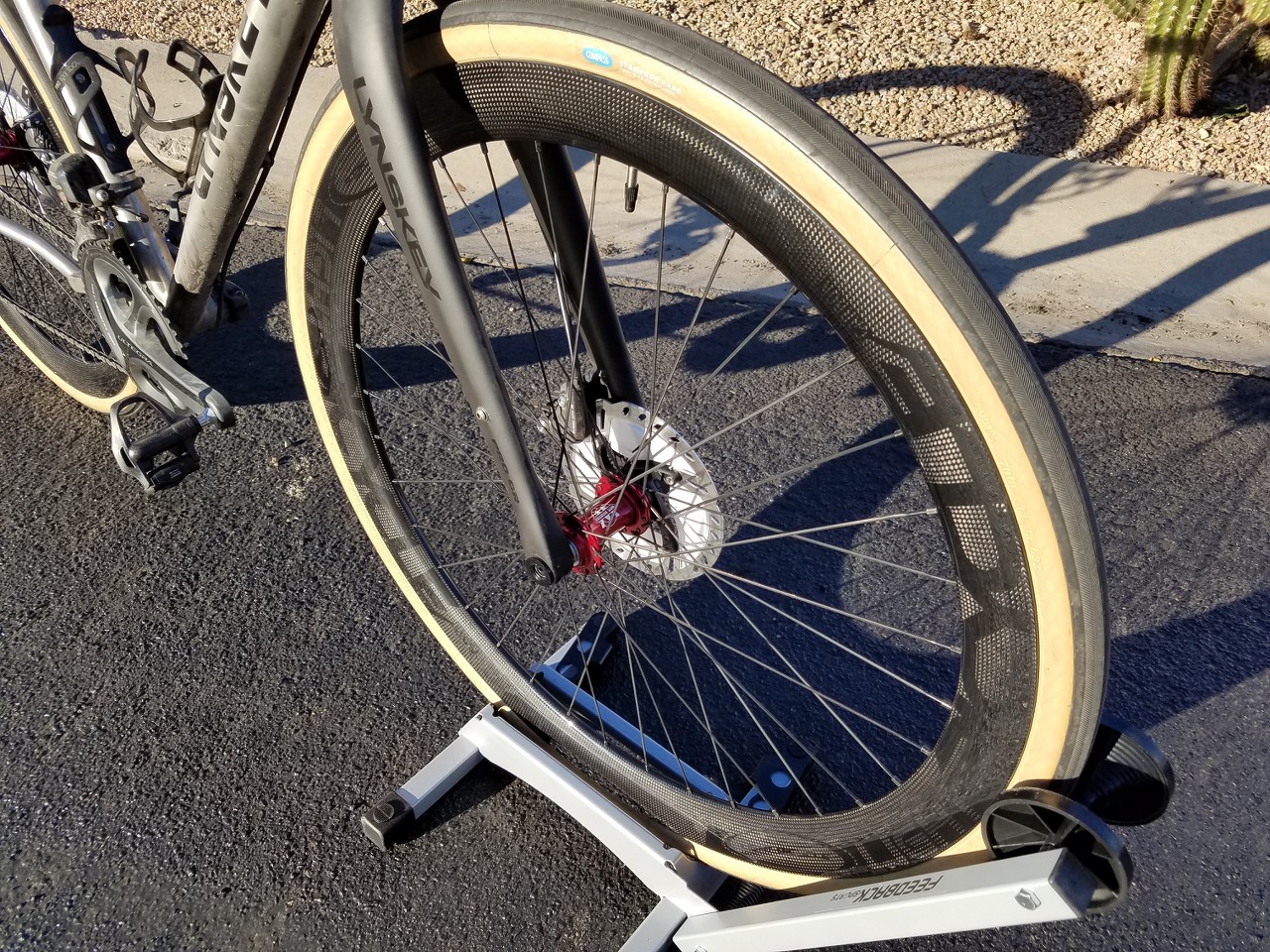
RR46C02 rim from light-bicycle.com. They are 28mm wide, and 46mm deep. The width is great because as a superclyde I really dig riding wide tires. Having read that the best aerodynamics in the wheels are had not just from having a deep section, but also matching the rim width to the tire width as closely as possible, it seemed that this rim would match up really well with the 32mm Compass tires I've been riding on the Lynskey. Also, Light-Bicycle allows you to customize the rims you order in quite a few ways, including offering spoke drillings all the way up to 36 spokes. This rim seemed likely to be tough, strong, and durable. It wasn't super light, nor was it super heavy. I could have gotten the rims with no logo, or with various colors for the logo. I opted to keep the logo because I'm not ashamed that I used some Chinese carbon rims, and I don't care if people know they are from light-bicycle.com. I did go with black, though, for a "stealth" logo that won't overpower the look of the rest of the bike with a big flashy colorful logo.
The hub choice was pretty much limited to
White Industries CLD by the constraints mentioned above. Had I been willing to go to 32 spokes some other options may have been available. While expensive, fortunately the White Industries hubs have a great reputation, so other than the money I was not disappointed by this choice. I got the red anodized CLD hub with 15mm thru-axle front, and 12mm thru-axle rear, Shimano 11-speed compatible. The White Industries uses a chromoly steel axle and titanium freehub, both of which contributed to my satisfaction with this choice of hub for my strong and durable superclyde wheelset.
For spokes I went with:
36
Sapim CX-Sprint spokes, black brass polyax nipples, HM nipple washers for the front wheel.
36
Sapim Force spokes, and the same nipples and washers, for the rear.
The CX-Sprint spoke is a bladed spoke that is the thicker brother of the popular CX-Ray spoke. While the CX-Ray starts life as a 2.0/1.5mm double butted spoke, and then has its center section swaged to an rounded flat blade section, the CX-Sprint starts life as a 2.0/1.8mm double butted spoke, then is similarly flattened. The CX-Sprint still offers whatever aerodynamic benefit one might expect from such a flattened spoke, but is tougher than the CX-Ray. It's also cheaper than the CX-Ray.
The Sapim Force spoke is a triple-butted spoke. It's 2.0/1.8/2.18mm, where the 2.18mm thick section is the one with the J-bend and spoke head, where its extra thickness will actually toughen up that critical area substantially. While normal 2.0/1.8mm double-butted spokes would have been fine, I decided that with my emphasis on this wheelset having long-term durability and strength, going with the Force triple-butted spoke was really a no brainer. It pays a very small weight penalty over a standard double-butted spoke, while concentrating all of that little bit of extra weight right where it will do the most benefit.
I used Sapim black brass polyax spoke nipples for durability and easy of building. The polyax nipples have a hemispherical shape where it meets the edge of the spoke holes. This matches up perfectly with the Sapim HM nipple washers, which provide a nice little cup for the spoke to sit in and ensure the best ability to move freely and be easily adjustable without digging into the rim around the spoke hole.
I used the
Shimano Ultegra 8000 generation of 160mm brake rotor.
Build: I've been wanting the Park Tools 2.2 truing stand for some time, and finally bought it for this project, and to have for the rest of my life for truing, other wheel builds, etc. I built my first wheelset using the fork of my previous bike with the bike upside down. It worked, but having a real truing stand is better. The Park Tools truing stand was not well centered when it arrived. Using a wheel of my Lynskey I trued up the Park Tools truing stand so I could be sure of a well-dished wheel build. I flipped the wheel around while truing up the stand to make sure the wheel I used to center it was in fact well dished, and it was.
I reviewed
Mike T's wheelbuilding site for tips on the build, his suggestions for stress relieving, etc. I've read quite a few other sites in the past as well, but I specifically went back and re-read this site before doing this build. I also re-watched some Youtube videos on doing a cross 3 spoke lacing, and watched one step by step while lacing these ones up.
For the front wheel I actually made a mistake with the first 9 spokes (trailing spokes) on both sides and ended up with spokes cross over the valve hole. I had to go around the rim moving each pair of spokes over two holes, and that got it right. The White Industries logo is nicely visible through the valve hole, the space above the valve hole is one of the parallel spaces that leave it nice and easy to attach the pump to the valve, etc.
I put a tiny drop of chain lube (NFS if you must know) with a syringe into each HM nipple washer before putting the nipple and washer onto the spoke. I also rolled the spoke threads onto some anti-size thread lubricant (the kind that has copper in it) from the auto parts store using my finger. Mike T's suggestion of carving a Q-tip like a pencil and screwing that into the head of each nipple in order to make it easy to get the nipples in and onto the ends of the spokes was incredible useful.
The builds otherwise were fairly uneventful. I took my time and just followed all of the suggestions, making sure to do my stress relieving, bringing the spokes up to tension as evenly as I could, etc. In the end it was kind of funny when I thought I was still deep in the process of building each wheel and suddenly realized that I was done. The wheels were properly dished, as true as reasonable (maximum side to side wobble of only a couple tenths of a mm, only barely discernible vertical wobble), the tension was as even as possible (within 5kgf maximum spread as far as I could tell reading off the fairly coarse scale of the Park Tools TM-1 tension meter). I just go to a point where I was thinking ok, what next, and realized that there was nothing next; the wheel was done.
There was no pinging of spokes after I mounted up tires and put the wheels on the bike and road them around the neighborhood, so my stress relieving was effective. I used 5 out of 6 of Mike T's suggested methods of stress relieving during the build. The only method I didn't use was using a hammer and punch to "set" the spoke heads into the hub flange. I slotted a scrap piece of hardwood with my bandsaw and used it to hold the blades of the CX-Sprint while tensioning them, to keep them from winding up.
Weight: Final weight of the built rims, with two layers of OrangeSeal tubeless ready rim tape, and the disc rotors installed onto the hubs. No cassette installed. I include the weight of the Stans No Tubes Grail ZTR wheelset that my AeroClyde wheels replaced for the sake of comparison. The Stans Grail wheels had Stan's yellow tape installed, of course.
AeroClyde front wheel w/rotor: 980 grams
Stans Grail front wheel w/rotor: 920 grams
AeroClyde rear wheel w/rotor: 1120 grams
Stans Grail rear wheel w/rotor: 1070 grams
The total weight penalty of the AeroClyde wheelset over my existing Stans Grail wheelset was only 110 grams. When you consider that most of this extra weight was in the hubs and rotor, that difference is pretty meaningless. My wheels have 4 more spokes each, but due to my 46mm deep rims instead of the Stans rims' 25mm or so, my spokes were shorter, so the spoke weight is something of a wash.
The benefits of the AeroClyde wheelset over Stans:
36 spokes in 3 Cross lacing instead of 32 spokes in 2 cross lacing, for improved strength and durability.
46mm deep section rim instead of 25mm for better aerodynamics
28mm outside rim width instead of 24mm for better aerodynamic transition from wide tires to the rim
Slight benefit from 1mm wider inner rim width for very modest benefit in shape and support of wider tires.
Likely stronger and stiffer rim due to larger cross sectional area and carbon vs. narrower/shallower aluminum. Light-Bicycle specifies a 130kg (286 lbs) weight limit for this rim, while Stans specifies a rider weight limit for the Grail wheelset of 230 lbs.
One minor bonus is that the 48-POE White Industries hubs are much quieter than the Neo hubs used in the Stan's wheels. The White Industries hubs are louder while freewheeling than a Shimano Ultegra hub, but much quieter than the Neos hub. While I'd gotten used to alerting people that I was coming up behind them on a MUP by freewheeling a little with the Stans wheelset, I am not sure the White Industries hubs are loud enough to do this, or at least to do it from as far away. The Ultegra hubs I've used on my previous bike definitely weren't loud enough to warn people by freewheeling until I was right on top of them. I'll have to see what happens next time I approach someone from behind on a MUP with the White Industries hubs.
Maiden Voyage: I took the bike out earlier today with the AeroClyde wheelset mounted on it out for a 32.5-mile route that I ride quite often. I cut 3 minutes off my 2017
PR for this particular course, averaging 18.7 mph including waiting short periods at several intersections. My previous
PR for 2017 had averaged 18.2 mph for the same course. I can't say that this improvement was due solely to the wheels, because I also averaged a little higher heart rate for this ride. While I didn't think I was consciously pushing for a faster ride today, it's likely that my excitement over the new wheels did drive me a little bit, because the heart rate doesn't lie.
The wheels felt great. No pinging, no wierd feelings, no nothing. They felt solid, tracked extremely well through turns, etc. It's possible that I'm feeling slightly more road vibration through these wheels than I felt with the same tires through the Stan's Grail wheels. I'm not sure, but I think these stiffer wheels are transmitting a little more of the road buzz up than the Grails. It's still a vast improvement over my previous bike with the 28/25mm tire combo and stiff aluminum frame. I wish I had a way to measure and quantify this road vibration, because I'm not really sure if I really felt an increase or whether it's just in my head because I was also going faster.
I was unable to use the same Vittoria latex tubes that I'd been using with the Grail wheelset, because their 45mm valve stem didn't stick out far enough from these AeroClyde rims. I had to use lightweight Vittoria butyl tubes that I had onhand instead, which have a 60mm valve stem.
The light-bicycle rims claim to be tubeless ready, so fairly soon I'd like to try tubeless again, preferably with a wide tubeless ready tire like the Compass 35mm Bon Jon Pass tire. If I am in fact getting a slight increase in road vibration through these stiffer wheels, going tubeless will almost certainly eliminate most of it. At least that was my experience with my previous experiments with road tubeless on my old bike.
Here are some photos.
All ready to go:
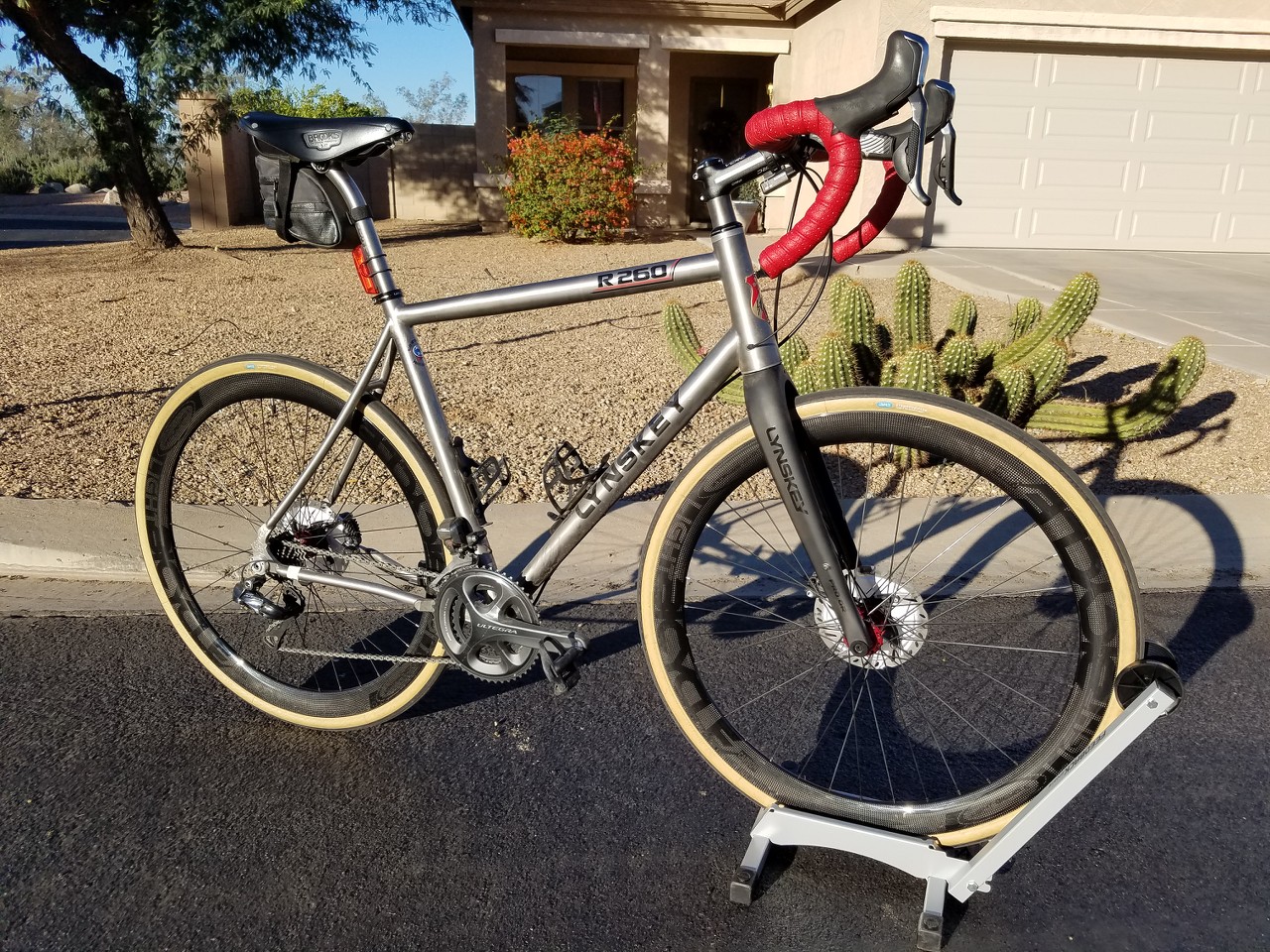
The Lynskey with the AeroClyde wheels on it, with the Compass 32mm Stampede Pass tires:
Closer shot of the front wheel. You can really see how nicely matched the 28mm wide rim is with these 32mm tires:
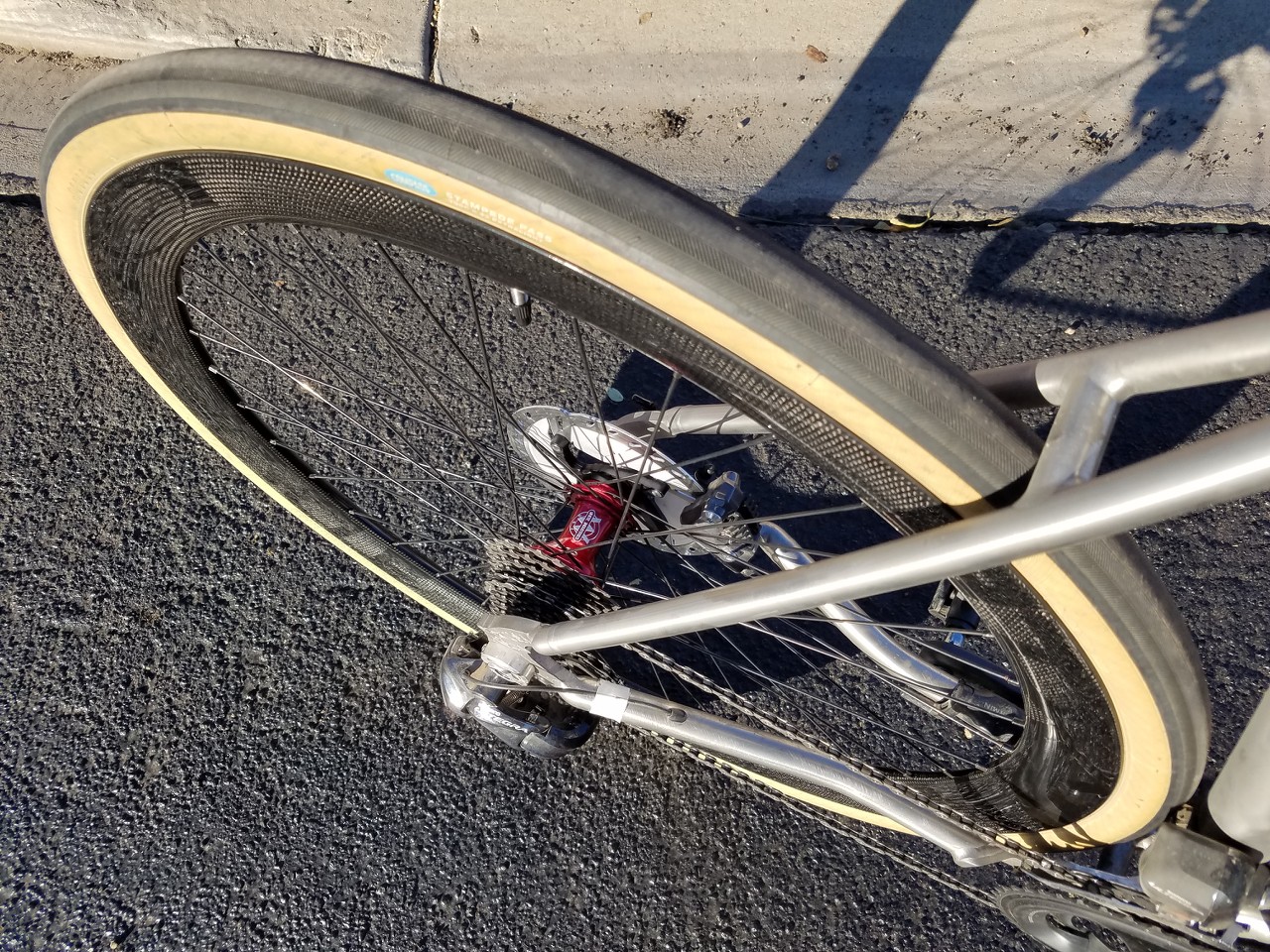
Rear wheel: