Originally Posted by
Kimmo
Au contraire.
So here's what we're talking about; a hub that comes apart like this (the fact it's a through-axle hub is immaterial).
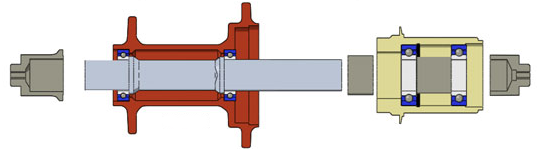
Are we on the same page? Okay.
Now, I flat-out refuse to be told that there's anything more than the axle (and unintended carnage in the ratchet) preventing this when you land a bunny hop:
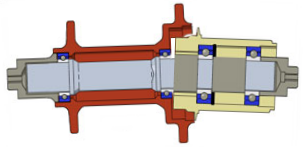
In fact, I've even seen this on a through-axle hub in the shop; admittedly it was helped along by the DS axle bearing seizing (crappy sealing on cartridge bearings anyone?), and scoring a line at the point of highest stress on the axle sleeve. The through-axle inside it didn't prevent the failure, interestingly enough.
Shimano freehubs are based on a far better principle, with the exception of the 7800 hub, and sadly it looks like future hubs going forwards, probably largely because folks seem to have a hard time appreciating the inherent superiority of having the DS axle bearing where it should be, robbing Shimano of their due credit.
Might as well start making lighter, nastier hubs.
Kimmo: thank you for about the only useful perspective in this entire thread. In general, your posts are among the only ones that I read because of your high 'get it' factor.
Back to the issue raised by the OP: the destruction of the rear derailleur probably has little to do with the rear wheel. Based on the dozens of bikes per week I've worked on at my Co-op, it was likely the result of a bent derailleur hanger or bent derailleur. Or both. Root cause: the bike was dropped on its right side. Or perhaps the limit screws weren't adjusted correctly.
Anyway, as to hubs: Kimmo is entirely correct regarding the impact of forces and stresses placed on cassette hubs. There are two classes of rear cassette hubs:
- The Shimano type, in which the freehub is structurally part of the hub shell. The freehub carries stresses from the spokes through to the bearings on the drive side.
- The Campagnolo type, in which the freehub is separate. The freehub does not carry the stresses of the rider and road, but it 'floats' separate from the hub shell. The hub axle is more cantilevered therefore more stressed, and has to be overbuilt relative to the Shimano design.
I own approximately a dozen (high-end) sets of each. Stuff labelled: Fulcrum, Campagnolo, Fast Forward, Vision, Hope, Zipp, etc. The Campagnolo style is fine, if properly executed. But the overall design is sub-optimal relative to the Shimano design. All things being equal, the Shimano-design hubs should be stronger and ligher. Just because the boutique vendors using the Campagnolo design cheat by using alloy freehubs, and small bearings, they can bring the weights below Shimano. But this decreases strength and longevity.
At least the better quality Campagnolo hubs use the superior cup and cone bearing design. Cartridge bearings are a sub-optimal solution in hubs, used by small-fry manufacterers who cannot afford to tooling to make custom cup and cone parts. Plus cartridge bearings by themselves are poorly sealed. If anything, the rubber ring on cartridge bearings causes moisture to be wicked into the inside of the cart, where it then sits forever to rust out the insides. Overall, Shimano hubs are better sealed.
Attending the first year engineering course: 'Statics and Dynamics' would clear up all of this wrong-headed confusion. Aside: the best bike mechanic I've ever run into had zero hands-on experience in working with bikes. But he had a masters degree in mechanical engineering, and access to a sophisticated machine tools, and years of experience in a fabrication shop. His very first used bike purchase resulted in him undertaking upgrades and overhauls that most pro mechanics would never take on. Outstanding: 'get-it factor'. The worst mechanics I've run into: our local bike flippers that clog up Craigslist with dysfunctional crap. Despite working on bikes every day, they are appallingly ignorant about almost everything to do with bikes.