Originally Posted by
tomato coupe
A 5 mm drill is the standard tap drill for M6 x 1 threads:
4.7 mm drill => 100% threads
5.0 mm drill => 77% threads
5.2 mm drill => 61% threads.
We're getting information from different sources apparently. I'd like to know 1) the correct sizes (and yours may be), and 2) the source. I put links in my post - do you have source info, or a citation for the above?
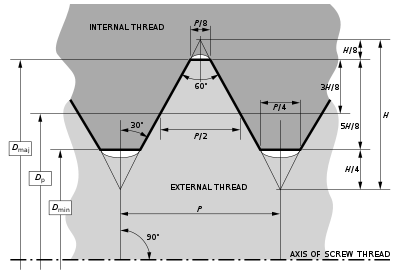
The metric thread form specification is shown on Wikipedia (below). I suspect that we agree that the theoretical thread height H, is sqrt(3)/2 * pitch. Pitch being 1mm, then, H equals 0.866mm. The thread form does not contain the top H/8 of the thread crest, nor the bottom H/4 of the thread root. This makes it stronger than the early American National Standard which used sharp root and crest. The current Unified (flat root) or Metric (allows for rounded root) standards are stronger. Anyway, the internal thread radius is 5/8H less than the nominal, or 5*0.866/8 mm, or 0.541mm. That's 1.082mm less in diameter. So 4.88mm should be 100%. The 13/64 drill bit is 5.159mm. I get this as being 77.6%. Given that most folks target 65 to 70%, and a hand-held drill is gonna make a hole that is a bit oversize I think the OP chose just about the perfect setup.
But where is this discrepancy coming from? 4.7 vs 4.88 for 100%, and 5.16 being either 77% or about 63%?
Can you share your source? I'm going to dig out may Machninists Handbook to see if I can find the numbers in there.