Glad to see that your post came out without the head of the post twisting loose! I've got a Bob Jackson bike in my basement right now with an early genuine LaPrade post with it's pinned-joint head now too loose to ever use again (or to use for much more twisting attempts). The post has been stuck for some years and I've set that one aside for a while in contemplation of phase two (having thus far used penetrants and dry ice in conjunction with too much twisting of the two-piece post). My next go will involve some serious heat-cycling with another round of the dry ice.
Note that heat-cycling (a torch or heat gun applied to the post, just short of damaging paint or precious transfers) is by far most effective on the more deeply-inserted posts. The aluminum post expands lengthwise, breaking much of the bond. A penetrant added while cooling gets pulled in, and with twisting resumed when the post has cooled or (better yet) been chilled.
I had an absolute worst-case sort of stuck post, three years ago. An oversized(!)
steel post pounded down into a Urago frame, probably during the early 1960's.
I couldn't really tell what was going on, other than that it simply would not budge even after much twisting force was applied periodically over several days, while PB Blaster was repeatedly applied to both ends, in conjunction with much thermal cycling using boiling water. This seemed really unlikely in that no stuck steel post had ever challenged me for long.
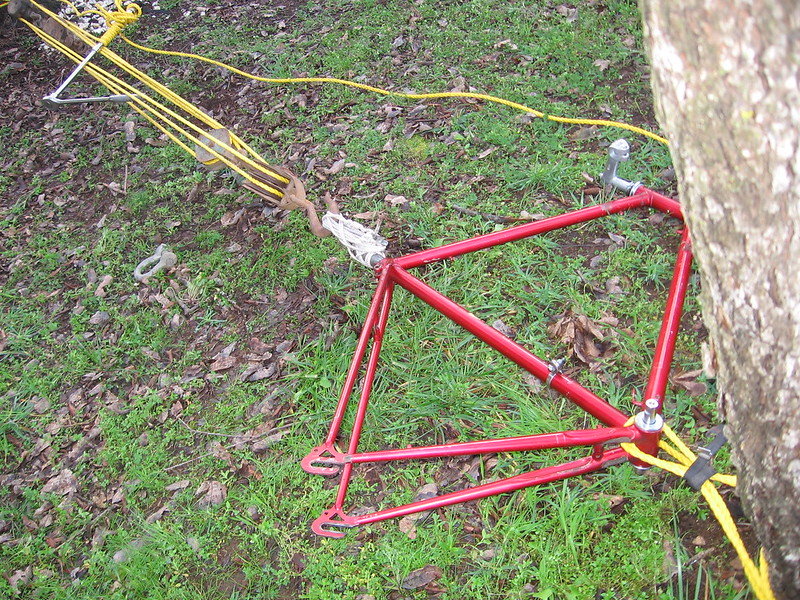
What eventually got it out was the roughly two tons of pure pulling force
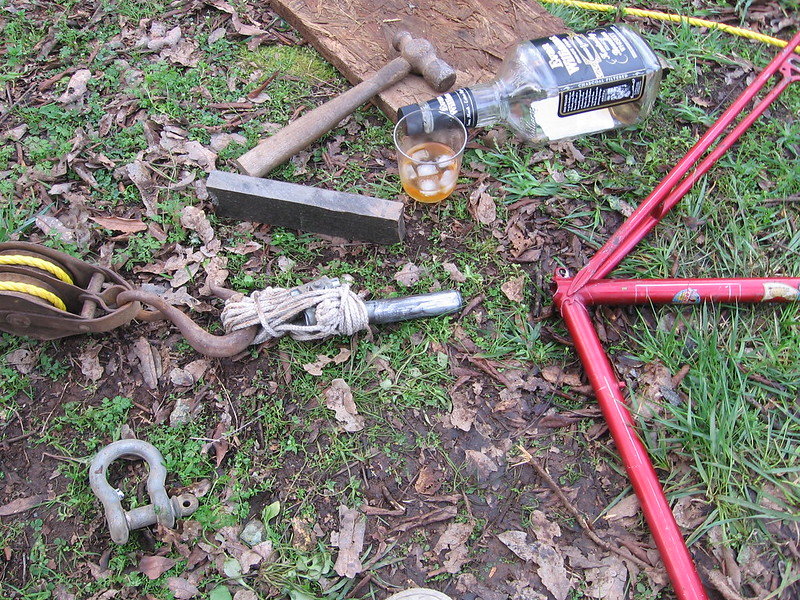
in conjunction with beating furiously on the seat tube using a 2# hammer on a piece of Trex material.
Amazingly, no dents or visibly scuffed paint resulted, and no undue stress to the seatstay attachment (other than the hammering vibration and previous twisting efforts).
The bb lug took all of the pulling stress, and held up to it!
I am still recalling the sound of neighbor's windows slamming shut in likely protest of the persistent, alcohol-fueled hammering resonance!
Truth be told, the drinking hadn't been going on for very long, the booze came out only AFTER I noted the first bit of post movement. I took a "celebration" break right there, then "went at it" in the manner of how I cut up a fallen oak limb with an axe just a month prior.