Canadian troops in later waves of the D-Day assault on Juno Beach, Normandy, came ashore with large numbers of bicycles -- this was after the beach had been secured enough that the landing craft could come in at high water and disembark soldiers close to the sea wall where the bicycles would not have fatally encumbered them over a long stretch of surf and exposed beach under fire. (By this time there was still bloody fighting in the American Omaha sector, where fierce German resistance at the beach persisted until the end of the day. Our lot had an easy time of it, by comparison.) They appear prominently in Canadian archival photos. Nearly all these bicycles were abandoned -- or given away to local civilians -- within a day or two and remain sprinkled over the Normandy countryside in various stages of rust and disrepair to this day. I don't think there was anything militarily special about them -- in other photos they appear similar to what these young men had ridden on farm roads or delivering newspapers in towns. They proved not practical in the bocage country, whose unexpected combination of near-impenetrability to vehicles, including tanks, and the cover they provided for German anti-tank ambushes was one of the great intelligence failures of the invasion.
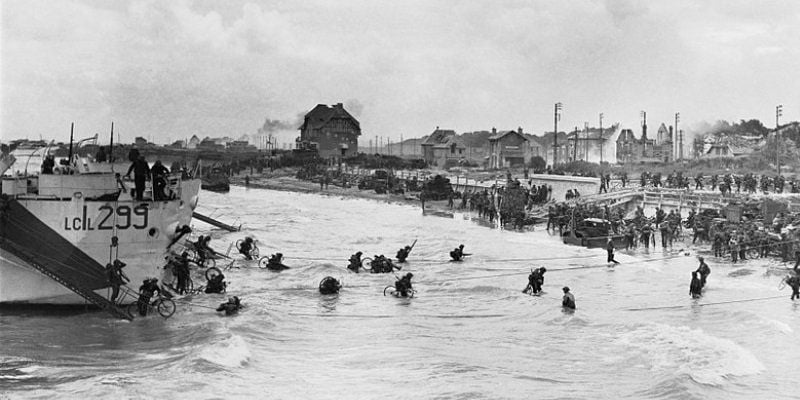 LCIL 299 has hit a mined beach obstacle and has grounded short. (She was later floated off and sailed back to England.) Bicycles being carried by disembarking troops are getting a good salt-water soaking. The prominent house in centre (left end of the beach) was the first house in Bernières-sur-Mer to be liberated by Canadian soldiers in the opening minutes of the landing. The family continues to maintain it as "Canada House" after the death of the owner. It was visited by many veterans over the years. Photo Credit: Imperial War Museum