This thread wouldn't be complete without the Helms cartoon:
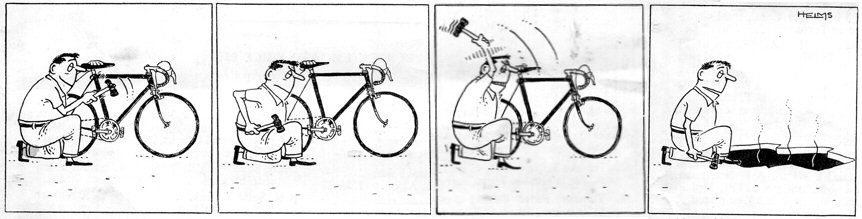
Note cartoon guy isn't employing Best Practice, bracing the crank to the floor as shown here:

Of course that drawing is wrong too -- wrong hammer (use a nailing hammer over a ball-peen) and most importantly, wrong hammer angle. Why did the idiot draw the hammer at that wacky angle? Or in this case I should say whacky. Plus I use a drift punch with a concave end that holds itself centered on the pin, but most people don't have one of those. And they show the bracing block being made of wood — not the best material though it's mos def better than nothing.
When I was in Beijing in the early '80s I rented a Chinese singlespeed (for something like 5 cents a day) and immediately brought it back because of the clunk-clunk every pedal stroke from a loose cotter. The guy just hammered on it like crazy with a BFH, which didn't do much, all the impact being absorbed by the too-soft tires. And as we all know, once those notches have been made in the cotter from riding loose, you can't fix that just by tightening. Oh well I just rode it around with the slightly-diminished clunk-clunk, and had a great time getting lost anyway. I rode through Tienanmen Square at rush hour, back when there were almost no cars and hardly any motorcycles. Just a million black bicycles, every single one with cottered cranks and roller-lever "stirrup" brakes. Fun! Will we ever see that many bikes in one place ever again? Their streets are all clogged with cars now, so sad.
But I digress.
I have a British-made crankset from the mid-60s called Wedge-Lock*, that used unique cotters that they claimed needed no press and no hammering, just tighten the nut. And just loosen the nut and wiggle the cranks a bit to loosen the cotter, no hammering on that end either. They called it "Blitz" mounting. (I like that just 20 years after the war they could already use the word blitz jokingly.)

I've been afraid to try them, not because of the cotters but because they're hollow (tubular), with pedal and BB ends brass-brazed (sometimes called bronze-welded) to a tubular center section. They may not have tested them with someone as big as me, and at my age I'm not as unbreakable as I once was — I really hate falling off. I've broken two cranks and one pedal axle. Thrice bitten, four times shy.
The wedge-lock cotters appear to really work though, maybe from being high-strength. Heat-treated? I'm taking this from the condition of mine — old enough that the toestrap has worn through the chrome plating, and the cotters are unmarked by the spindle. I seriously doubt they've been replaced — because of their unique shape, spares must be rare as rocking-horse manure.
*The name Wedge-lock was also used for a cotterless crank. Confusing? Probably they weren't both on the market at the same time. I've never seen one of the cotterless ones; I'm guessing they didn't catch on.

- Mark B