I like BioPace on hills. Sheldon Brown liked BioPace too.
https://www.sheldonbrown.com/biopace.html
"Biopace is a patented non-round chainwheel design made and licensed by
Shimano. To a casual glance, Biopace chainwheels resemble elliptical chainwheels, but on closer examination they turn out to be the opposite of the classical elliptical design. The product of extensive research and computer-aided design, Biopace chainwheels have the small radius engaged when the cranks are horizontal, the large when they are vertical. This is because the Biopace design is based on a dynamic analysis of the motion and momentum of moving cranks and legs, unlike the static, geometric analysis that produced classical ellipticals.
The theory is that during the power stroke, when the cranks are more or less horizontal, you are using the power of your legs to accelerate your feet, which get going quite fast in the lower gear provided for that part of the stroke. The momentum of your feet then carries the pedals through the "dead spot" when the cranks are near vertical. Since the rider doesn't push as hard during the power phase of the stroke, and motion is slower when the leg is changing direction, the Biopace design is gentler on the knees than even round chainwheels.
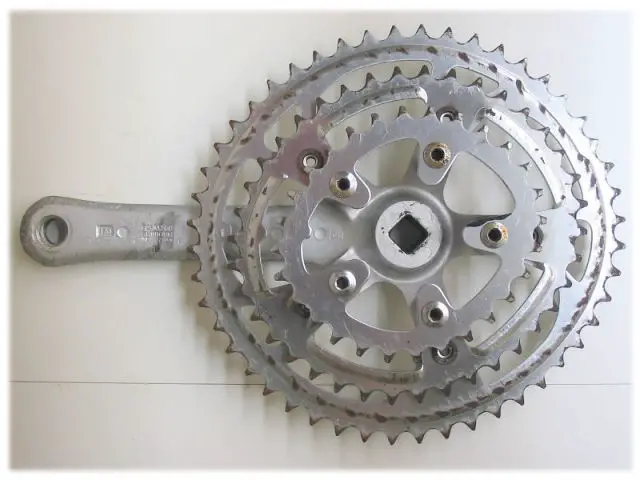
The image above shows 48-38-28 Biopace chainrings on a triple crankset. Note that the smallest diameter is at a right angle to the crank, so the crank turns fastest when horizontal -- in the middle of the power stroke.
What Are They Good For?
Biopace chainwheels are particularly suitable for
touring cyclists and
time trialists, or any application that involves a steady, fairly constant
cadence. They allow healthy, efficient pedaling at slower cadences than is possible with round chainwheels. They are especially suitable for
triathletes and
mountain bikers. The triathlete benefits because the motion is a little bit closer to that of running, making the transition easier.
The mountain biker particularly benefits, because the Biopace design somewhat smooths out the delivery of power to the rear wheel. In climbing on loose surfaces, the limiting factor is often
traction. The rear wheel tends to break loose during the maximum power phase of the pedal stroke, wasting most of the cyclist's energy. The Biopace chainwheel works like a storage device, storing power during the main power phase of the stroke as the feet accelerate, then delivering the stored power to the rear wheel during the "dead center" phase when the cranks are nearly vertical. The same average amount of power is delivered to the rear wheel, but in a smoother, less pulsating flow. The bicycle moves at a more even speed. All the energy is used to propel the bike forward, without the high-power peaks' spinning the rear tire or causing the bike to "
wheelie."
(A bicyclist may achieve a similar effect by leaning back to accelerate the bicycle when the cranks are vertical, then leaning forward during the power stroke, but this "pigeon walk" technique has a cost in efficiency and is not possible when spinning at high RPMs.)
The marketers of Biopace made a crucial error of judgment: too much information. In particular, they mentioned that the Biopace design was optimized for
cadences of about 90 rpm and slower. Many readers interpreted this as an indication that Biopace chainrings would somehow interfere with pedaling faster than that. This perception caused a bit of a self-fulfilling prophecy, and the Conventional Wisdom arose that Biopace was bad for high-performance cyclists for this reason. I [Sheldon] used to believe this myself, but I rode them anyway because I appreciated their other virtues.
In 1989, Shimano introduced a new variant, Biopace HP (High Performance), more nearly round than standard Biopace. This was marketed to cyclists who race in packs and use clipless pedals, but did not overturn the marketing problem.
Among other bikes, I run Biopace on several of my
fixed-gear machines, where high cadences are quite common in descending hills. In practice I have found no less ability to spin fast with Biopace chainrings, and, if anything, they permit me to spin
faster without bouncing in the saddle.
Here's why: While your feet go around in circles, your legs basically go up and down in a reciprocating motion. With Biopace chainrings, your leg speed is faster in the middle of the stroke (when the cranks are horizontal) but slower at the top and bottom of the stroke (when the cranks are vertical.)
The slower motion at top and bottom means that your leg changes direction from upward to downward, or downward to upward motion at a slightly slower, more gentle speed. The increased leg speed near the middle of the stroke is the result of a more gradual acceleration/deceleration with the leg moving in the same direction. Bouncing in the saddle generally results from difficulty with changes in leg direction, not speed in the middle of the stroke. Thus, as Biopace makes it easier on your knees, it also can help you spin faster without bouncing!"
Cheers