Today I took Blue out for a run during a break in the rain, a kind of point-to-point route where the points were all the local dumpsters. Everything was fine, except there is something wrong with the velosteel coaster hub on this bike, because the sprag clutch does not re-engage after coasting or braking. Sometimes it comes in within a quarter of a turn, and sometimes I am left pushing the bike to get up speed, pedalling and then, 100 meters later, it comes back online with a clunk.
I have now determined that the sprocket cone is not tight on the axle shaft, but as yet I have no threadlocker or big vice to tighten it the 'Russian' way. I discovered it after I noticed that the rear sprocket could be rocked from side to side, while the one on Tigger felt normal. I removed the wheel and the cone/spacer combo was indeed loose enough to allow the sprocket to move, yet there were no flats or anything on it by which I could use to tighten it. This was a mystery and, many Russian language videos later, including farmyard chicken background sounds, I was sure of two things: that the cone should be tight on the shaft, and that I understand Russian bicycle mechanics better than I do Russian anyone else.
The trick at the moment is to keep on pedalling, even when braking, the latter being done using the front hand brake. This at least prevents the drive from disconnecting, but it hardly makes for a great ride. Since I am not quite ready to start stripping these hubs, I kind of fiddled it by tightening the cone as best I could with some pliers with the wheel still sitting in the frame, set the chain tension and tightened the axle nut on that side. Then I adjusted the brake at the other end of the axle, aligned the wheel and tightened the other axle nut. Of course, that makes it sound so simple.
My first mistake was to grease the sprocket bearing, much as one would normally do. Howerver, all that grease can then leak into the hub and interfere with the mechanism. It likes it dry in there, as dry as the Russian steppes in summer with just a splash of lubricant, like a shot of vodka when you would normally expect to order beer. In all those Russian language videos (they might have been Belorussian or Ukrainian for all I know) they made it look so easy, but of course they had already removed the wheel and spokes so that the hub could fit snugly in their hand. I, on the other hand, with my loose cone, had to wrestle with a whole bike and inadequate tools.
The Russian way is to strip everything down, grip the sprocket cone in the vice, and tighten the 7 mm square at one end of the axle. The sprocket end. Then you merely reassemble the slightly oily components and adjust the preload at the other end of the axle in a vaguely demonstrated way. Once a chicken has clucked its agreement, you know that the job is done.
With the cone tightened as much as I could with the pliers, the only close-to-suitable tool I had, I then had to make sure that the axle did not turn while I aligned the hub steady bar and tightened the second axle nut. Any rotation of the axle would have slackened the sprocket cone. I was sure that I had a 7 mm open-ended spanner, but no such panner was to be found. I tried my massive adjustable wrench, normally used for plumbing work, but that was too heavy to hold and keep the wheel aligned while I tightened things. My other adjustable was too small, and I began to feel a Golidilocks moment coming on. So off I went to the local builders merchants, whistling 'heigh ho', to buy a suitable 7 mm spanner. This allowed me to kind of get it all back together, but with less than full success. The sprocket no longer wobbled, but the coaster/brake combo still would not reconnect the drive as reliably it should.
Then I found my old 7 mm spanner lying behind a pile of tires, so now I had two. Later, after perusing the local internet for a velospeed wrench, as shown in the 'Russian' videos, I saw that a lot of old bicycle wrenchs have a square hole in them to fit the axle. Then I remembered that I have such a wrench... Off to the garage I went, and sure enough it had the required 7 mm square hole in it. A week later, while sorting out a puncture repair kit, I noticed it too included a wrench with the same square hole in it. Argh!
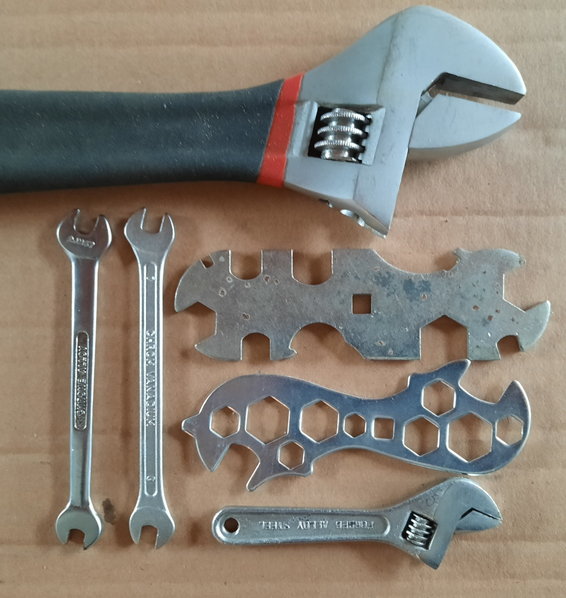 Everything I need to keep one end of the axle in place while I adjust the hub at the other end...
On the up side I did come across a couple of old Romets on my trip, and one was a Jubilat. I stood Blue next to it, and they shared exactly the same type of frame, so finally I knew for sure that mine is a Jubilat 2 and not the more commonplace Wigry. It had been a long and confusing path, as all the sources had suggested that the Jubilat had 24" wheels, while mine have 20" wheels. Given how much a Wigry frame has changed since the 1970s, it took a lot of looking before I noticed that the Jubilat has an extra stiffener tube welded between the crank tube and the folder hinge - on the underside. The upside is that 20" wheels are freely available secondhand, on folders, BMX and kids bikes. It would be handy to find one with a working 'torpedo' coaster brake hub - or even a SRAM or Sturmey Archer hub for that matter.
Interestingly the Jubilat 2 has its seat stays welded to the seat tube below the seat post clamp, while the original Jubilat, like most old Romets, had the seat stays bolted to the seat tube as part of the seat stem clamp. Therefore, once the seat post rusts in place, any loosening of the seat clamp lever may only become obvious when the rear of the frame starts to flex. I suppose that such a design was cheaper on materials and manufacturing, important for a Poland of the 1950s and 1960s as a land of shortages of almost everything, including such basics as shoes. Every year the news reported that, oh no, once more, there was an inadequate supply of bailer twine for the farmers, so it kind of makes sense.
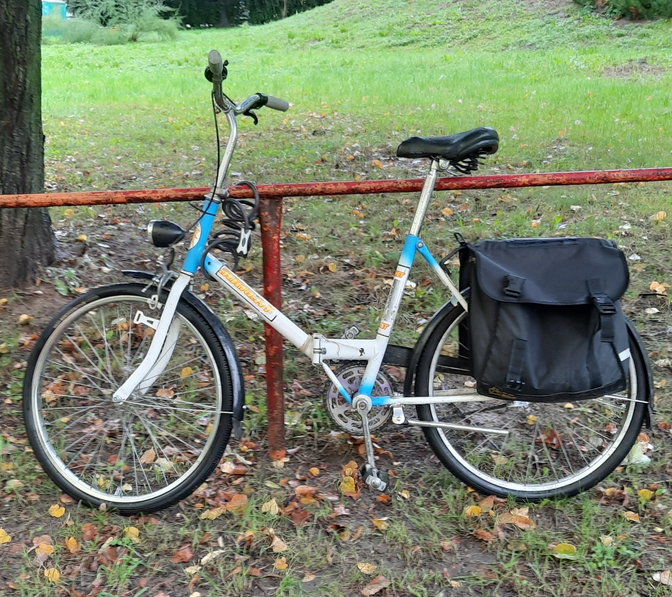 Jubilat 2, still a daily ride. Compare its level of equipment with the red one in an earlier post (and the rather nice front light). Looks like it is still regularly ridden, and while it certainly has a later paint job than mine it is still the old-type frame design. Worringly, it appears to be lacking the locking lever on the folding hinge, maybe it is held together by wire.
Oh, by the way, if you find yourself in dire need of a 7 mm spanner while passing through this part of Poland, I can point you towards a stash of them.