Most of Poland is relatively flat, and this region where I have lived for the past twenty odd years the land gently undulates, cut through with the occassional river valley and plenty of rather cute dry gulleys that have seen centuries of wagon use. It is all part of a former inland sea, basically sea bottom sand with a thin skim of soil on top. This makes it ideal for fixies, single-speeders and coaster brakes, and if little old ladies can survive without hand brakes then I thought so could I. This saves a tiny bit of weight, a little bit of maintenance, improves reliability, cleans up the look and does away with the rather flexible plastic brake lever. Lots of wins! What's more, the great benefit of all that sand is the lack of slippery clay and the quicker draining puddles, although it is a poor surface for tarmac as it easily breaks up and washes away from the edges of the road. However, there are a lot of unsurfaced lanes available to ride between the strip fields and through forests, which compact nicely in damp weather rather than turn into the kind of boot-sucking quagmires I grew up with. Now I remember why, as a kid, I spent so much time with my dog at the beach in winter.
After completing the paintjob and the general cleaning up of the styling on Tigger, there was a fair pile of parts left over. Most of the styling beyond the paint job involved not refitting anything deemed inessential, so the excess parts become available for other projects. There are still some things to do, like finalising the seat and handlebar positions, and sorting the electrics, but anything else beyond this means first hunting down some parts. Like off-road tires.
The front brake from Tigger, nicely painted black because I stripped and chucked it in the spray box along with actual things I needed painted, could be Blue's new back brake. A back brake would mean that I could fit another kind of hub on the back of Blue, if I can manage to turn up an old Sturmey Archer / SRAM / Shimano 3-speed hub, making Blue a better shopper for those places located on the other side of those numerous steep-sided valleys and gulleys. With the addition of a longer brake cable and a bit of fiddling to space the long mounting bolt intended to fit a set of forks, and it should fit. While I am at it, turning up a pair of metal brake levers would not go amiss.
I have seen those arguments on the Internet where someone claims he can prove that one only requires a front brake, but they fail to cover basic situations where someone has average calliper brakes, wet leaves and a lot of shopping - particularly that sack of spuds plus carrots and other root vegetables in the rear basket. The sum total of the latter is unlikely to allow the rear wheel to lift before the probably shuddering front brake manages to bring the whole lot to a stop. I have seen babcias (grandmothers) do it solely on their coaster brakes, probably because they they failed to read up on the subject on the internet. So I want a rear brake on my shopper, but not one that is going to cost more than a bike used as a low-speed root vegetable transporter.
In removing the coaster brake wheel from Blue, or at least the hub if I fancy some wheel rebuilding, I then enter the exciting realm (ahem) of picking up a spare (and cheap) front wheel plus a pair of off-road tires so that I have two relatively easily alternative city and rural wheel sets.
Anyway, the reassembly of Tigger has progressed well, not that there has been much left to refit. The tires on Blue were hard and plasticky, with a tendency to bite as you levered them over the rim using your fingers. Those on Tigger, although coming out of the same factory at the same time, were pleasantly rubbery and slipped over those rims like they were coming home to mama. The tread pattern also looked better: modern and racy, as opposed to Blue's old and pedestrian.
I dropped the saddle height on tigger to BMX level, as it is to be ridden predominantly in the standing position. The handlebars in the standard position do not feel quite right, and could do with being positioned further forward. All I need is the curved handlebar post found on certain models of Wigry and Flaming, and potentially the handlebar from one of Romet's BMX-style kids' bikes, to keep it all in the family. These kind of things are freely available on the internet for little money.
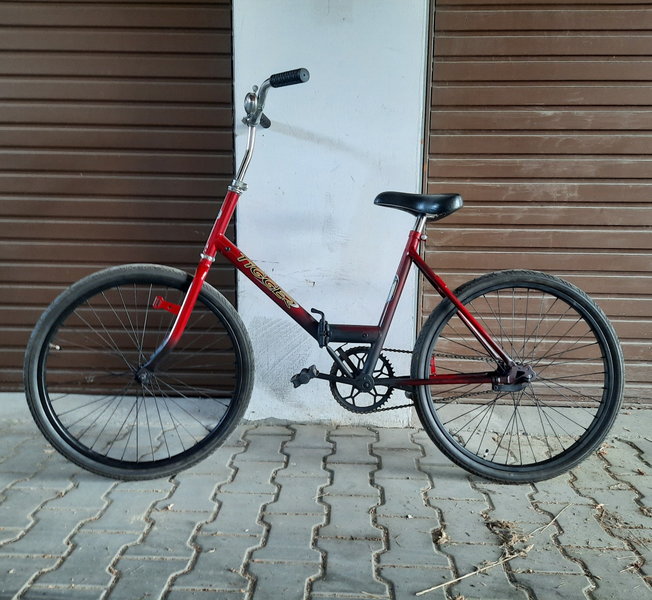 Tigger taking shape, now I just need to finish off the details and it will be ready for the road
.
If I am lucky, the said kids' bike would have 20" wheels and a three speed hub. Back in the days of my old Carlton Continental road bike, i.e. the 1970s, I spent a lot of time riding off road as I enjoy exploring everywhere. I would fit a standard treaded tire of the era to the rear and a 'racing' tire to the front as a compromise between grip at the rear in mud and security in cornering at speed while on the road. This was, after all, the time before mountain bikes. Today, as I can afford a spare set of wheels and tires, I feel this is the way to go, now that suitable tires are readily available. Summer tires and winter tires, what a dream!
Rather than buying a donor bike, there is another option, and that is to keep scouring the roadsides on dustbin emptying days, as well as my regular dumpster scouting, in case someone is throwing a bike away. I have the perfect area in mind: family houses, aging owners with a fair income, willing just to throw stuff out as not worth their time to sell it.
ON other matters, while I do not need any brake other than the coaster brake, I do have to retain a bell to make a bike legal. Both bikes had a nice looking if not magnicent chromed metal bell, although not classic Romet ones, but the mechanism inside relied on some cheap plastic. With my memories of bells from the 1970s with mechanisms that quickly corroded to uselessness, I was not sure whether the cheap plastic was astep back or forward. At least Blue's had already broken before I started using it, and hence before I got attached to it. I removed the now useless plastic and two washers used for the ringing and quietly screwed the top back on.
After riding Tigger for a while, the bell began to ring to itself, every time I went over some bump. I spun the chrome top off only to find that one of the steel washers had vanished, along with part of the plastic frame. I didn't mind the losof the latter, but the washer would have been nice. I think the trouble was that I had rotated the bell to face forward, and the feeble plastic frame was unable to withstand the massive forces of gravity. I added the remaining washer to my fasteners collection, and figured that no one reasonable would expect one of those bells not to have corroded up on such an old bike. The funny thing is that I had only rotated the bell position so that it would not get damaged when I stood the bike upsidedown to work on the wheels. Ho hum.
Other than that, while out riding Blue, I happened to pass by a local bike shop, poked away in a container behind a carpark, and so well camouflaged that I was unaware of its existence until searching for Romet parts stockists on the net. Anyway, look what I found:
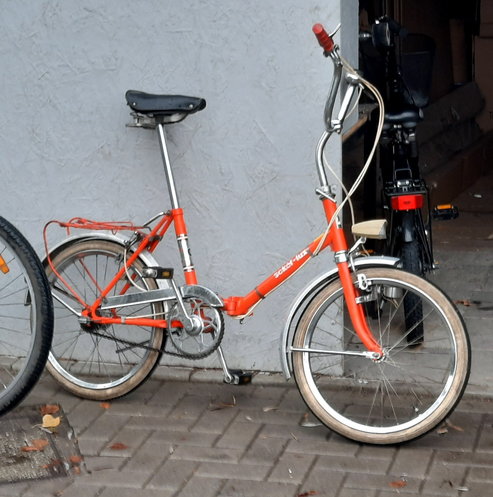 'Lux' it says, so it must be true.
A Romet Sokoł Lux, I had seen a few pictures but this one was the first I had knowingly seen in the flesh. It is like a Romet Wigry but with better specs, and generally made for export to Western countries for the dollars that Soviet countries so desperately needed to remain afloat, under the 'Universal' brand instead of 'Romet'. While the Wigry featured a front hand brake and a coaster brake hub, the Lux had front and rear hand brakes and a Shimano 3 speed hub. I have no idea how many were made or exported, or even where they were exported, but I would buy one. 'Sokoł' means 'hawk', and for some reason in the 1970s both Romet (bicycles and mopeds) and WSK (helicopters and small bikes) decided to start naming their product variants after birds, often the same birds. So a Romet Gil is a non-folding shopper, but otherwise much like a Wigry, while the WSK Gil is a bog-standard 125cc 2-stroke bike that I would not even bother to mention were it not for the fact that the WSK factory is about 10 miles away, alongside Lublin Airport.