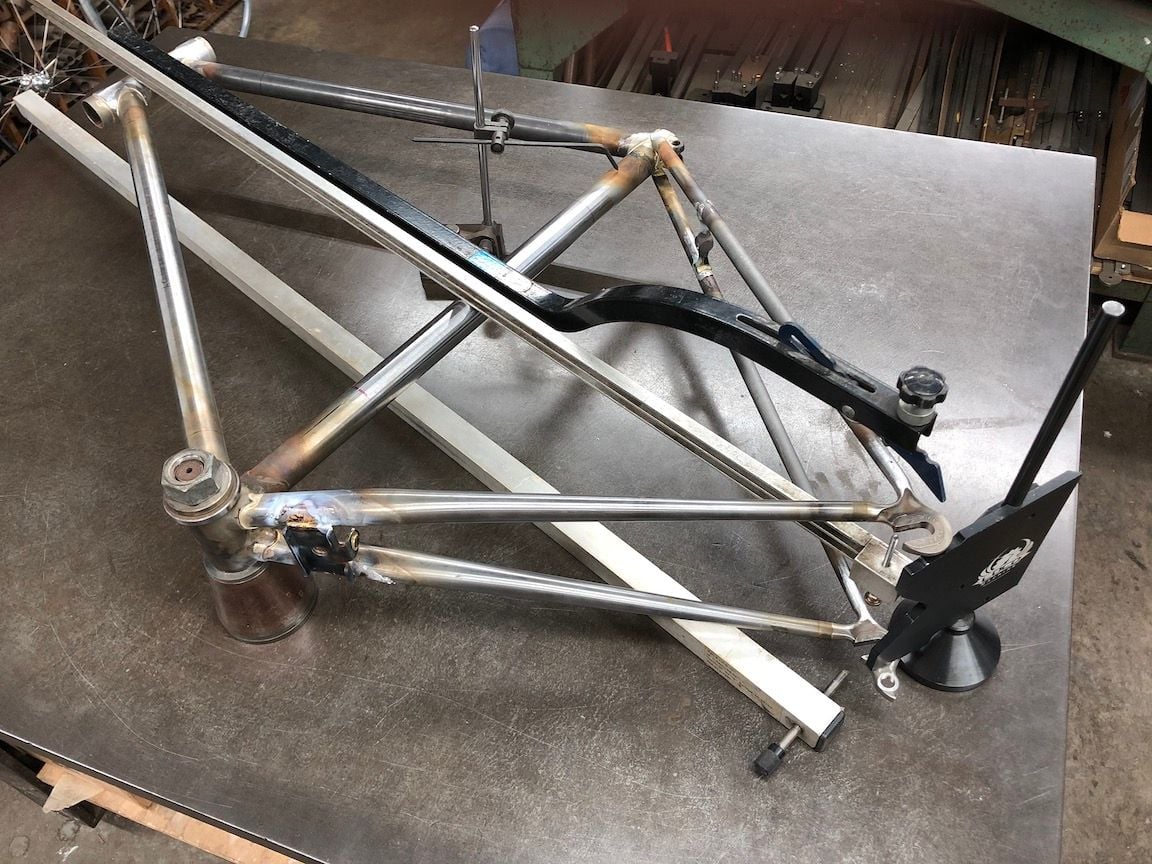
I've aligned thousands of frames in the 45 years I've had this cast iron table. It came from Johnny Berry's shop in Manchester and I suppose he got it from army surplus after the war. However there were a lot of British builders that didn't have an alignment table but what they all had was some kind of long straight edge with an adjustable screw. None of them used string and if you are interested enough in building frames to read subject threads on this forum, you need to get/make a straight edge too.
It is possible to make a decent one between 42" and 48" long out of square tube aluminum that can be bought at Lowes. A finely threaded hole can be taped close to one end (like an M5 or 10 X 32). In Ukraine we used an aluminum level taped on one end. 80/20 makes aluminum extrusion tubing that works too.
Frame alignment begins by making the seat tube 90º to the BB threads. This can be checked with the straight edge holding it against a faced BB shell. If one doesn't have a facing tool, an alternative is using a BB cup as the reference. This is obvious but the threaded rod of the straight edge is held against the cup close to the BB shell. The screw is adjusted to just touch the seat tube. Next the screw is held near the top of the seat tube to see how much it leans. After adjustment the straight edge can be used on the down tube and head tube. These alignment adjustments are necessary to check the accuracy of the rear triangle.
The rear triangle can now be checked holding the straight edge against the head and seat tube and adjusting the screw to just touch the inside face of one dropout. The SE can switched to the other side to see if the face of the other dropout is equidistant from the frame's centerline. Of course they not only have to be equidistant but also at the right width. I use a 6"/150mm ruler for this.
Here is a picture of my alignment tools.