It is always interesting to look at the Location when reading threads. This is predominantly an American thread. If it were a European thread there would be a nuanced distinction based on use.
In American terms, in speaking about stiffness, think the difference between a Cadillac and an F-150 Ford pickup truck. Stiffness in a truck allows carrying capacity. Ditto in a bicycle. If you buy an Italian city bike with a Dedacciai steel tubing Zero Uno frame it will ride like the proverbial Cadillac (think 1950's squishiness) but offer nimble handling that is called
sporty as opposed to racing. You will be unaware your regular ride has constant small bumps and irregularities because the flexible steel springs and frame absorb them. Only when you do the same route in a stiff bike do you start cursing the highway department for using the lowest-bid contractor.
However, if you then put panniers on your Dedacciai frame bike and load them up with 30kg of gold bricks, it will sway to the point of being unsafe. I had this experience once in Berlin when we were relocating to Dresden and had to pack everything (not gold bricks, unfortunately) on the luggage racks to ride to the train station. It took all my concentration to not crash. When we got to Dresden with cobblestones, I gave up and pushed the bike to the hotel. After that I organised a van to carry everything on to Prague and carried a credit card with me instead.
For a freight bike you need stiffness. The ride will not be as comfortable, but the weight will be manageable.
The American approach is different because the DNA of cycling is different. Bicycles in Europe evolved over a century as a mode of transport. They were tools. They went out of fashion for a while until the 1973 OPEC Embargo when Europe - especially the flat lands - began to build bike paths, roads and lanes. Riders were equally men and women, mostly dressed in street clothes going about their business. The bike was a way to get around and was designed as a tool not a toy. In contrast, bicycles in America were forms of mobility for children until they got their drivers license. A small minority would road race, and this gave rise to emulators - 10-speed, drop handlebar bikes great for racing. Think the Peugeot PX-10 versus the Schwinn Continental... often both sold in the same bike store to uninformed customers who would buy what the sales person pushed - both were silly for the average flatland city rider who really needed the Raleigh Sport or DL-1 that was sitting in the back room of the bike store gathering dust as old-fashioned.
Then a group of Peter Pans (adults who don't want to grow up - I'm one of them BTW) began to take the bikes of their childhood and use them to crash down steep hills in Marin County, California. These became mountain bikes, and the American buyer could now go into the bike store and choose between a 10-speed racer and a MTB like a Gary Fisher hardtail. The active shock absorbers necessary when striking stumps and boulders at high speed going down mountains moved into street user bikes (euphemistically called
hybrids) to address the same issue spring steel addressed in Europe. From an industry perspective, this is good because shocks don't last. European bikes, like the Raleigh DL-1 can last 50 years or more. The industry needs planned obsolesce to sell more new product. It is not billed for the cost of disposal, so it designs its bikes for a specific life cycle, after which the vast majority end up in the town dump.
A small population of Americans, mostly in places like Boston and Portland, educate themselves on European bikes and small bike shops eke out a living importing and selling them. But for the most part, Americans only know what the bike stores sell, and they sell trends not tools.
Bottom line: yes: flexibility is important, stiffness is important, but not for some obscure blather that marketing types put in their brochures so bicycle sales people can quote it authoritatively to prospective customers as an important reason why to buy their brand over Walmart bikes.
Relative stiffness is all about use.
- If you need a lightweight bike because you live in a walk-up apartment that is different than weight considerations for the Tour de France.
- If you want to go bike camping for a month, you need a different bike than a month bike touring with a van that carries the group's luggage from hotel to hotel.
- If you use a bike to commute to work the same route every day, relative stiffness and riding position will be based on the road conditions, but that also opens up different requirements...
What angle the back and head? In racing, head down reduces wind resistance but you can't see the bus trying to squash you. Head up allows eye contact with others, riding becomes more friendly. Fenders means you can wear business attire and not have a brown skunk line up your back when you arrive.
And of course, electric motors are the big game changer. Suddenly bikes become an option in Switzerland. Their extra speed means better brakes, better tyres and rims and eventually more safety equipment like rear view mirrors, horns instead of bells, always-on lights and in some cases stronger frames that have a different stiffness requirement for different reasons.
And as usual, I try to include a photograph so readers keep interested in my posts.
This was taken on EU bicycle Rt 2 somewhere in Germany. Unfortunately, I did not want to be obvious about it, so look carefully. One bike frame has been welded onto the other and the load is incredible, including juggling pins and leeks for dinner.
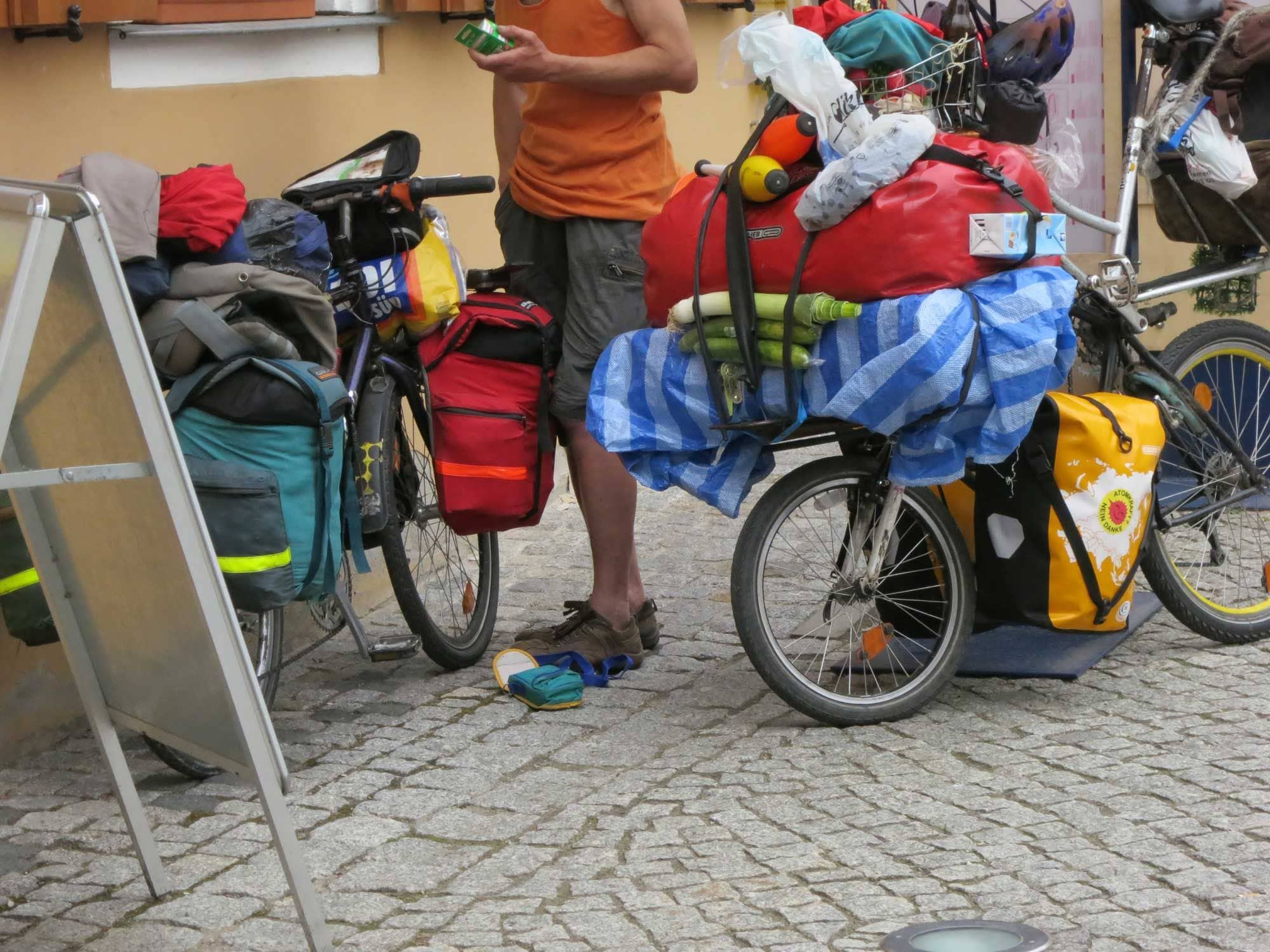
On the same route, at what used to be an armed border before the EU, we have bikes packed for credit card touring. Note the umbrella:
