Clothing, I always have a down vest. Packs really tiny, weighs almost nothing. Front open, adds little warmth, front zipped or snapped up and adds more. Under a windbreaker or rain jacket it adds a lot more. I keep my thin beany stocking cap in a vest pocket so I know where to look for it. The stocking cap seems to make a sleeping bag warmer too.
My rain gear is strapped on top of my Frontloader panniers, it is very handy there, release the buckle and it is ready to go. And front panniers, you can see if it is loose. The Frontloader panniers have a strap that goes over the top, that is the strap I use.
A gal I used to work with always used a sleeping bag liner. She said it kept her bag much cleaner when you are grungy. That was good advice, I have been using one for over a decade, it is easier to wash a sleeping bag liner than a sleeping bag.
***
I have used both top loading (load from the end) and side loading (much wider opening to load it) drybags on top of the rear rack. Advantages and disadvantages to both.
The top loading ones, when empty are easily rolled or folded to store it in a pannier when not needed. Side loading ones have a stiff piece on the opening to make it easier to roll it up and close it. That stiff piece makes it much less likely that you can fold it up to shove inside a pannier when not needed.
Previously I suggested to you a side loading one because it has a bigger opening and is easier to organize. But if you pack light and would usually not use the extra drybag, a top (or end) loading one that is easier to store in your pannier would make more sense. So, disregard my previous suggestion for a side loading one, for you a top loading (end loading) one probably makes more sense.
A few years ago I became a big fan of those bungee nets with hooks to attach drybags to a rack. But a nylon strap or two is a good thing to have along too.
***
There is one more option that you may consider instead of front panniers. The bike packing crowd has been using things that are essentially a cross between a rack and a water bottle cage, two of them that come to mind are Salsa Anything cages or Blackburn Outpost Cargo Cages that can be used to strap a small dry bag onto a fork. Once those two brands of cages came out, lots of other manufacturers jumped on the same band wagon to make similar devices. And Salsa has made several versions of them. The drybags that you can use with that option are roughly half the volume of the Ortlieb Frontroller panniers and much lighter. I have no photos to show as I do not use them. I think your bike will have the fittings on the front fork to use those cages if you so choose. The Salsa ones use three mounting bolts, the Blackburn uses two that are the same distance apart as standard water bottle cages.
You might consider those as another option if you are packing as light as I think you plan to.
***
You mentioned the tent you plan to carry. It looks like that is a trekking pole type of tent, you probably have either long trekking poles for it or long tent poles that will not fit in a pannier. You would either need a tent pole bag, or poles that fold up much shorter.
I went the shorter pole route. Tent in the photo below is the trekking pole tent I like for bike touring, the poles for it are ones I cut to fit in a front pannier. This is from my bike tour two years ago.
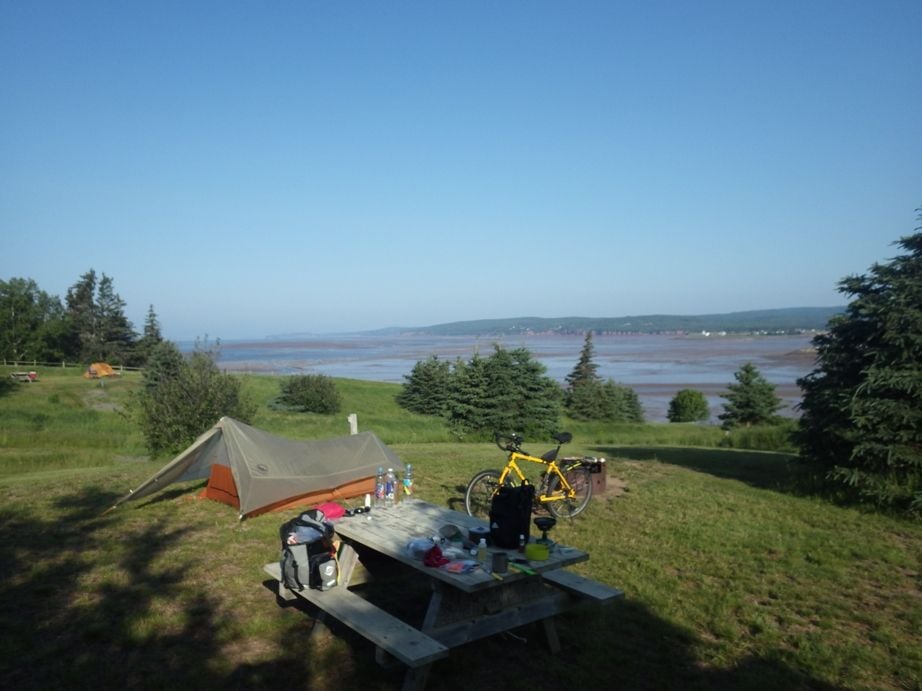
I bought a cheap long tent pole on Ebay, shipped from asia. I cut down the pole segments so that I could fold up my tent poles to be short enough to fit in a pannier. It took some quality time with a spreadsheet to calculate the exact lengths I needed for the pole segments and a good hack saw, file and vice to do the cutting. I probably spent a lot more time calculating lengths than I did actual cutting and fitting. Also bought some trekking pole rubber feet from asia, used them on each end.
I do not know if any camping stores these days will custom cut a tent pole or not. But I did not look for any, I am an engineer by training and have lots of tools, so it was easy for me to make the shorter poles myself. And I do not know if any of the tent makers that are making poles that substitute for trekking poles wll cut ones that fold shorter for a pannier.