Originally Posted by
rm -rf
(That was a bit confusing when I landed on the first page of this old thread.)
You can test your wheel sensor: while off the bike, spin the wheel with the sensor. if your GPS (Garmin?) shows random very slow speeds, it's using the GPS signal, which randomly drifts around your location if you are stopped. The wheel sensor will show the fast wheel rotation speeds.
I like having a wheel sensor on my Garmin. It's more accurate on slow, steep climbs, and handles starting and stopping a bit better. It's not critical, though.
I'm not sure why your climbing recording showed those odd dips. Try uploading the recording to ridewithgps.com, and see how it looks there. They have different smoothing methods.
I followed your suggestions: I deleted the sensor, re-paired it and started a ride indoors, spun the wheel and the reading was quite accurate. I can confirm the sensor is doing its job. Not sure if I should rely on the automatic calculation or if I should manually enter the wheel's size though.
Originally Posted by
rm -rf
Ride recordings need to smooth out the second-by-second raw data!
Each second of the ride is another data point. Slight inaccuracies in location and elevation will produce big swings in the data from one second to the next, up and down.
I save my rides in the free software "
My Tourbook" on my PC, along with Strava.
My Tourbook has settings for the smoothing method and amount. I kept the defaults. Too little smoothing, and there's fake peaks in speed and elevation gain. Too much, and top speeds, gradients, etc, are all rounded off. It's a tricky balance.
That was very useful, thank you. I loved the app. I wonder if it is possible to trim tours in order to generate Garmin courses based on this data?
I tried it and it shows very interesting data indeed:
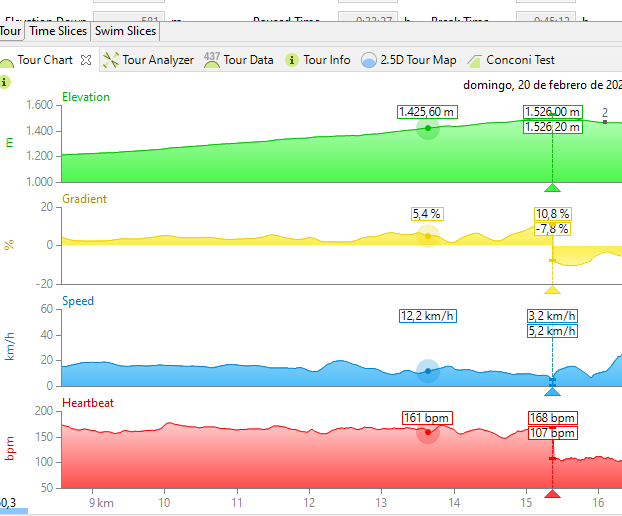
Still doesn't explain why the reading real-time on the bike reading it from the Garmin's screen at a constant pace sometimes is erratic, but I guess the re-pairing may fix it. I'll know the next ride tomorrow morning if the weather helps.
Thank you!