I attached a photo of my rear sprocket before I flipped it over to start wearing out the other side of the teeth. This is a 16T sprocket, older threaded style.
That Sheldon Brown article that I linked to above commented that only the chain links that have outer plates are elongated, the inner plate links stay the same length as they wear. And it commented that some people mark one tooth so they can always put the chain on the way it was before. I cut a small notch in a tooth on chainring and sprocket, so I can always put my outer links on the notched tooth.
The left tooth in the photo is a tooth that had inner plates. If this sprocket was still on the bike, the camera would have been on the right side of the sprocket looking towards the sprocket. I mentioned above that I run a small chainline error, my bottom bracket spindle is 10mm shorter than it should be, I did that so that the Q factor on my Rohloff bike and deraileur bikes is the same. Because of that chainline error, teh chain links with inner plates rub more on one side of the tooth than on the other, that is why that one tooth shows so much side wear.
In this photo, the chain was pulling towards the right, thus the chain was rubbing on the left side of each of the two teeth shown. That is why each of the teeth is more hooked on the left side of the teeth, that left side is where the metal was worn away. I run my chains on my Rohloff bike well beyond the conventional 0.75 percent wear, that is why there is so much more wear on the left tooth than the right tooth.
If on the other hand your sprocket has an odd number of teeth, each tooth will wear the same way, as each revolution with an outer plate on that tooth is followed by a revolution with an inner plate on that tooth.
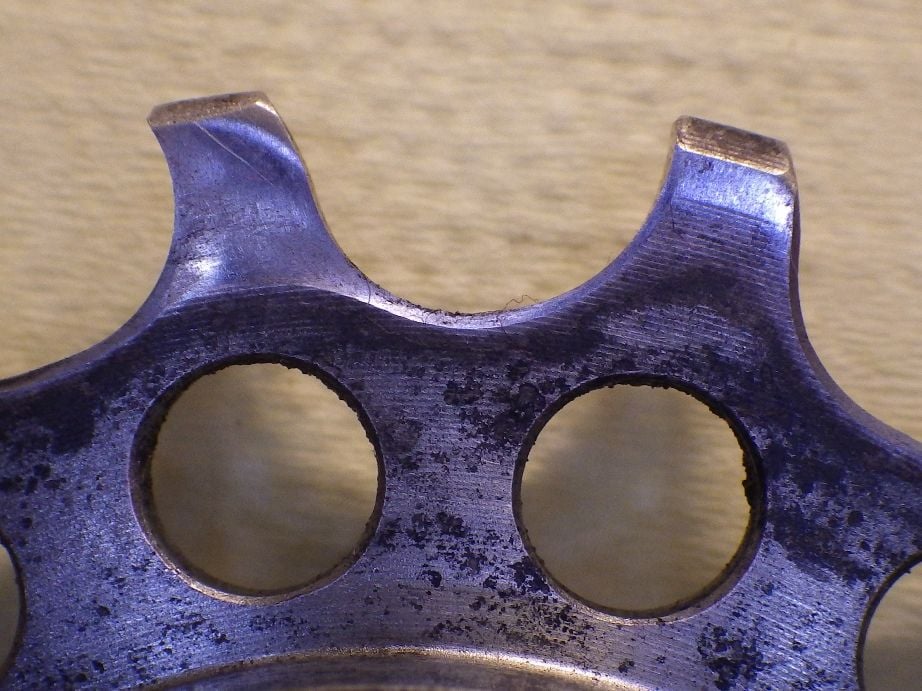
The teeth were hooked enough that when I put a newer chain on the bike, the teeth caught on the chain links, as that chain was not elongated as much as the older chain I removed. So, it was time to flip the sprocket over so that I could use a less-elongated chain.
***
They no longer sell threaded sprockets, so if your sprocket is threaded, to replace a sprocket you will also need to buy a new sprocket carrier that threads on to the bike.