I figured out that your ego won't allow you to ever admit being wrong, that's why I offered you an off ramp at the end of my last post to protect your ego with, but you refuse to take it and again double down on these incorrect beliefs. Amazing.
Originally Posted by
cyccommute
... excessively meadering post that can't focus ...
This isn't very complicated. It all comes down to you mistakenly tying spoke tension balance to dropout width like it's some kind of critical lifeline. I explained patiently to you that the hub designer can give ANY hub ANY tension balance simply by moving the non drive side flange left or right on the hub shell, or by changing the diameters of the flanges. You indicated that you understood what I explained, and immediately afterwards you come out with this:
Originally Posted by
cyccommute
Once the hub is made, there is nothing that the wheel builder can do to change the flange placement.
Yeah no sh*t Sherlock, it's because you're wrong. The hub designers at Shimano don't agree with you and that's why they don't manufacture hubs your way. What an outrage that the industrial engineering team at a $14 Billion market cap international corporation doesn't take advice from an obscure chemist in Colorado. The world apologizes to you on their behalf. LOL!

Let's take a modern hub,
(link here). This is Shimano's latest and greatest XT level 12 speed mountain hub. As you can see since is made for modern mountain bikes it has a 142mm width, which according to you is a good start for spoke tension balance. But wait, what else do we see? Excessively large non drive side flange. Oh the humanity the world is about to explode! If according to you the spoke tension balance was the end all be all, they could have reduced the non drive side flange diameter to vastly improve the spoke angle and greatly improve the tension balance. But why don't they take this completely free opportunity to get the spoke tension balance as close to 100% as possible? According to you 80% is better than 70%, 70% is better than 65%, 65% is better than 60%, no?
Because you are wrong and Shimano's engineering team knows better than you. They chose to prioritize more overall triangulation instead of getting the best possible spoke tension balance. But didn't you say tension balance was the end all be all way to achieve a strong wheel? Who is right, you or Shimano? We're over a hundred years into the history of bicycles and some obscure nobody like you thinks he can come out and start back seat driving global manufacturers on something as fundamental as hub design. It's freaking hilarious how big your head is.
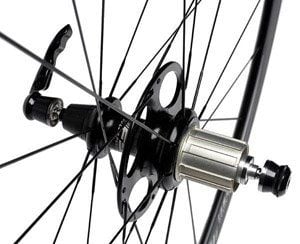
And for your curiosity here is an FSA hub which does play with flange sizing. A rather extreme example that uses some bizarre triple flange system that supposedly "improves aerodynamics" according to their marketing. It looks like all the outboard spokes are radial. Crazy stuff. Whatever else you say about this hub, that tiny non drive side flange certainly makes the non drive side spokes as vertical as possible to achieve high tension on that side.
FSA RD-600
________________
Regarding wheel building and spoke breakage: You clearly don't understand the mechanism for how spokes break. If you cannot explain the correct reasoning behind why things should be done a certain way, then you're nothing but a rote repeater. You should not be building because a wheel building machine can do just as good a job as you. You should not be teaching because a tape recorder or photocopier can do a better job at repeating rote information.
Yes, contrary to what you claim front wheels do develop loose spokes. You claim to work at a bike co-op? Seriously how many bikes do you see? You're volunteering only once a year or what? You have 200+ lb guys out there whose front wheels see more load than the rear wheels of normal cyclists. You have fixed gear guys out there who are riding completely symmetrical flip flop hubs which still break spokes. All wheels can easily fail if not built well. Yes, it is the highest tension spokes that break, which is most frequently the rear wheel drive side. Once some spokes lose tension the load becomes disproportionately concentrated on the remaining spokes which have the highest tension. That's how the highest tension spokes exceed the yield point and fatigue to failure. If you look at a failing wheel it will always have spokes that are going slack. It's not the slack spokes that fail, it's the tight ones which now have to carry too much load. This is how poorly built wheels fail over time.
Previously I thought you were at least a good mechanic. Now it turns out this is not the case either. Unbelievable. Why don't you use a tension meter? You think you can rely on "experience"? When you need to measure a distance can you also use your eyeballs instead of a ruler because you have "experience"? Ridiculous. You can pluck the spoke for sound or squeeze the spokes with your fingers all day, buts since every wheel is using a different spoke layout and spoke gauge, you will never know the precise kgf tension without a real tension meter. If you can't measure tension with complete accuracy, then your wheel will never be as strong as it could be. Is this amateur hour or what? Nowadays you can get a nice dial gauge tension meter from Aliexpress for very cheap, and they work way better than that old blue colored stamped metal thing from Park Tools.
(Link)