That may have been a post of mine you remember, I've been harping on that for years.

Just a gut feeling really, can't prove it, but the cracks I've seen in chainstays over the years does somewhat back that up. Confirmation bias is a real possibility though, like maybe I only notice the broken ones that match my pet theory?
But here's my thinking: That sharp crease down the middle, which normally might be cause for alarm (stress-riser), is down closer to the neutral axis, both for bending and twisting loads, so stress in th part will tend to flow around that crease, not through it. The creases that matter more for fatigue endurance are the ones around the periphery of the indent. And if you make the bottom (or central) crease with a larger radius, it tends to make those peripheral creases sharper.
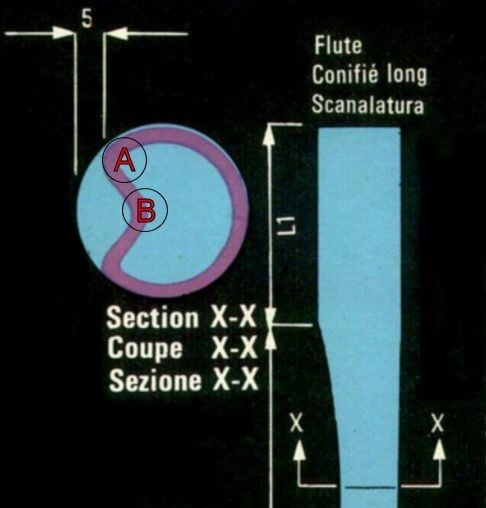
This is from a Reynolds brochure from the '70s. The "A" and "B" markups added by me.
I think you can see how, if you increased the radius of the crease at B (made it more gradual), that would tend to
sharpen the bend at A, which is where durability matters more.
This is backed up by the observation that some brands of chainstays that had a sharp crease down the middle lasted a long time. Both in the sense of individual frames lasting, and in the sense of that design feature continuing to be used for decades of chainstay production. One example you might be familiar with is the sort of leaf-shape indent in Columbus SL and SP, in the decades before the round-oval-round took over in popularity.

Another good example is the aluminum Barra frames from the 1940s. A good example because those frequently broke — but not at the chainstay dimple! So even in fatigue-prone aluminum, this shape didn't cause cracks.


That second pic is of a 65 cm frame, so presumably a big rider. No telling how many miles though.
Contrast that to a style I see a lot in recent years, mostly China or Taiwan made, with a big-radius curve down in the bottom of the indent and sharper transitions around the periphery. I can see why they'd want to use a big-radius indenter, but I think it's misguided. Example, from a Crust bike:

Look how sharp the radius is above and below that chainring clearance indent, visible by the reflection lines.
I'm not saying Crust bikes are going to break there. So much more goes into whether a chainstay will last, like thickness, alloy, heat-treat, welding skill, rider weight mileage and riding style among others. Al I'm saying is I kinda hate this indent style!
Other bad style, that I know for sure caused cracks (saw plenty of them BITD) was the short-lived "flattened" style used by Reynolds on their 531 SL tubeset when it first came out. Any halfway-strong riders broke those so you don't see them much these days! R soon switched to a R-O-R style.
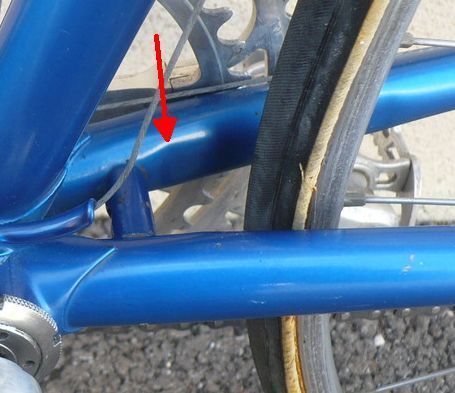
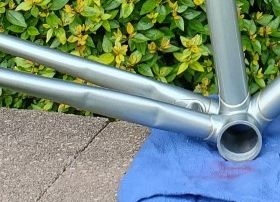
It's subtle, but you can see it's more an up-down shape, similar to what you'd get by hammering in a big pipe to add clearance on a finished frame. here's another pic showing this shape used as chainring clearance:
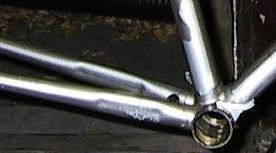
And another from a '70s Moto Le Champion:
Anyway without any numbers or other proof, all this amounts to is which ones I like and don't like. But after 50+ years of looking at broken frames, I think my gut feeling is hopefully based on some semblance of reality.
Mark B