Originally Posted by
Andy_K
Here's my take on this. If you're a professional wheel builder, you need to build wheels to a higher standard of reliability. If you're building wheels for yourself, you have the advantage that your wheelbuilder rides along with you every time you're on the bike. If I build a wheel for myself and after 20,000 miles it starts breaking spokes, I replace all the spokes and start over. I get more wheel building experience that way. Frankly, if I paid my LBS to build a wheel for me and it started breaking spokes after 20,000 miles, I wouldn't be too upset. If I build a wheel for myself and it goes out of true after a few rides, I true it and ride on. That's where I'd be unhappy with a wheel I paid to have built.
My quote was in regards to fatigue, so while it's handy to be your own wheel builder, you'll have to be carrying spare spokes for that to be useful.
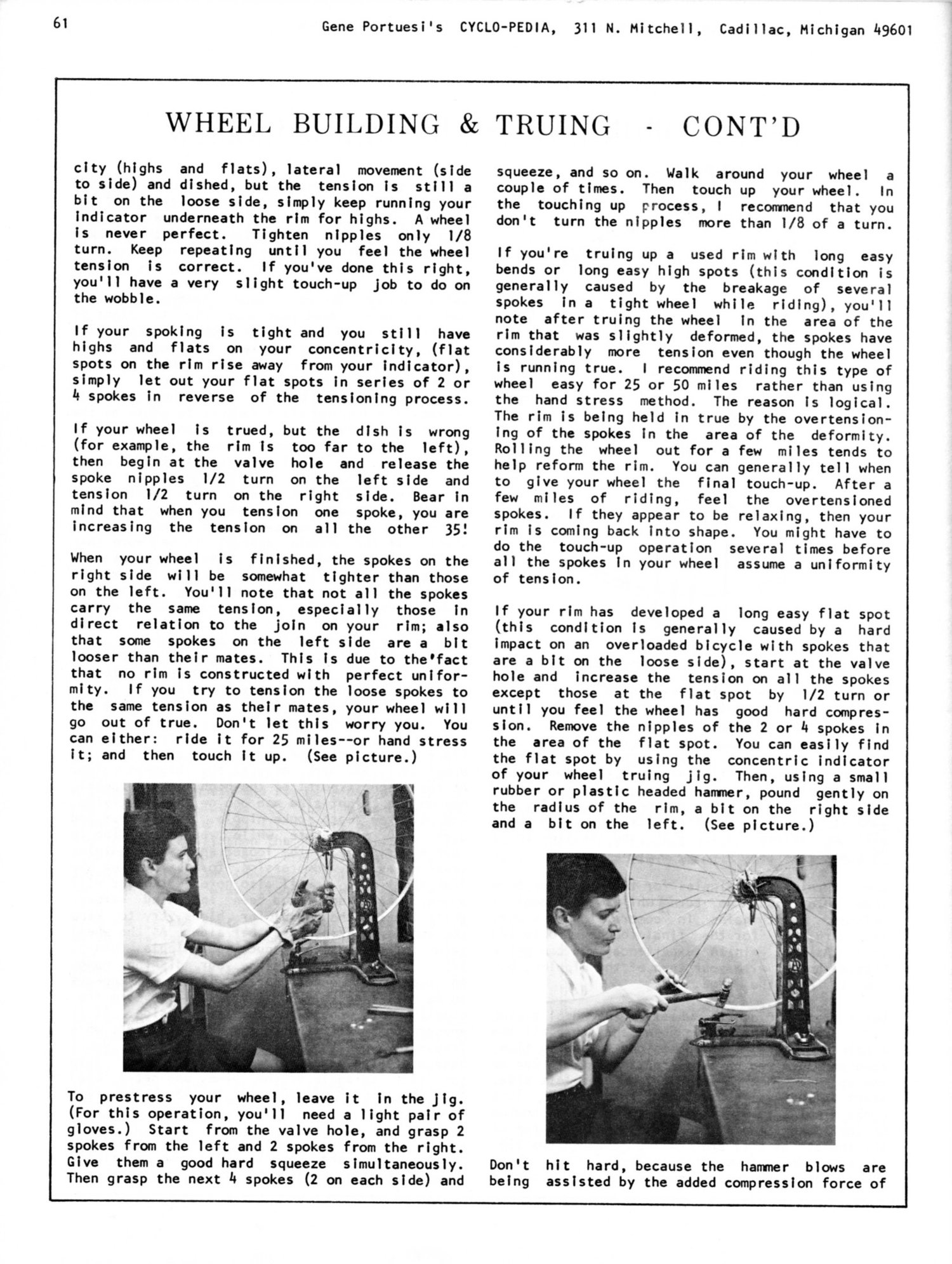
Fortunately, I have the feeling that you'll experience wheels going out of true due to low spoke tension before fatigue becomes an issue. As long as you recognize that low tension is the reason for the recurring untrueness, you should be able to correct the situation. Back in the 70's when I learned to build wheels, I don't recall that there was an explicit mention of the relationship between tension and fatigue. Of course, there were no tension gauges either... in the Cyclo-Pedia catalog article about wheel building and truing that was part of my education, it just said "Tighten the nipples only 1/8 turn. Keep repeating until you feel the tension is correct". I do still stop once I get to 1/8 turn increments, but the whole idea of knowing what tension is correct is pretty unquantified. Even Jobst said to tighten until the rim started to collapse, which never quite made sense to me.
I think I had to wait until I could check the tension in friends' wheels (that I had faith in) before I got a good feel for what the proper tension should be. I still check my new wheels against my old wheels when deciding when the tension is adequate. I haven't invested in a tension gauge. Instead, I just grab pairs of spokes and see how far they flex when I squeeze... very much like the hand-stressing in the photo below.
Steve in Peoria