Originally Posted by
Kontact
A shaft of 2mm steel is weaker than a shaft of 1.8mm steel? I don't think so. Butted spokes just distribute large load variations better.
It’s not the shaft that is important. Breakage midspoke is very rare no matter what the thickness of the spoke. Breakage at the threads is also rare. The overwhelming point of breakage is at the elbow of the spoke. Read the Hjertberg link. But someone has actually measured the strength of spokes of various gauges. Pillar actually provides graphs with actual results. For example the P14, straight gauge spoke has a breaking strength of 270kgf
 Image 5-11-18 at 1.41 PM
 by
Stuart Black, on Flickr
The 1415 spoke is a 2.0/1.8/2.0mm double butted spoke with a breaking strength of 308 kgf. That’s an strength increase of 14%
 Image 5-11-18 at 1.44 PM
 by
Stuart Black, on Flickr
The 2018 spoke is a 2.2/1.8/20mm spoke with a breaking strength of 340kgf. That’s a 26% increase over the straight spoke. Pillar also makes a 2.3/1.8/2.0mm spoke with a breaking strength of 400 kgf which is a 48% increase in strength over the 2.0mm spoke.
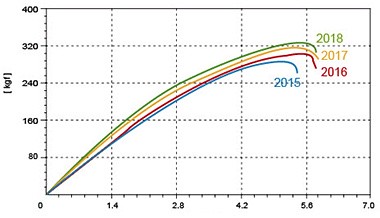 Image 5-11-18 at 1.43 PM
 by
Stuart Black, on Flickr
There is a very real gain in strength over “regular” spokes that make these kind of spokes worth using.
Why wouldn't 32 2mm spokes be strong enough for the task at hand? How many 14g spokes does it take? 36? 48?
To your first question, because they aren’t. Broken spokes are the most common
failure problem for bicyclists. Derailer adjustment is most likely the greatest problem but when it comes to something breaking, there is no other item that breaks more consistently on a bicycle than spokes. To your second question, yes. 36 2.0mm spokes would be the minimum for most heavy riders. 40 2.0mm spokes would be better. 48 2.0mm spokes would be the best. Or you could build a 32spoke wheel with triple butted spokes and, according to Hjertberg, have a wheel that is the equivalent of a 42 spoke wheel. Since 48, 40, and even 36 spoke hubs and rims can be difficult to find, building with stronger spokes makes sense.
What is it you see as such a monumental problem that the kind of wheel nearly every bike came with for some 30 years is not strong enough to handle?
The fact that spoke breakage is a huge problem for many riders. My wife and daughter have never broken a spoke…even on loaded tours. As someone who is dragging 200 lbs pretty hard and rides carrying touring loads on a regular basis, spoke breakage has been something that I
have experienced on a frequent basis. I’ve experienced spoke breakage on a frequent basis on bikes that
weren’t carrying touring loads. Going to triple butted spokes stopped that problem dead in its tracks.
I did read. I don’t agree. A heavier rim is just that…heavier. It’s not stronger.