Originally Posted by
Schwinnsta
No, that is not well known. I don't know it. We are talking about two three speed hubs. In this case, we have three gears involved. The design of both are similar, with the number of teeth in the planet and sun gears differing. As you add more driven gears to the system, inefficiency increases. The inefficiency is mainly due to internal friction. The reason that Rohloff has good relatively good efficiency for the number of gears it has is the high tolerances in its manufacture, use of ball bearings versus roller bearings and bushes in the less costly IGH. Also, it uses light oil, too, versus grease.
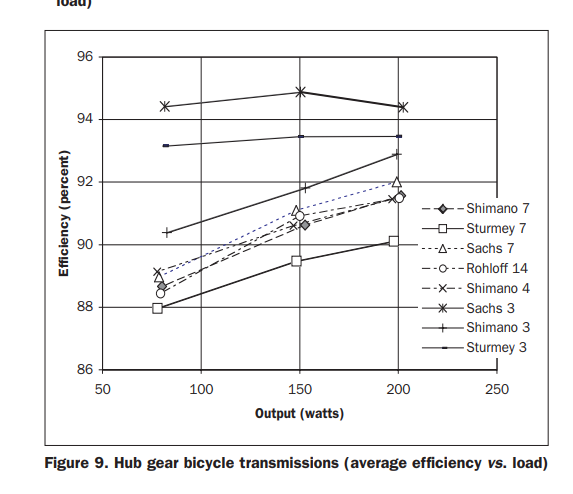
This is from
http://ihpva.org/HParchive/PDF/hp52-2001.pdf
International Human Powered Vehicle Association. Note, this is an independent source, not from a manufacturer. As you can see, the three speeds were more efficient than your Rohloff. Though, the Rohloff does well considering how many gears it has.
Those types of efficiency tests generally use brand new hubs. I did not check to see if this test did, I just assume it did.
Ask any Rohloff owner if it gets better with use after the seals loosen up some and the gear teeth get more polished, and you will hear that they are much more efficient after several thousand miles (or kms). My 10 year old Rohloff is a lot smoother now than when I first bought it.
I am not saying you are wrong, the three speed hubs could easily be more efficient than the Rohloff, the oil seals in the Rohloff are there to minimize how fast the liquid oil leaks out of the hub, and those seals reduce efficiency.