Originally Posted by
Schwinnsta
I had read previously somewhere that the Sachs 3 had lower friction than most, but that above shows a big difference. I have a Dahon 20" 3 speed with the Sachs hub, with aluminum frame, got it from a doctoral student who bought it thinking he'd need it, didn't know that the buses here have bike racks, never used it, used his mountain bike the whole time. I tried it a short distance as it's lighter than my Speed, dang, just doesn't have the gear range I need for a very hilly city (and this was before I upgraded the Speed from 7 speeds/273%, to 14 speeds/400%). Been sitting ever since in a cool dry place, like fine wine

. Maybe a candidate for a Schlumpf drive. I should put it up for sale. I even printed out the whole Sachs technician manual for the hub, figuring to disassemble to lube it, as no lube port (says in owner manual, "permanently lubricated", B.S., Mercedes Benz went through a slew of automatic transmissions that made that claim). But I only recently realized, I could drip in gear lube through the shift linkage port.
The other thing that strikes me about the above chart, is in general, efficiency increasing with increasing power output. That strikes me as backwards, as higher power output means more torque, so pushing harder on the gear teeth, or more revs, so greater displacement, or both. What the chart tells me is that most of the efficiency loss is "parasitic"(?), meaning fairly constant drag, so with increasing power, that same fixed drag constitutes a smaller portion of the total power, therefore, greater efficiency. (EDIT: Confirmed in deep dig on above report, "Obviously the residual friction in a gear train becomes less important as the input power increases, while the friction factors that increase with load go up less rapidly than the load.")
Also, there should be a big jump in efficiency in the center, for any hub where one of the gears (usually 2nd on a 3 speed), is "fixed gear", neither reduction or overdrive; at that point, the hub efficiency loss should be purely the wheel bearing friction, if chain/sprocket friction is neglected (unknown with the above). So I have questions about the above chart values. (I wanted to investigate deeper, but the link failed. EDIT: I located the PDF manually, need to digest... AHA! "The efficiencies reported in this article include ergometer wheel drive losses, so the actual transmission efficiencies would be higher by 2-2.5%." I see other causes for variation in their test, such as including bottom bracket friction, chain friction, etc. They also state that most of the IGHs were internally greased from the factory, but some had that replaced with light oil. They state that these factors don't matter, as their goal was simply to compare the efficiencies of various hubs and derailleur systems, not determine actual efficiencies of each. But they are still way off. Some hubs were new, some were used. One hub could only use 2 of 7 gears, indicating something was broken, which could drastically affect the results. The Sachs 3 was used and worn-in (known to polish IGH gear surfaces and improve efficiency), AND had the grease changed out for lighter oil (which they acknowledge increases efficiency, which is why they recommend that changout for racing, even though it "doesn't last as long"), those two factors alone could skew the results a ton.)
All the 3-speed IGHs in gear 2 (direct drive, 1.00 ratio), all performed above 94% or 95%. Damned straight. The design, quality of the gears and internal bearings, lube, etc, matters not when it's basically a fixed gear. The rest of the inefficiency is in other parts of the drivetrain.
Everything else about the tests, including that chart above, should be completely discarded, you can't infer anything from it. Very poor test procedures (way too much variation in condition of different sample parts). Read the study if you don't believe me. Link that works for me is:
http://ihpva.org/hparchive.htm
Look for HP52 - 2001
Further note!:
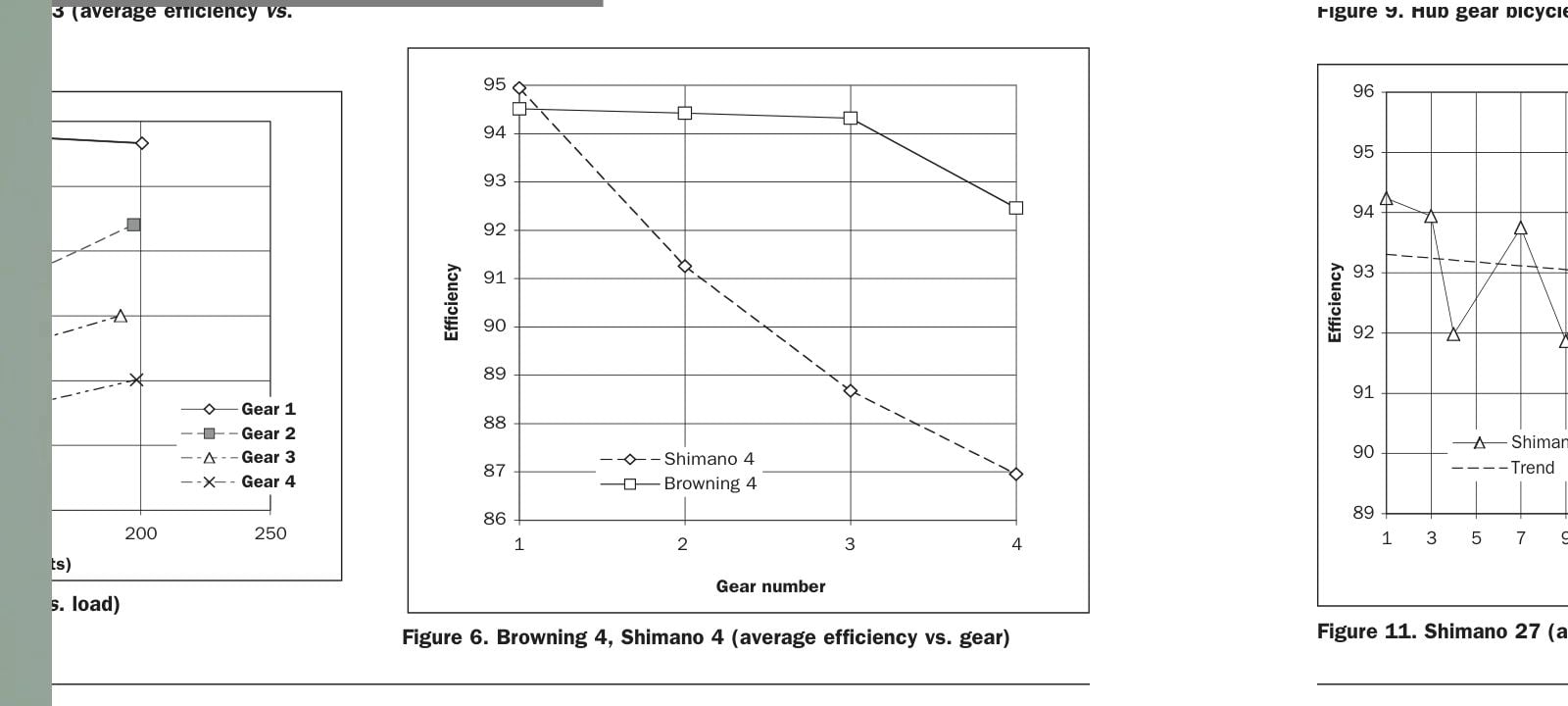
The middle chart is a comparison between the Shimano 4 (1st gear 1:00) IGH, and "Browning 4", an external derailleur system with some sort of torque sensing that functions as an "automatic". Shimano having max efficiency in gear 1 makes complete sense. The Browning, being all external cogs, makes sense having more constant efficiency, until the smallest cog, being a tighter chain curve, has a bit less efficiency. But note: a) These tests were all conducted at "Browning Research", who designed said system, and b) it's not mentioned if the Browning derailleur has things like ball bearing pullies, or larger diameter pulleys, accounting for its superior efficiency versus other (rather dated and possibly worn) commercial derailleur systems they tested. Yeah. Because I can see no other reasons for superior efficiency. It's just a derailleur system, without an actuation cable. EDIT: I stand corrected, this is a different external gearing system with "split" chainrings and cogs, but efficiency should match other external systems; It was designed to shift better under load:
https://www.bikeforums.net/classic-vintage/1225519-equipment-product-review-1987-browning-transmission.html
But I can still grok some conclusions. For efficiency, external gearing systems are king (99.99% of the time, this also means derailleur systems for multi-speeds, but not always). You'll lose a bit of efficiency on the smallest cogs, but otherwise great. IGHs are inherently less efficient, unless when operating in the 1:00 direct drive gear, if the hub offers one, and it doesn't achieve that by stepping down and back up or something like that, if needed with a really complex IGH; Just everything locked and direct drive. In all other gears, there is generally more energy loss, increasing with greater gear ratios, always more than a good derailleur system with good quality pulleys (low friction pulley bearings, and largest pulley diameter that will package), and a chain in good condition and well-lubed.